Relative Dating
Interactive passage with audio narration, comprehension questions, and printable PDF.
By completing this purchase you agree to our Terms of Use and Privacy Policy. Your subscription renews automatically until you cancel. You can cancel anytime from your account settings. All sales are final and non-refundable. Digital content is available for download in your account immediately upon purchase.
What's included
Relative Dating preview and details
About this printable Relative Dating science reading passage, NGSS-aligned (Grades 5-8)
Sample passage and quiz from Relative Dating
Reading passage and comprehension quiz preview
Relative Dating
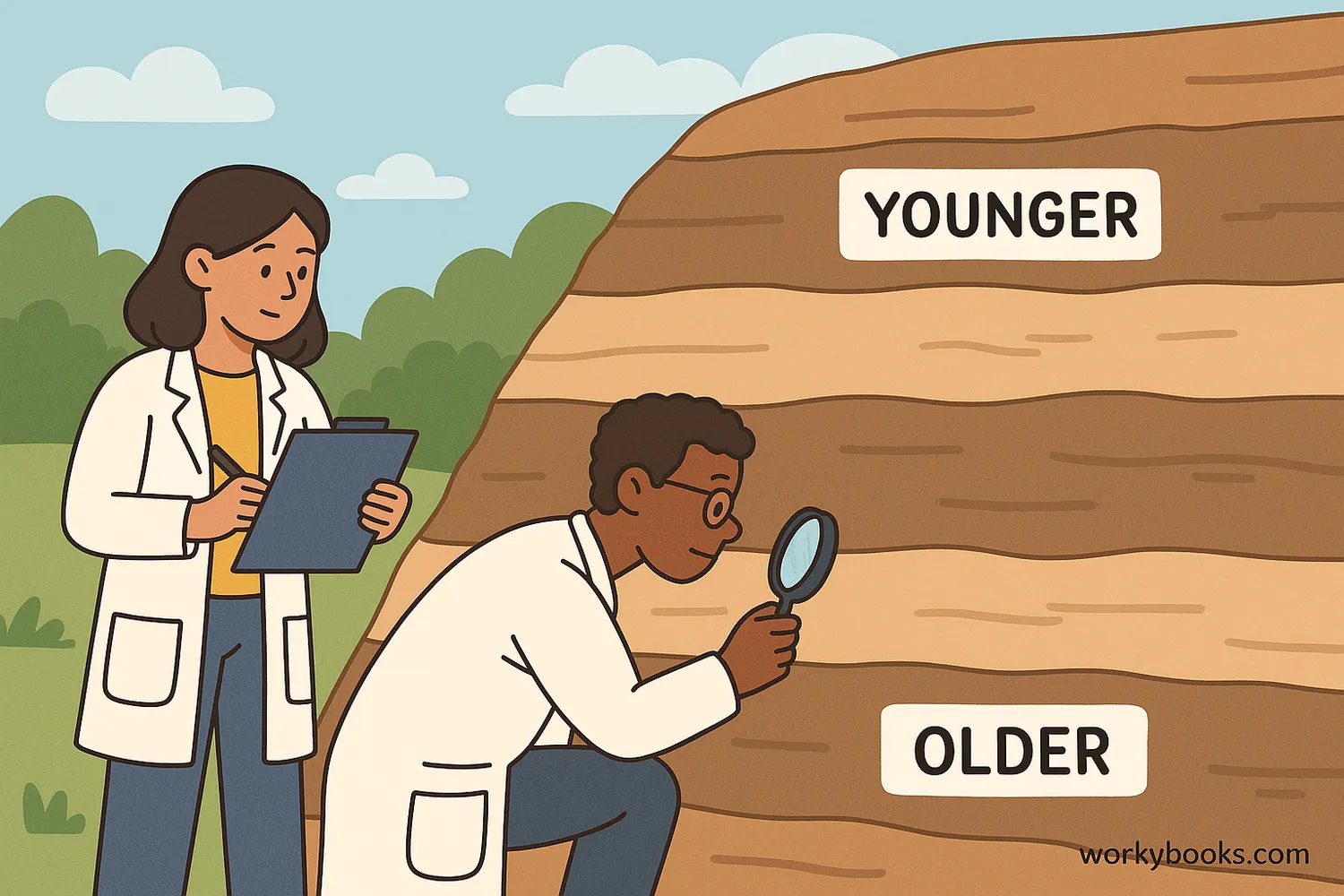
Relative dating is a scientific method used to determine the order in which geological events happened, without knowing their exact numerical ages. Scientists use this process to study the Earth’s history by examining patterns in rock layers and the features within them. Understanding the sequence of events helps us reconstruct past environments, identify natural hazards, and locate valuable resources. The principles of relative dating are essential tools in geology and paleontology, especially when absolute dating techniques are not available or practical.
Laws That Guide Relative Dating
The main principle guiding relative dating is the law of superposition. This law states that in undisturbed sequences of sedimentary rock, the oldest layers are at the bottom and the youngest are at the top. For example, when geologists study layers in the Grand Canyon, they know the bottom layers formed first. Another important principle is the law of original horizontality, which states that sediments are originally deposited in flat, horizontal layers. If rock layers are tilted or folded, it means they were disturbed by geological forces after they formed. The law of cross-cutting relationships states that any feature, such as a fault or an intrusion, that cuts across other rocks must be younger than the rocks it cuts through. For instance, if a crack (fault) slices through several layers, the fault happened after the layers were in place.
Additional Clues: Inclusions, Unconformities, and Index Fossils
Geologists look for inclusions—pieces of one rock type found inside another. These inclusions are always older than the surrounding rock because they had to exist before being trapped. Another important clue is an unconformity, which is a gap in the rock record caused by erosion or non-deposition. Three main types are angular unconformities (where tilted rocks are overlain by flat layers), disconformities (gaps between parallel layers), and nonconformities (sedimentary rocks above eroded igneous or metamorphic rocks). These features indicate missing time periods and help geologists piece together Earth’s history. Index fossils are fossils of species that lived for a short, specific time but were widespread. If the same index fossil is found in different locations, scientists know those rock layers are the same age.
Applying Relative Dating: Real-World Implications
By combining all these principles, geologists can create detailed histories of rock formations, even if they cannot assign exact ages. For example, a quarry in Wyoming might show several flat rock layers, a fault cutting through them, and an ancient fossil embedded in a middle layer. Using relative dating, scientists could determine the sequence: first, the sediments were deposited; then, the fossil formed; next, the layers were tilted; finally, the fault occurred. This work is crucial for understanding natural hazards, such as earthquakes, and for finding fossil fuels. It also connects to larger scientific ideas about Earth’s systems and how they change over time.
Interesting Fact:
Some index fossils, like the trilobite, help scientists match rock layers that are thousands of kilometers apart, showing how life and environments changed across the globe.
Comprehension quiz (10 questions)
1. What does relative dating allow scientists to determine?
2. According to the law of superposition, where are the oldest rock layers found?
3. What is an unconformity?
4. Which feature is always younger than the rocks it cuts through?
5. What does the law of original horizontality state?
6. What does the term 'index fossil' mean in the passage?
7. Why are inclusions important in relative dating?
8. If a rock layer is tilted, what does that tell a geologist?
9. True or False: An index fossil found in different places means the rock layers are the same age.
10. True or False: The law of cross-cutting relationships says that the feature doing the cutting must be older than the rocks it cuts.
Perfect for the way you teach
- Build comprehension skills
- Auto-graded quiz
- Differentiated reading
- Read together at home
- Improve fluency
- Quiet reading time
- Reading curriculum support
- Independent practice
- Track Lexile growth