Types of Fossils and Preservation
Interactive passage with audio narration, comprehension questions, and printable PDF.
By completing this purchase you agree to our Terms of Use and Privacy Policy. Your subscription renews automatically until you cancel. You can cancel anytime from your account settings. All sales are final and non-refundable. Digital content is available for download in your account immediately upon purchase.
What's included
Types of Fossils and Preservation preview and details
About this printable Types of Fossils and Preservation science reading passage, NGSS-aligned (Grades 5-8)
Sample passage and quiz from Types of Fossils and Preservation
Reading passage and comprehension quiz preview
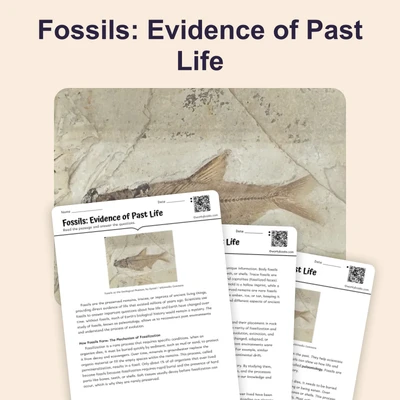
Types of Fossils and Preservation
Fossils serve as windows into Earth's ancient past, allowing scientists to reconstruct how life and environments have changed over millions of years. The study of different fossil types reveals not only what organisms once existed, but also how geological processes preserve their remains. By analyzing fossils, researchers solve mysteries about evolution, extinction, and the conditions that led to exceptional preservation events.
How Fossils Form: Mechanisms and Processes
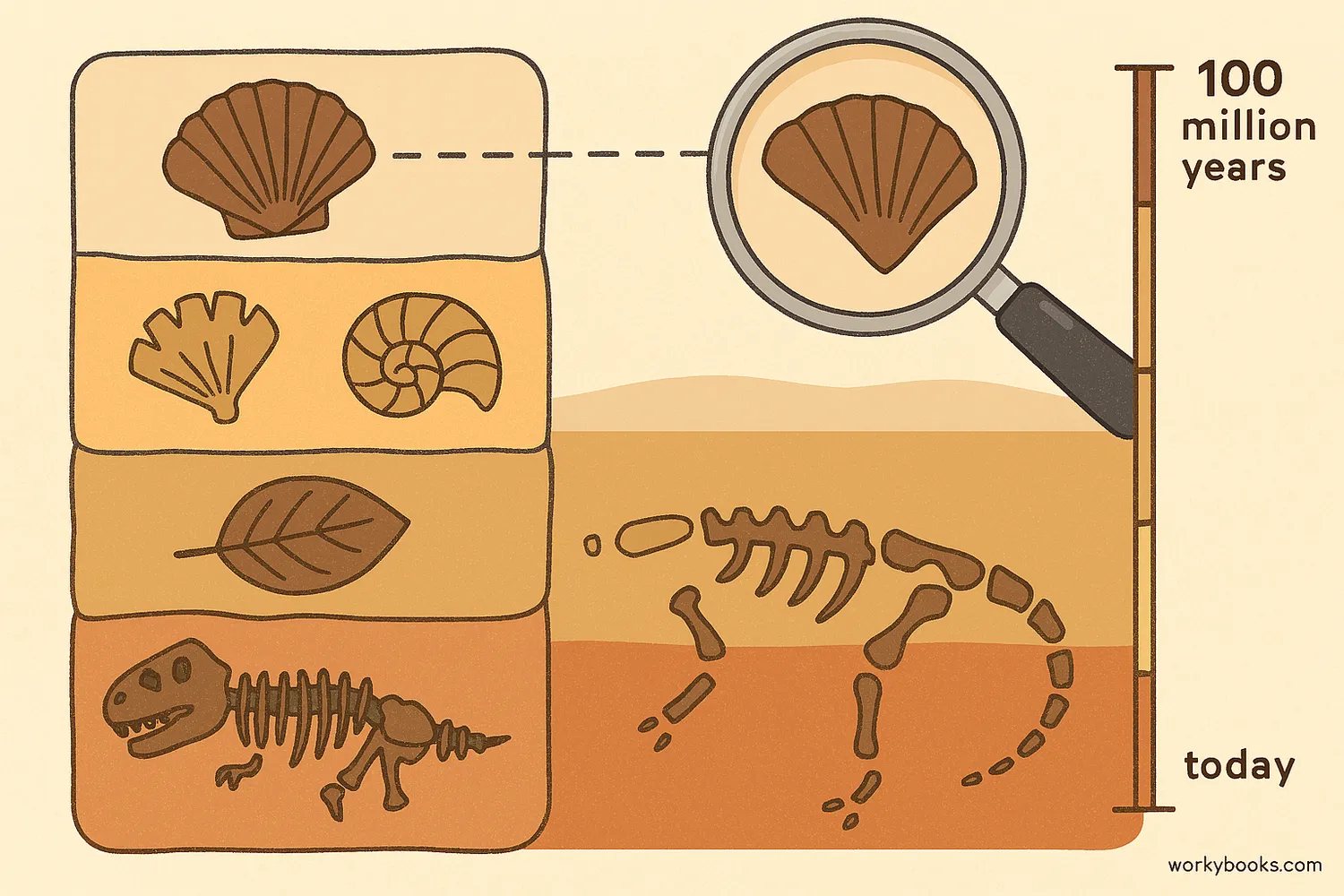
Most fossils form when organisms are buried quickly by sediment. Over time, different mechanisms act to preserve their features. Permineralization is a common process where minerals fill tiny spaces in bone or wood, turning them into rock-like structures, as seen in petrified wood. In replacement, the original material is completely dissolved and replaced by minerals, often creating detailed stone replicas of shells or bones. Carbonization occurs when heat and pressure squeeze out gases and liquids, leaving a thin film of carbon that outlines delicate organisms, such as leaves or fish. Original preservation is rare and happens when the actual remains are preserved, like a mammoth frozen in ice or insects trapped in amber. Molds form when an organism leaves an impression in sediment, and casts occur when these molds are later filled with minerals. Trace fossils record the activity of organisms, such as dinosaur footprints, nests, burrows, or even fossilized dung called coprolites.
What Fossils Reveal: Scientific Insights
Each fossil type provides different clues about ancient life. For example, permineralized fossils like petrified wood show cellular structure, revealing how ancient plants grew. Replacement fossils can preserve fine details of shells or bones, helping scientists compare extinct and modern species. Carbon films allow paleontologists to study soft-bodied organisms that rarely fossilize by other means. Trace fossils provide evidence of behavior and movement, such as how dinosaurs walked or how early animals built nests. Sites like the Burgess Shale in Canada, the La Brea Tar Pits in California, and the Liaoning province in China have yielded exceptionally preserved fossils, offering snapshots of entire ecosystems, including species with soft tissues or feathers.
Fossils and the Story of Earth
By studying a wide variety of fossil types, scientists can reconstruct ancient environments and understand the interactions between organisms and their habitats. Fossils show how life adapted to changing climates, mass extinctions, and geological events. For instance, the discovery of feathered dinosaurs in Liaoning provides evidence for the evolutionary link between dinosaurs and birds. Trace fossils reveal how animals behaved and interacted, even when their bodies were not preserved. Collectively, fossils help us answer big questions: How did life evolve? What caused past extinctions? How might current changes affect future life?
Fossil research continues to advance through technology, such as CT scans and isotope analysis, allowing scientists to extract more information than ever before. These discoveries deepen our understanding of Earth's history and guide efforts to protect present-day biodiversity.
Interesting Fact:
Some of the oldest known fossils are more than 3.5 billion years old, showing that life on Earth began incredibly early in the planet’s history.
Comprehension quiz (10 questions)
1. What is permineralization?
2. Which site is famous for preserving Ice Age animals in tar?
3. What is a trace fossil?
4. What is the main way carbonization preserves an organism?
5. In the passage, what does the word 'replacement' mean?
6. According to the passage, why are sites like Liaoning important?
7. If you find a fossilized nest, what type of fossil is it?
8. Which of these is an example of original preservation?
9. True or False: Molds and casts are exactly the same type of fossil.
10. True or False: Fossils only form from bones and shells.
Perfect for the way you teach
- Build comprehension skills
- Auto-graded quiz
- Differentiated reading
- Read together at home
- Improve fluency
- Quiet reading time
- Reading curriculum support
- Independent practice
- Track Lexile growth