Climate Through Earth's History
Interactive passage with audio narration, comprehension questions, and printable PDF.
By completing this purchase you agree to our Terms of Use and Privacy Policy. Your subscription renews automatically until you cancel. You can cancel anytime from your account settings. All sales are final and non-refundable. Digital content is available for download in your account immediately upon purchase.
What's included
Climate Through Earth's History preview and details
About this printable Climate Through Earth's History science reading passage, NGSS-aligned (Grades 5-8)
Sample passage and quiz from Climate Through Earth's History
Reading passage and comprehension quiz preview
Earth's Climate Through Time
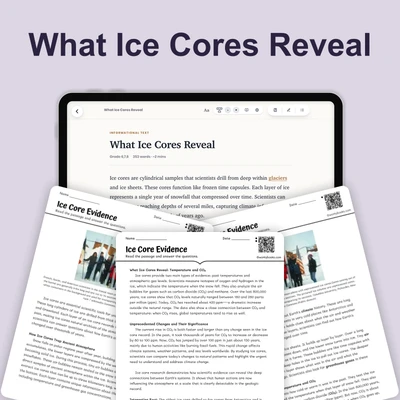
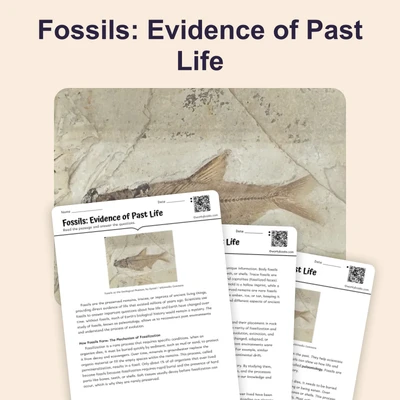
Earth's climate has never stayed the same for long. Over millions of years, our planet has swung between extreme cold and surprising warmth. Scientists observe these changes by studying rocks, ice cores, and fossils. Evidence shows that Earth has experienced many ice ages, when thick sheets of ice called glaciers covered large parts of North America, Europe, and Asia. Between these frozen periods came warm times so mild that forests grew near the North and South Poles.
What causes these dramatic climate shifts? Several natural processes work together over long time periods. Earth's orbit around the Sun changes slightly over thousands of years. These orbital variations affect how much sunlight different parts of Earth receive during different seasons. When continents drift to new positions through plate tectonics, they change ocean currents and wind patterns. Large volcanic eruptions can inject particles into the atmosphere that block sunlight temporarily. Perhaps most important, the amount of carbon dioxide in the atmosphere rises and falls naturally over time. Carbon dioxide traps heat, so more of it warms the planet while less allows cooling.
Scientists have documented specific examples of these climate swings. About 20,000 years ago, during the last ice age, glaciers covered Canada and reached as far south as present-day New York City. The ice was more than a mile thick in some places. Ocean levels dropped about 400 feet because so much water was frozen in glaciers. Then Earth's climate warmed gradually, and the ice sheets melted over thousands of years. Going back even further, evidence shows that 50 million years ago, Earth was so warm that palm trees grew in Alaska and crocodiles lived near the Arctic Circle.
Understanding past climate changes matters for several reasons. These natural shifts show that Earth's climate system responds to changes in greenhouse gases and other factors. The key difference between past changes and today involves speed. Natural climate shifts typically unfolded over thousands or millions of years. This gave plants, animals, and ecosystems time to adapt or migrate. Current warming is happening much faster, over just decades. Scientists explain that this rapid change makes it harder for natural systems to adjust.
Interesting Fact: During the last ice age, so much water was locked in glaciers that you could walk from Asia to North America across a land bridge where the Bering Strait is today. This is how humans first migrated to the Americas.
Comprehension quiz (10 questions)
1. What do scientists study to learn about Earth's past climate changes?
2. During the last ice age about 20,000 years ago, how far south did glaciers reach in North America?
3. What is the term for changes in Earth's path around the Sun that occur over thousands of years?
4. In the passage, what does the word 'glaciers' mean?
5. Which natural process involves continents moving to new positions over millions of years?
6. Why does carbon dioxide in the atmosphere affect Earth's temperature?
7. What is the key difference between past natural climate changes and current warming?
8. Based on the passage, what happened to ocean levels during the last ice age?
9. True or False: About 50 million years ago, Earth was so warm that palm trees grew in Alaska and crocodiles lived near the Arctic Circle.
10. True or False: Natural climate changes in Earth's past always happened quickly, in just a few years.
Perfect for the way you teach
- Build comprehension skills
- Auto-graded quiz
- Differentiated reading
- Read together at home
- Improve fluency
- Quiet reading time
- Reading curriculum support
- Independent practice
- Track Lexile growth