Radiocarbon Dating
Interactive passage with audio narration, comprehension questions, and printable PDF.
What's included
Radiocarbon Dating preview and details
About this printable Radiocarbon Dating science reading passage, NGSS-aligned (Grades 5-8)
Sample passage and quiz from Radiocarbon Dating
Reading passage and comprehension quiz preview
Radiocarbon Dating
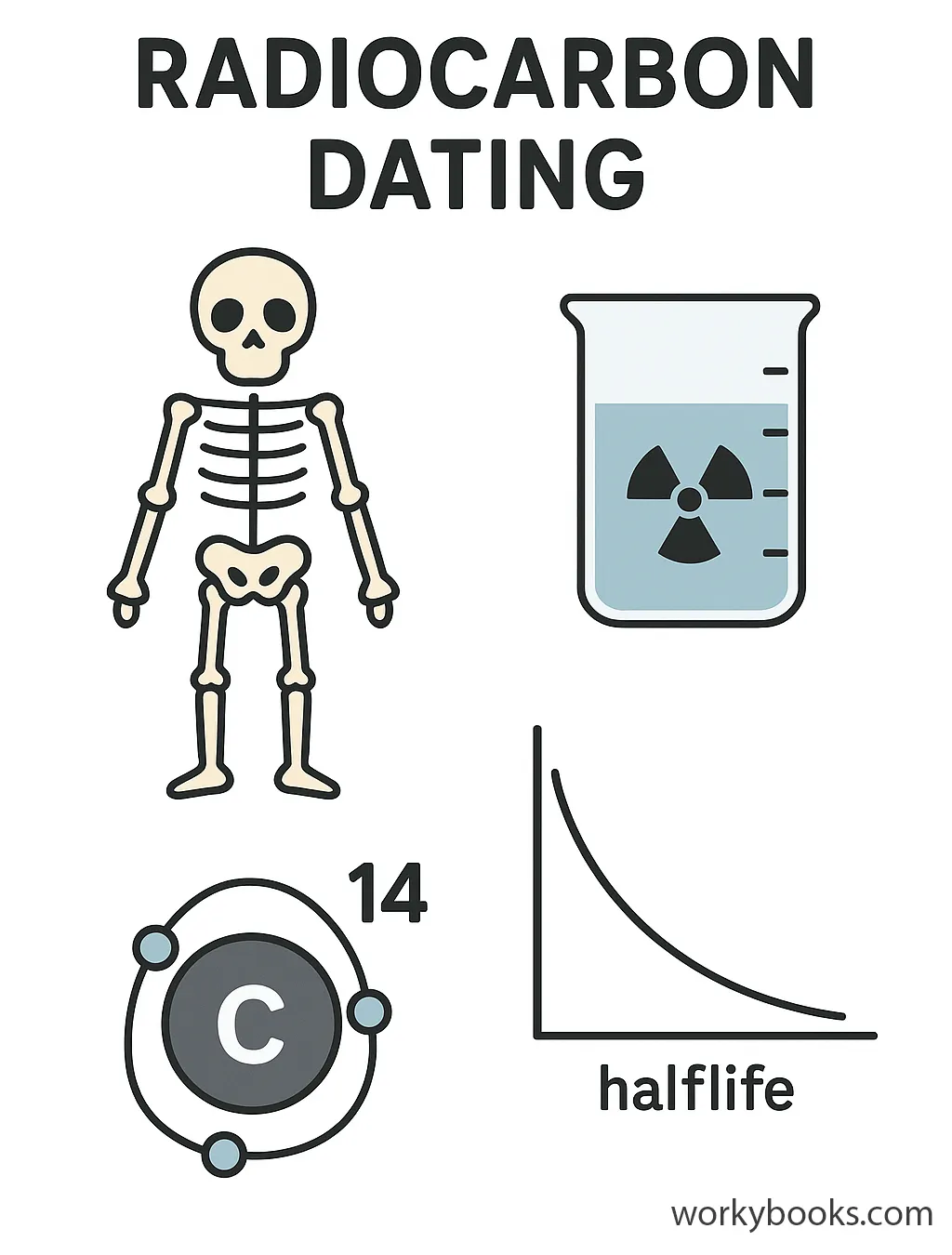
Radiocarbon dating is a powerful scientific tool that helps researchers determine the age of once-living materials, such as bones, wood, and shells. This method has revolutionized our understanding of history and the timing of past events. By measuring the decay of a special form of carbon, known as carbon-14, scientists can estimate when an organism died. Radiocarbon dating is essential for archaeology, paleontology, and many other fields that study the past.
How Radiocarbon Dating Works
All living things absorb carbon from their environment, including a small but constant amount of radioactive carbon-14. This isotope forms naturally in the atmosphere when cosmic rays strike nitrogen atoms, turning them into carbon-14. Plants take in carbon dioxide during photosynthesis, and animals eat the plants, so both plants and animals maintain a steady level of carbon-14 while alive. However, when an organism dies, it stops absorbing carbon, and the carbon-14 inside it begins to decay at a predictable rate. The time it takes for half of the carbon-14 to decay is called its half-life, which is about 5,730 years. By measuring how much carbon-14 remains in a sample compared to the original amount, scientists can calculate the number of years since the organism’s death.
Applications and Limitations
Radiocarbon dating is especially useful for dating materials up to about 50,000 years old. For example, archaeologists used this method to date the famous Ötzi the Iceman, revealing he lived over 5,000 years ago. Museums use radiocarbon dating to verify the age of ancient artifacts made from organic materials. However, there are important limitations. Radiocarbon dating only works on materials that were once part of living organisms, such as wood, bone, or cloth. It cannot be used to date rocks or metals. Also, after about 50,000 years, the amount of carbon-14 left becomes too small to measure accurately, so older samples require other methods.
Other Dating Methods and Scientific Connections
To date rocks or much older samples, scientists use other radioactive isotopes, such as potassium-argon or uranium-lead dating. These methods rely on the decay of different radioactive elements with much longer half-lives. Radiocarbon dating is a great example of how chemistry, physics, and earth science work together. By understanding atomic structure and radioactive decay, scientists can build a timeline of Earth’s history and human civilization. These dating methods also help us understand environmental changes, extinction events, and how life on Earth has evolved over time.
Radiocarbon dating continues to be a key tool for unlocking the secrets of our past. As technology improves, scientists can measure even smaller amounts of carbon-14, making the method more accurate and versatile. Together with other dating techniques, radiocarbon dating helps us answer important questions about life, history, and the changing planet.
Interesting Fact: A single gram of carbon from a 5,000-year-old sample contains only about half the carbon-14 of a living organism today!
Comprehension quiz (10 questions)
1. What does radiocarbon dating measure to determine the age of an object?
2. Which material can be dated using radiocarbon dating?
3. How is carbon-14 formed in the atmosphere?
4. What is the half-life of carbon-14?
5. What does the word 'decay' mean in the context of radioactive materials?
6. What is one limitation of radiocarbon dating?
7. Why can't radiocarbon dating be used for rocks?
8. What is an example of another dating method used for very old rocks?
9. True or False: Radiocarbon dating can be used to date metals.
10. True or False: Carbon-14 levels stay the same in a dead organism.
Perfect for the way you teach
- Build comprehension skills
- Auto-graded quiz
- Differentiated reading
- Read together at home
- Improve fluency
- Quiet reading time
- Reading curriculum support
- Independent practice
- Track Lexile growth