Interpreting Earth's History from Rock Layers
Interactive passage with audio narration, comprehension questions, and printable PDF.
By completing this purchase you agree to our Terms of Use and Privacy Policy. Your subscription renews automatically until you cancel. You can cancel anytime from your account settings. All sales are final and non-refundable. Digital content is available for download in your account immediately upon purchase.
What's included
Interpreting Earth's History from Rock Layers preview and details
About this printable Interpreting Earth's History from Rock Layers science reading passage, NGSS-aligned (Grades 5-8)
Sample passage and quiz from Interpreting Earth's History from Rock Layers
Reading passage and comprehension quiz preview
Interpreting Earth's History from Rock Layers
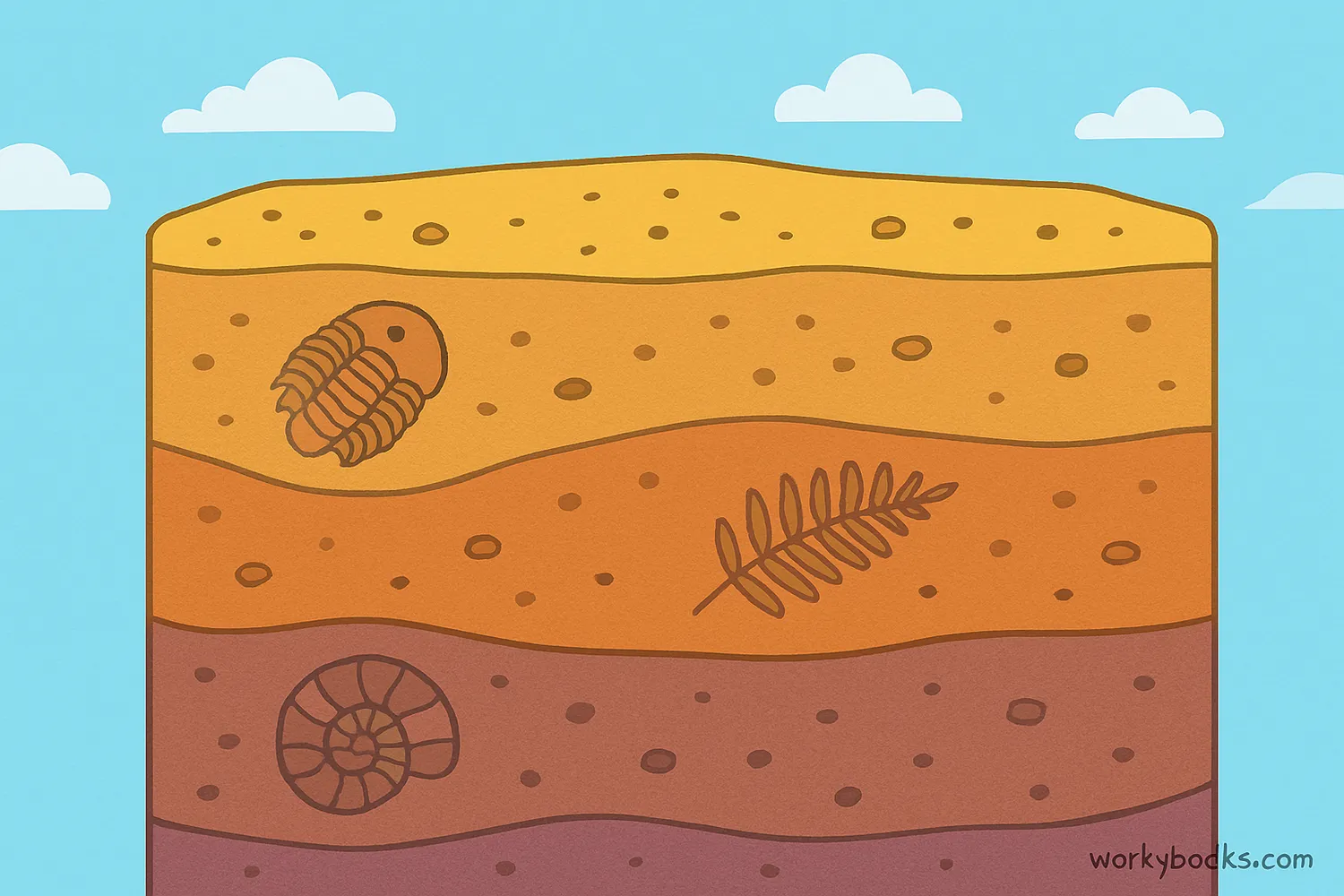
Earth's surface is covered with layers of rocks that preserve a detailed record of past environments and major events. Geologists use these rock layers to reconstruct the history of our planet, answering questions about how landscapes, climates, and life have changed over millions of years. The study of rock sequences provides evidence for processes such as mountain building, sea level changes, and mass extinctions. Understanding how to read these layers is essential for making sense of Earth's dynamic history.
Principles of Relative Dating and Fossil Correlation
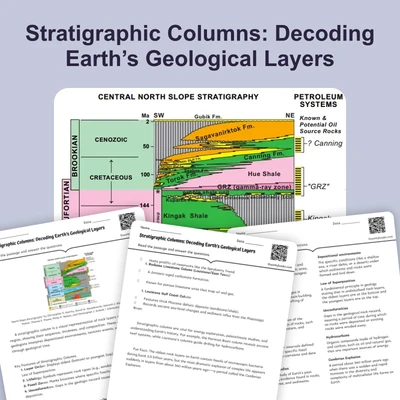
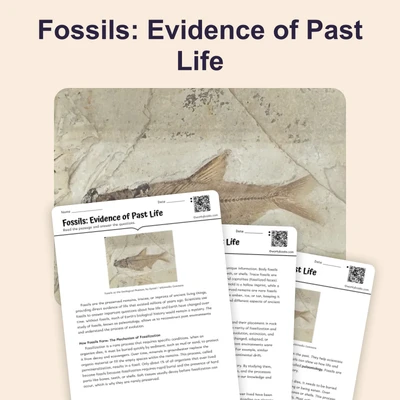
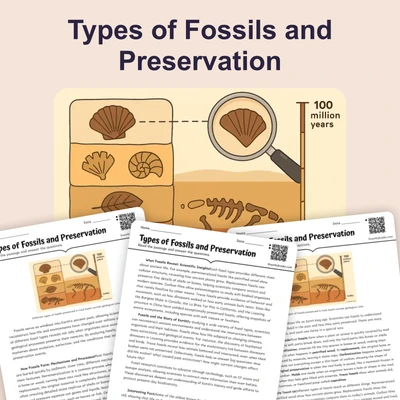
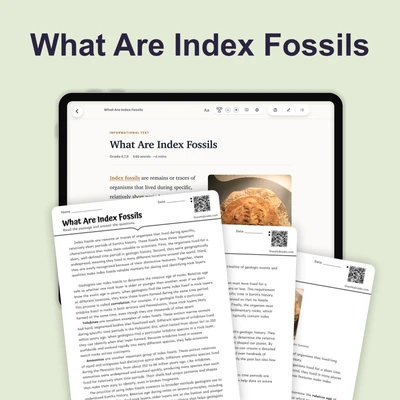
The main method for interpreting rock layers is relative dating, which determines the order of events without assigning exact ages. The Law of Superposition states that in an undisturbed sequence, the oldest rocks are at the bottom and the youngest are at the top. Geologists also use fossils, the preserved remains or traces of ancient organisms, to match layers across large distances—a process called correlation. Certain fossils, known as index fossils, are especially useful because they were widespread but only lived during a short time period. By finding the same index fossil in different locations, scientists can infer that those rocks formed at roughly the same time. Sometimes, absolute dating techniques, such as radiometric dating, are also used to assign a numerical age to a rock layer, providing a more complete timeline.
Interpreting Ancient Environments from Sedimentary Layers
Different types of sedimentary rocks form in specific environments, allowing scientists to reconstruct ancient landscapes. For example, limestone often forms in warm, shallow seas, while shale typically forms in deeper, quieter waters. Sandstone is commonly deposited on beaches or in river channels, and coal forms from the remains of dense, swampy forests. By observing a sequence of limestone at the bottom, overlain by shale, then sandstone, and finally coal at the top, scientists interpret this as a record of a sea retreating and being replaced by a swamp. This reflects changes in sea level and climate over time.
Complexities and Recognizing Unconformities
Not all rock sequences are complete. Unconformities are gaps in the rock record caused by erosion or periods without deposition, representing missing time. Identifying these features is important for building accurate geologic columns and cross-sections. By combining evidence from rock types, fossils, and absolute dating, geologists can correlate layers across continents and reconstruct a detailed history of Earth's surface. These methods reveal patterns such as the rise and fall of sea levels, the appearance and disappearance of species, and the timing of major geological events.
By interpreting rock layers, scientists connect evidence from many locations to understand the global history of Earth. This work helps us predict future changes, locate natural resources, and learn how life and environments have interacted across geologic time.
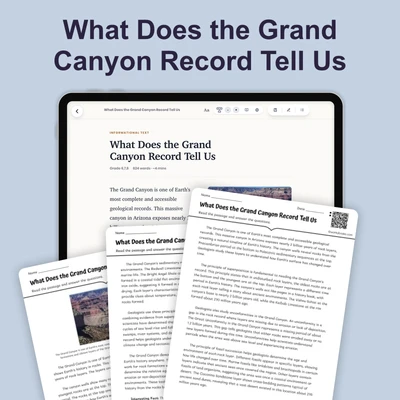
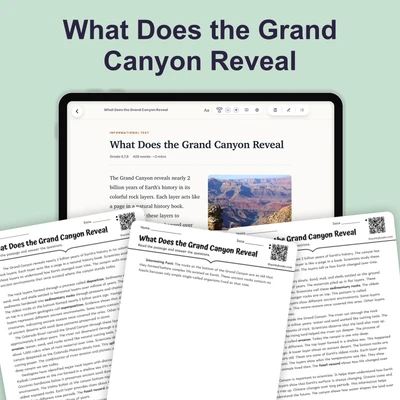
Interesting Fact: The Grand Canyon exposes over 1.5 billion years of Earth's history in its rock layers, making it one of the best places to study geologic time!
Comprehension quiz (10 questions)
1. What does the Law of Superposition state about rock layers?
2. Which type of rock forms in warm, shallow seas?
3. What is an index fossil?
4. What process is used to match rock layers across distances?
5. What is a gap in the rock record called, caused by erosion or no deposition?
6. What does 'absolute dating' provide that relative dating does not?
7. If a rock sequence has limestone at the bottom, then shale, then sandstone, and coal at the top, what does this show?
8. True or False: Geologists can use fossils to date and match rock layers from different places.
9. True or False: Every rock sequence is complete and contains no missing time.
10. Why are unconformities important in geologic columns?
Perfect for the way you teach
- Build comprehension skills
- Auto-graded quiz
- Differentiated reading
- Read together at home
- Improve fluency
- Quiet reading time
- Reading curriculum support
- Independent practice
- Track Lexile growth