Slavery in the Southern Colonies
Interactive passage with audio narration, comprehension questions, and printable PDF.
By completing this purchase you agree to our Terms of Use and Privacy Policy. Your subscription renews automatically until you cancel. You can cancel anytime from your account settings. All sales are final and non-refundable. Digital content is available for download in your account immediately upon purchase.
What's included
Part of this bundle

Slavery in the Southern Colonies preview and details
About this printable Slavery in the Southern Colonies reading passage (Grades 3-5)
Sample passage and quiz from Slavery in the Southern Colonies
Reading passage and comprehension quiz preview
Southern Colonies Slavery
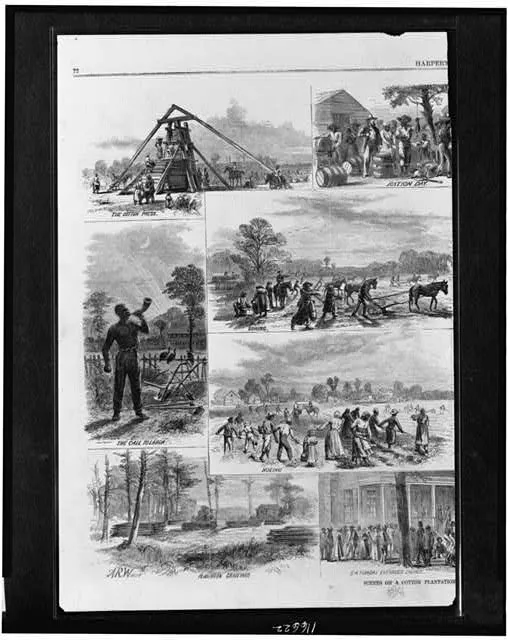
"Scenes on a cotton plantation" by Waud, Alfred R. (Alfred Rudolph), 1828-1891 / Library of Congress.
The Southern Colonies of America depended on the labor of enslaved Africans to grow crops like tobacco, rice, and cotton. Slavery in the Southern Colonies began in the early 1600s and became more common as plantations grew larger and needed more workers.
Plantations were large farms owned by wealthy landowners. These landowners wanted to make more money, so they needed many workers to plant, care for, and harvest crops. At first, indentured servants from Europe did some of this work, but soon, landowners started bringing enslaved Africans to do most of the labor.
Enslaved Africans were taken by force from their homes in Africa. They were shipped across the Atlantic Ocean in terrible conditions. Many did not survive the journey. Those who did arrive in the colonies were sold at markets and forced to work on plantations.
Life for enslaved people was very hard. They worked long hours in hot fields with little rest. They had no freedom and could not leave the plantation. Families were often separated, and enslaved people were not allowed to learn to read or write. They lived in small cabins and had very little food or comfort.
Despite these harsh conditions, enslaved Africans showed bravery and strength. They found ways to survive and keep their culture alive. Some sang songs, told stories, or practiced traditions from Africa. A few even tried to escape or resist their owners.
The plantation system made the Southern Colonies very wealthy. The crops grown by enslaved people were sold to other colonies and to Europe. This brought money and power to the landowners, but it also created great suffering for millions of people.
In time, some people began to fight against slavery. They spoke out and worked to end it. Slavery did not end in the Southern Colonies until after the Civil War, many years later.
Interesting Fact: The songs sung by enslaved Africans, called spirituals, often carried secret messages about freedom and escape.
Comprehension quiz (8 questions)
1. What was grown on plantations?
2. Who did most of the work on plantations?
3. What happened to enslaved families?
4. Why did landowners want more enslaved workers?
5. What is a plantation?
6. How did enslaved Africans keep their culture?
7. Slavery ended after the Civil War. True or false?
8. What does 'resist' mean?
Common Core standards for Slavery in the Southern Colonies
Explain events, procedures, ideas, or concepts in a historical, scientific, or technical text, including what happened and why, based on specific information in the text.
Determine the meaning of general academic and domain-specific words or phrases in a text relevant to a grade 4 topic or subject area.
Write informative/explanatory texts to examine a topic and convey ideas and information clearly.
Perfect for the way you teach
- Build comprehension skills
- Auto-graded quiz
- Differentiated reading
- Read together at home
- Improve fluency
- Quiet reading time
- Reading curriculum support
- Independent practice
- Track Lexile growth