This learning resource is available in interactive and printable formats. The interactive worksheet can be played online and assigned to students. The Printable PDF version can be downloaded and printed for completion by hand.
This engaging passage introduces students to the impact of steamboats during the Industrial Revolution in U.S. history. The reading explores how inventors like Robert Fulton changed transportation on American rivers, making travel and trade faster and easier. Students will learn about the challenges faced by early steamboat builders and how these inventions helped connect cities and people. The passage uses clear, simple language and emphasizes cause-and-effect relationships, making it ideal for building social studies knowledge and literacy skills. Included are a glossary, timeline, multiple-choice quiz, and writing prompts to deepen understanding. Graphic organizers help students visualize key concepts. Spanish translation and read-aloud audio support diverse learners. This resource aligns with D2.His.1.3-5, D2.His.2.3-5, RI.4.3, RI.4.4, W.4.2, making it a valuable addition to any classroom studying the Industrial Revolution and its influence on American life.
CONTENT PREVIEW
Expand content preview
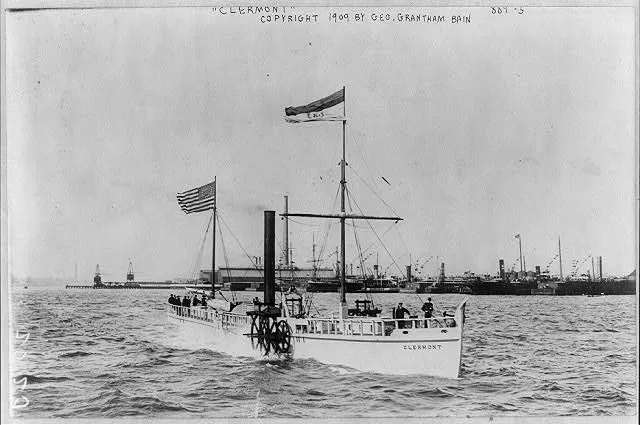
Clermont. Source: Library of Congress - Bain, George Grantham, 1865-1944
The Industrial Revolution in the United States was a time of great change. One of the most important inventions from this time was the steamboat. Steamboats made river travel faster, easier, and safer. Before steamboats, people used flatboats or rafts to move goods down rivers. They could not travel upstream easily because the current was too strong.
In 1807, an American inventor named Robert Fulton launched the first successful steamboat, called the Clermont. Fulton's steamboat used a steam engine to turn a large paddle wheel. The paddle wheel pushed the boat forward, even against strong river currents. Now, boats could travel both up and down rivers, making two-way travel possible for the first time.
This new kind of water transportation changed life in America. Farmers and traders could ship their crops, cotton, and other goods to distant cities. Steamboats could carry much more cargo than wagons or horses. They brought new supplies, people, and news to towns along the rivers. Many new cities grew up along riverbanks, especially along the Mississippi and Ohio Rivers.
Steamboats also helped connect the East and West. People could travel farther and faster than ever before. This helped families move west to new lands. It also allowed new businesses to grow, because products could reach more customers. Steamboats made river trade quick and reliable, so prices for goods became lower, and more people could buy what they needed.
There were some dangers. Steamboats sometimes exploded if the steam engine broke, and fires were common. But inventors worked to make steamboats safer over time. By the mid-1800s, hundreds of steamboats traveled American rivers each day. They helped build a strong economy and made the United States a leader in trade and industry.
Steamboats are a symbol of the Industrial Revolution's power to solve problems and bring people together. Their engines and paddle wheels changed how Americans lived, worked, and moved across the land.
Interesting Fact: Robert Fulton once took passengers on a 150-mile trip from New York City to Albany in just 32 hours—much faster than other boats of the time!
Who invented the first successful steamboat?
Robert FultonThomas EdisonEli WhitneyAlexander Graham Bell
What was the Clermont?
First steamboatRailroad engineTelegraphFactory
Which rivers did steamboats help grow cities?
Mississippi and OhioAmazon and NileHudson and ThamesDanube and Seine
How did steamboats change trade?
Made trade fasterStopped all tradeMade trade slowerOnly helped trains
Why could boats travel up rivers after 1807?
Steam engines powered themWind helped moreThey used horsesThey floated downstream
What was a risk of steamboats?
They could explodeThey could flyThey became trainsThey turned into cars
Steamboats could only travel downstream. True or false?
TrueFalse
What does 'Industrial Revolution' mean?
Time of big inventionsA river nameA kind of boatA holiday
Perfect For:
👩🏫 Teachers
• Reading comprehension practice
• Auto-graded assessments
• Literacy skill development
👨👩👧👦 Parents
• Reading practice at home
• Comprehension improvement
• Educational reading time
🏠 Homeschoolers
• Reading curriculum support
• Independent reading practice
• Progress monitoring
Reading Features:
📖
Reading Passage
Engaging fiction or nonfiction text
❓
Comprehension Quiz
Auto-graded questions
📊
Instant Feedback
Immediate results and scoring
📄
Printable Version
Download for offline reading
🔊
Read Aloud
Voice-over with word highlighting
Reviews & Ratings
No reviews yet. Be the first to share your experience!
Related Content
Native American Tribes Across America
This engaging history reading passage introduces students to Native American tribes across America, focusing on their da...
D2.HIS.1.3-5D2.HIS.2.3-5RI.4.1RI.4.2
The Sioux: Warriors and Tribal Leaders
This history reading passage explores the Sioux Nation, focusing on their roles as warriors and tribal leaders. Students...
D2.HIS.1.3-5D2.HIS.2.3-5RI.4.1RI.4.3
Jamestown: The First Permanent English Colony
This engaging history passage explores the founding of Jamestown, the first permanent English colony in America. Aligned...
D2.HIS.1.3-5D2.HIS.2.3-5RI.4.3RI.4.4
Pocahontas and the Powhatan People
This engaging reading passage explores the life of Pocahontas and the Powhatan people and their important role in early ...
D2.HIS.1.3-5D2.HIS.2.3-5RI.4.1RI.4.3
Colonial Games and Entertainment
This engaging history reading passage explores the types of games and entertainment enjoyed by children and families in ...
D2.HIS.1.3-5RI.4.3RI.4.4
Colonial Towns and Village Life
This engaging history reading passage explores the daily life, work, and unity found in colonial towns and villages. Ali...
D2.HIS.1.3-5D2.HIS.2.3-5RI.4.3RI.4.4
George Washington Leads the Army
This engaging history reading passage explores how George Washington bravely led the Continental Army during the America...
D2.HIS.1.3-5D2.HIS.2.3-5RI.4.3RI.4.4
The Battle of Yorktown Ends War
This engaging U.S. history reading passage explores the Battle of Yorktown, a key event that ended the American Revoluti...
D2.HIS.1.3-5D2.HIS.2.3-5RI.4.1RI.4.3
Life as a Continental Soldier
This passage explores the daily life of a Continental Soldier during the American Revolutionary War, highlighting challe...
D2.HIS.1.3-5RI.4.1RI.4.3
Loyalists vs. Patriots: Divided Families
This engaging U.S. history reading passage explores the division between Loyalists and Patriots during the American Revo...
D2.HIS.1.3-5D2.HIS.2.3-5RI.4.3RI.4.4
Manifest Destiny: Coast to Coast
This engaging U.S. history reading passage explores Manifest Destiny and the westward expansion of the United States. St...
D2.HIS.1.3-5D2.HIS.2.3-5RI.4.3RI.4.4
Abraham Lincoln Becomes President
This engaging U.S. history reading passage introduces students to the story of Abraham Lincoln’s rise to the presidency....
D2.HIS.1.3-5D2.HIS.2.3-5RI.4.3RI.4.4
The Southern States Leave the Union
This engaging reading passage explores the key events leading up to the Southern states leaving the Union before the Civ...
D2.HIS.1.3-5D2.HIS.2.3-5RI.4.3RI.4.4
Lincoln Assassinated at Ford's Theatre
This history reading passage explores the events of President Abraham Lincoln's assassination at Ford's Theatre in 1865....
D2.HIS.1.3-5D2.HIS.2.3-5RI.4.3RI.4.4
Juan Cabrillo Explores California
This engaging U.S. history reading passage introduces students to Juan Cabrillo, the first European explorer to reach Ca...
D2.HIS.1.3-5D2.HIS.2.3-5D2.HIS.3.3-5RI.4.3
California's Early Spanish Settlements
This engaging U.S. history reading passage explores life during the early Spanish settlements in America, highlighting t...
D2.HIS.1.3-5D2.HIS.2.3-5D2.HIS.3.3-5RI.4.1
Discovery of Gold in 1848 by James Marshall
This engaging U.S. History passage introduces students to the discovery of gold in 1848 by James Marshall and the beginn...
D2.HIS.1.3-5D2.HIS.2.3-5D2.HIS.3.3-5RI.4.1
The Gold Rush Changes California Forever
This engaging U.S. History reading passage explores how the Gold Rush changed California forever. Students will learn ab...
D2.HIS.1.3-5D2.HIS.2.3-5D2.HIS.16.3-5RI.4.3
The Golden Spike: Connecting California to the Nation
This engaging U.S. history reading passage teaches students about the Golden Spike and how the first transcontinental ra...
D2.HIS.1.3-5D2.HIS.2.3-5D2.HIS.14.3-5RI.4.3
Farms, Factories, and Growing Cities
This engaging U.S. history reading passage explores the dramatic changes in America during the Progressive Era, focusing...