Stone Age Tools and Technology — Reading Comprehension
Rate this
Premium Resource
Present
Present in classroom. No work saved
Assign
Classroom with student accounts, Track progress
Quick Play
No student accounts, assign with a link
Grades
6
7
8
PRINT+DIGITAL RESOURCE
This learning resource is available in interactive and printable formats. The interactive worksheet can be played online and assigned to students. The Printable PDF version can be downloaded and printed for completion by hand.
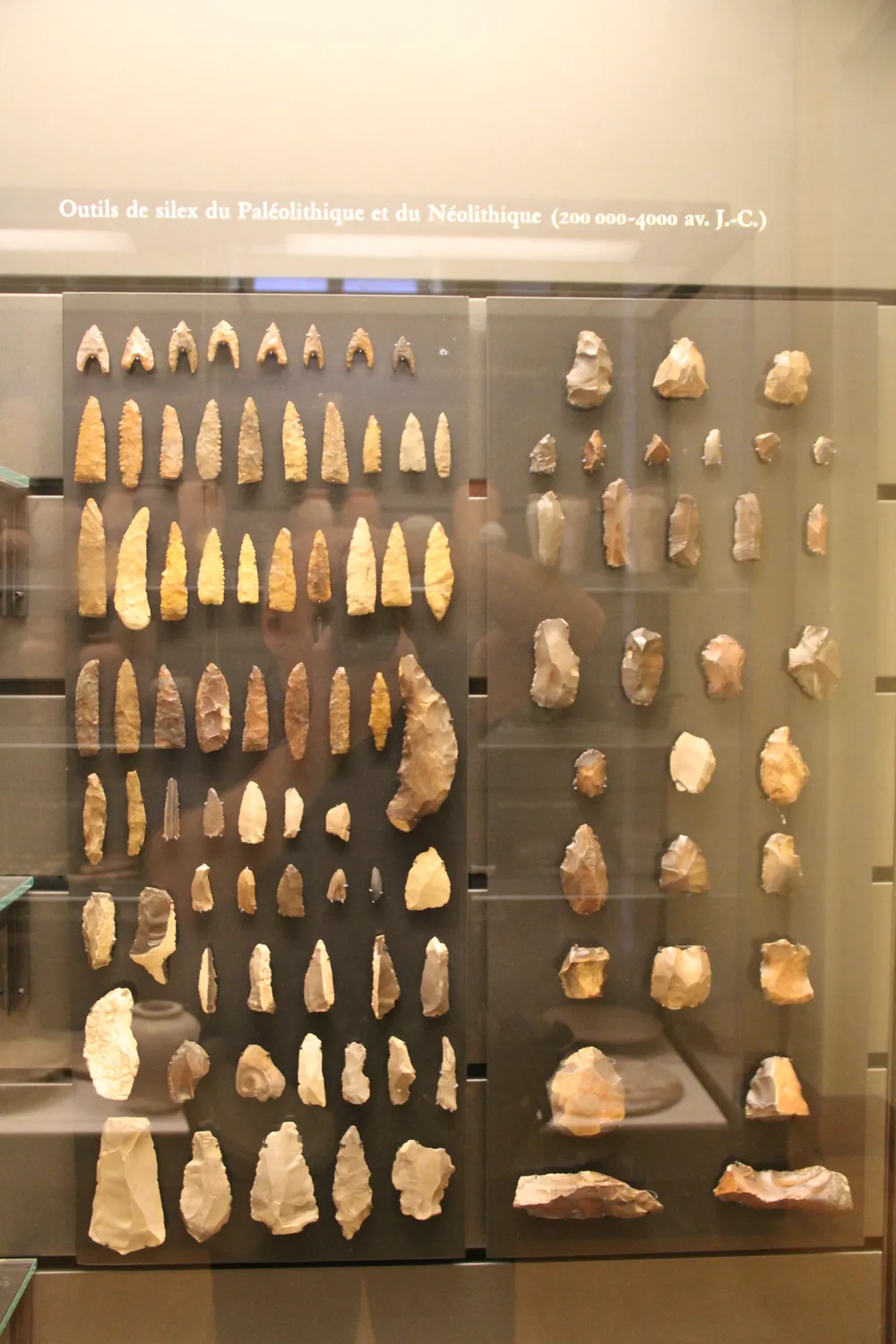
This comprehensive history reading passage introduces students to the development of tools and technology during the Stone Age, spanning from the Paleolithic to Neolithic periods. Students will learn how early humans used resources from their environment to create various stone tools, how technological advancements changed daily life, and the role geography played in shaping innovation. The passage includes archaeological evidence, examples of social organization, and clear cause-and-effect relationships. Activities include a glossary of key terms, multiple-choice and writing assessments, graphic organizers, and a timeline. It is designed for middle school classrooms and aligns with CA HSS 6.1 and CCSS RH.6-8.1 standards. This resource also features a Spanish translation and read aloud audio, making it accessible for diverse learners. Students will develop historical thinking skills by analyzing evidence, connecting technological change to broader human history, and understanding the significance of early inventions.
The Stone Age marks the earliest period of human history when people primarily made tools and weapons from stone. Archaeologists divide the Stone Age into three main periods: the Paleolithic (Old Stone Age), the Mesolithic (Middle Stone Age), and the Neolithic (New Stone Age). These periods span from roughly 2.6 million years ago until about 3,000 BCE. The development of tools and technology during these periods reveals how early humans adapted to their environments and laid the foundation for future civilizations.
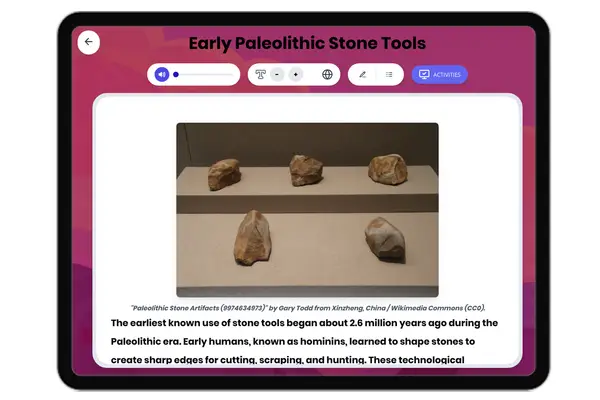
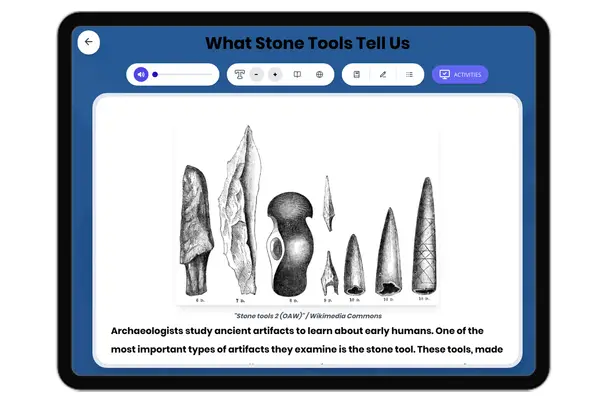
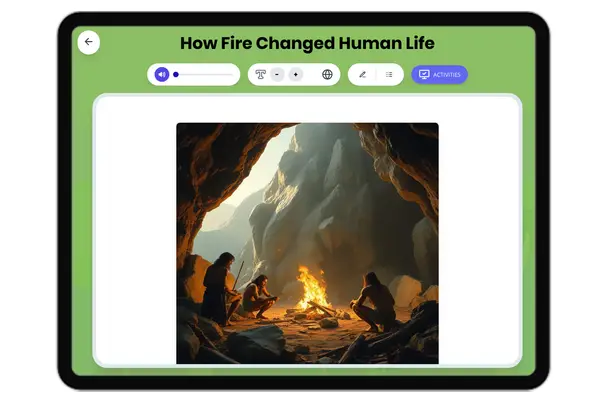
During the Paleolithic period, early humans such as Homo habilis and Homo erectus created basic stone tools known as Oldowan tools. These simple implements, sometimes over 2 million years old, included hand axes and flakes used for cutting meat and plants. Archaeological sites like Olduvai Gorge in Tanzania provide evidence of these tools. Over time, humans learned to create more specialized and efficient tools, such as blades and scrapers, which allowed them to hunt, process animal hides, and prepare food more effectively. The ability to control fire, first seen about 1 million years ago, also improved survival by enabling cooking and protection from predators.
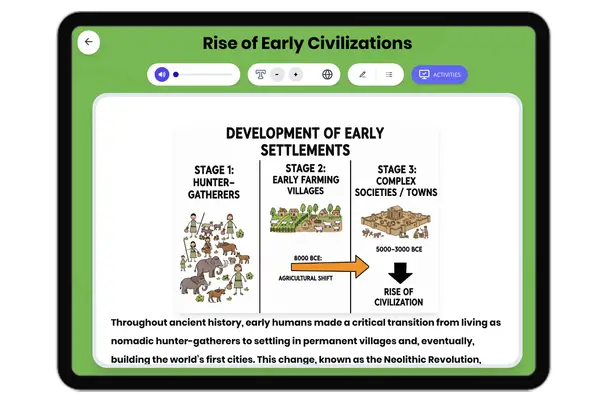
By the Neolithic period, which began around 10,000 BCE, humans had developed advanced stone tools and new technologies. They began grinding and polishing stones to make axes and adzes, making them sharper and more durable. The Neolithic period also saw the rise of agriculture and the domestication of animals. These changes were closely connected to geography, as fertile river valleys in places like the Near East allowed for successful farming. People built permanent homes and villages, leading to new forms of social organization and the beginnings of social hierarchy. Archaeological discoveries at sites like Çatalhöyük in modern-day Turkey show evidence of specialized tools for farming, weaving, and food storage.
The impact of Stone Age technology on daily life was significant. Tools improved hunting and gathering, which increased food supplies and population growth. As humans learned to modify their environment, they influenced their ecosystems, both positively and negatively. Over thousands of years, continuity in tool-making methods can be seen, but there was also innovation as people learned from experience and adapted to new challenges. The gradual development of stone tools laid the groundwork for the later Bronze and Iron Ages, when metal tools would transform societies even further.
Stone Age tools and technology are essential for understanding the origins of human civilization. By examining archaeological evidence, historians and scientists can reconstruct how early humans lived, survived, and shaped the world. Studying these innovations helps connect us to broader themes in ancient history, such as adaptation, innovation, and the role of technology in shaping societies.
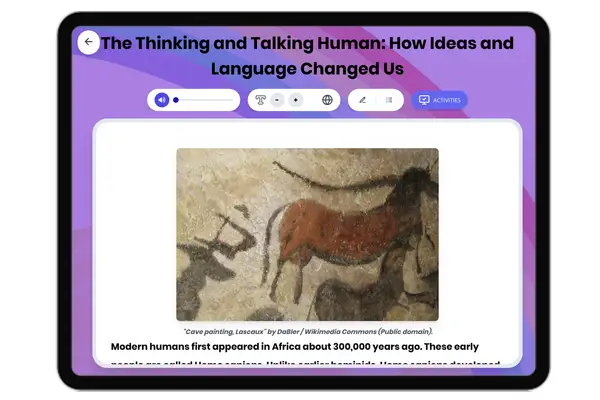
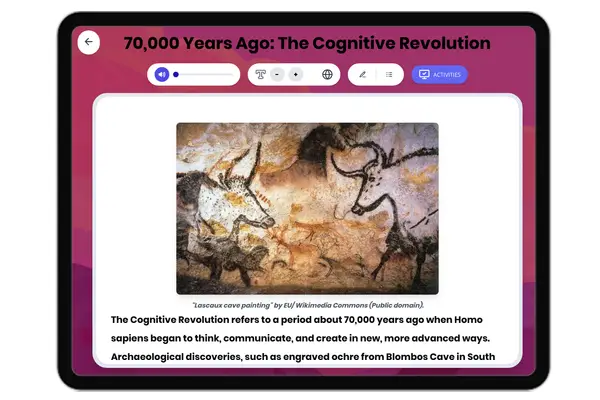
Interesting Fact: The earliest known art created by humans, such as cave paintings and carved figurines, was made during the Stone Age, showing that creativity and technology developed side by side.
Which tool type is the oldest?
OldowanBronzeIronSteel
Where is Olduvai Gorge located?
TanzaniaTurkeyEgyptGreece
What did Neolithic people begin doing?
FarmingWritingBuilding pyramidsUsing metal tools
Why did toolmaking improve survival?
Better hunting and foodMade jewelryHelped with writingBuilt ships
How did geography affect technology?
Fertile areas led to farmingNo effectTools were not neededPeople moved less
What is a scraper used for?
Cleaning hidesWritingBuilding housesMaking fire
The Stone Age ended around 3,000 BCE. True or false?
TrueFalse
What does 'agriculture' mean?
FarmingHuntingFishingPainting
Perfect For:
👩🏫 Teachers
• Reading comprehension practice
• Auto-graded assessments
• Literacy skill development
👨👩👧👦 Parents
• Reading practice at home
• Comprehension improvement
• Educational reading time
🏠 Homeschoolers
• Reading curriculum support
• Independent reading practice
• Progress monitoring
Reading Features:
📖
Reading Passage
Engaging fiction or nonfiction text
❓
Comprehension Quiz
Auto-graded questions
📊
Instant Feedback
Immediate results and scoring
📄
Printable Version
Download for offline reading
🔊
Read Aloud
Voice-over with word highlighting
Reviews & Ratings
No reviews yet. Be the first to share your experience!
Related Content
Early Humans Reach Australia
This reading passage explores the journey of early humans who reached Australia by crossing the ocean over 60,000 years ...
CA HSS 6.1CCSS RH.6-8.1CCSS RH.6-8.4CCSS RH.6-8.7
Early Humans in Europe and Asia
This passage explores the arrival of early humans in Europe and Asia around 40,000 BCE, highlighting their migration, ad...
CA HSS 6.1.1CCSS RH.6-8.1CCSS RH.6-8.2CCSS RH.6-8.4
Early Human Migration
This comprehensive history reading passage explores the Out of Africa movement and how early humans migrated across cont...
CA HSS 6.1.1CCSS RH.6-8.1RH.6-8.2RH.6-8.4
Ancient Humans Adapt to Different Climates
This engaging ancient history reading passage explores how early humans adapted to different climates, especially during...
First Humans
This engaging history reading passage explores the evolution of early humans, tracing the journey from the earliest homi...
CA HSS 6.1RH.6-8.1RH.6-8.2W.6.2
Origins of Human Language
This engaging history reading passage explores how early humans developed language and complex ideas, transforming their...
The Turkana Boy: A Nearly Complete Early Human Skeleton
This history reading passage explores the remarkable discovery of the Turkana Boy, a nearly complete Homo erectus skelet...
Early Stone Tools
This engaging history reading passage explores Early Paleolithic Stone Tools, focusing on how early humans crafted sharp...
Rise of Early Civilizations
This reading passage explores the critical transformation from early human hunter-gatherer societies to the development ...
CA HSS 6.1CCSS.RI.6.1CCSS.RI.6.3CCSS.RI.6.4
Neanderthals and Denisovans
This comprehensive history reading passage explores the fascinating story of Neanderthals, Denisovans, and other ancient...
CA HSS 6.1.1TEKS 6.2BCCSS.RH.6-8.1CCSS.RH.6-8.2
Paleolithic Migration by Land and Sea
This passage explores the migration of Paleolithic humans from Africa to the rest of the world, focusing on the routes t...
6.1RH.6-8.1RH.6-8.2RH.6-8.4
Introduction to the Paleolithic Age
This engaging passage explores the lives and achievements of ancient humans during the Paleolithic Age, focusing on thei...
CA HSS 6.1.1CCSS RH.6-8.1CCSS RH.6-8.2CCSS RH.6-8.4
Paleolithic Shelters
Explore how early humans in the Paleolithic Era built shelters such as caves and huts to survive harsh climates. This pa...
CA HSS 6.1CCSS.RI.6.3CCSS.RI.7.1CCSS.RI.8.2
Paleolithic Hand Axe
This engaging ancient history passage explores the development and significance of Acheulean hand axes, one of the earli...
CA HSS 6.1.1CCSS.RI.6.1CCSS.RI.6.4CCSS.W.6.2
How Paleolithic People Changed the Environment
This passage explores how Paleolithic people, or early humans, shaped their environment through the use of fire, hunting...
Discovery of Fire
This history reading passage explores the revolutionary impact of fire on early human societies. Students will learn how...
Evidence in Ancient History
This engaging history reading passage investigates how archaeologists and historians discover clues about how ancient pe...
Oldowan Tools
This engaging history reading passage explores the emergence of the first stone tools, known as Oldowan tools, around 2....
Nomads to Farmers
This engaging passage explores the two major ways of life practiced by early humans: nomadic hunter-gathering and settle...
CA HSS 6.1.1CCSS RH.6-8.2
Prehistoric Cave Art
This passage explores the significance of cave paintings and early symbolic art, examining how ancient humans used these...