The Great Schism
Interactive passage with audio narration, comprehension questions, and printable PDF.
By completing this purchase you agree to our Terms of Use and Privacy Policy. Your subscription renews automatically until you cancel. You can cancel anytime from your account settings. All sales are final and non-refundable. Digital content is available for download in your account immediately upon purchase.
What's included
The Great Schism preview and details
About this printable The Great Schism reading passage (Grades 5-8)
Sample passage and quiz from The Great Schism
Reading passage and comprehension quiz preview
The Great Schism
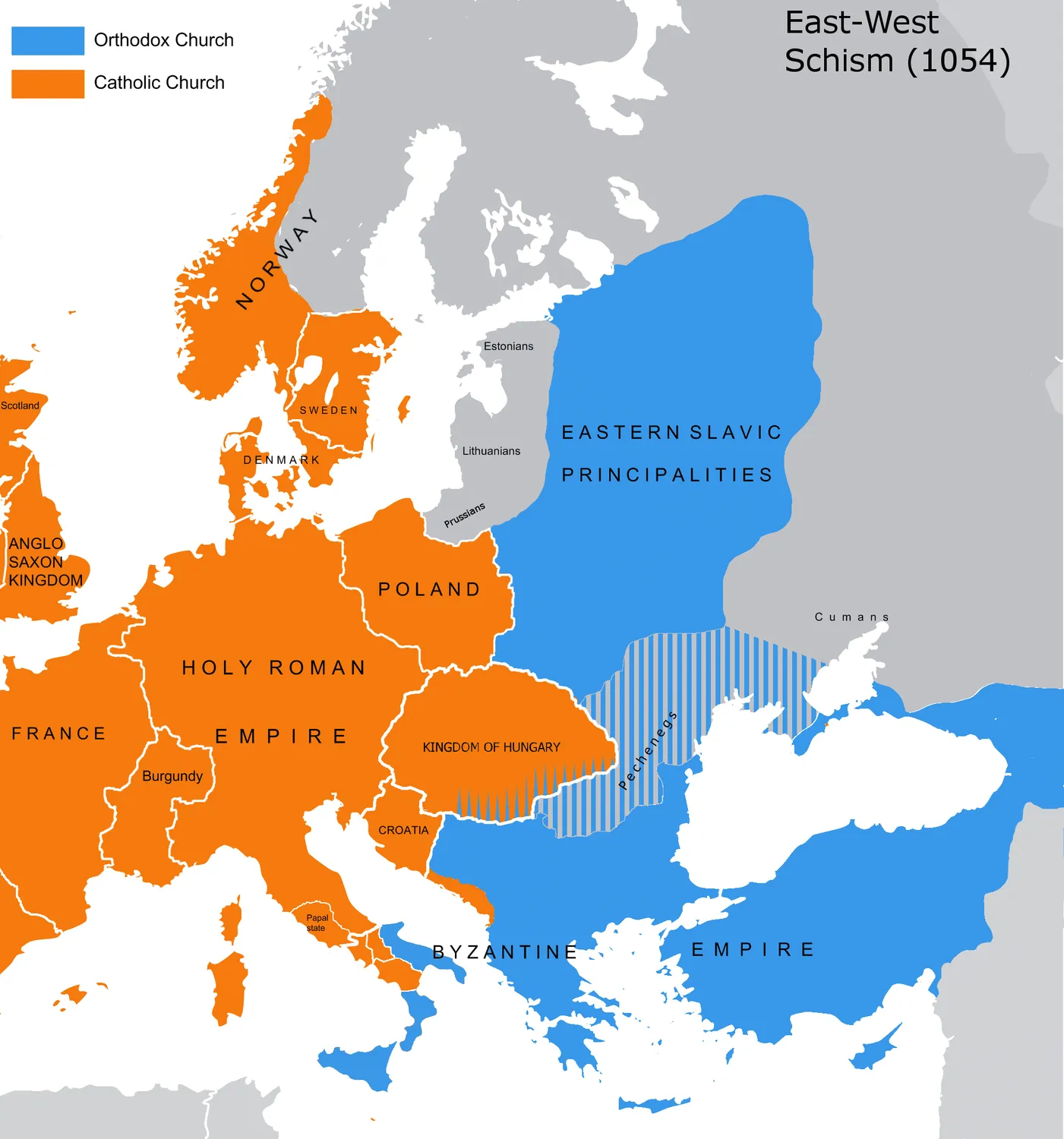
"Great Schism 1054 with former borders" by Tobi85 / Wikimedia Commons (Public domain).
The Roman Catholic and Eastern Orthodox Churches are two major branches of Christianity that developed in different regions of the former Roman Empire. Their split, known as the Great Schism of 1054, shaped religious life in Europe and the Mediterranean for centuries. Understanding how these churches became distinct helps us explore the ways religion, politics, and geography influenced ancient societies.
Both churches trace their roots to the early Christian communities established in the Roman Empire. As Christianity spread, different cities became centers of authority. Rome became the leading city in the West, while Constantinople was the most important in the East. Roman Catholics recognized the authority of the Pope, who they believed was the spiritual leader of all Christians and the successor to Saint Peter. In contrast, Eastern Orthodox Christians were led by the Patriarch of Constantinople and other regional patriarchs. This difference in leadership led to disputes about who held ultimate authority over the church.
The division between East and West was shaped by geography and culture. The Western Roman Empire used Latin for religious services and writings, while the Eastern Empire used Greek. This language barrier affected how people practiced their faith and understood religious texts. For example, the Roman Catholic Church emphasized doctrines such as the use of unleavened bread in the Eucharist and the belief in the Filioque, a phrase added to the Christian creed. The Orthodox Church rejected these changes, insisting on original traditions. Archaeological evidence, such as church buildings and icons, reveals differences in art, architecture, and religious rituals between the two traditions.
The Great Schism of 1054 was the official split between the Roman Catholic and Eastern Orthodox Churches. This event was caused by disagreements over doctrine, leadership, and religious practices. For example, in 1054, the Pope and the Patriarch of Constantinople excommunicated each other, meaning they officially broke ties. Primary sources from this period, like the letters exchanged between church leaders, show how serious these conflicts became. Over time, the split remained, but both churches continued to influence society by providing education, supporting the poor, and shaping social structure and daily life in their regions.
The division between the Roman Catholic and Eastern Orthodox Churches had a long-lasting impact. It affected not only religion, but also politics, art, and culture in Europe, the Middle East, and beyond. The separation remains today, reminding us how historical events can shape the world for centuries. Learning about the Great Schism helps us understand how religion and power can both unite and divide societies.
This topic connects to broader themes in ancient history, including the influence of geography on culture, the development of religious traditions, and the importance of leadership in shaping societies.
Interesting Fact: The Hagia Sophia in Constantinople was once the largest church in the world and a symbol of the Orthodox Christian faith. Today, it stands as a museum and mosque in Istanbul, Turkey.
Comprehension quiz (8 questions)
1. What was the Great Schism?
2. Who leads the Roman Catholic Church?
3. Which language was used in the Eastern Church?
4. Why did the churches split?
5. What is the Filioque?
6. What was one effect of the split?
7. The Great Schism happened in 1054. (True/False)
8. What does 'excommunicate' mean?
Perfect for the way you teach
- Build comprehension skills
- Auto-graded quiz
- Differentiated reading
- Read together at home
- Improve fluency
- Quiet reading time
- Reading curriculum support
- Independent practice
- Track Lexile growth