This learning resource is available in interactive and printable formats. The interactive worksheet can be played online and assigned to students. The Printable PDF version can be downloaded and printed for completion by hand.
This grade 6-8 science passage explores the relationship between heat and changes of state, aligning with NGSS standard MS-PS3-4. Students will learn how thermal energy drives phase changes such as melting, freezing, boiling, and condensation. The passage explains why temperature remains constant during phase changes, as energy is used to break or form molecular bonds. Real-world examples, including melting ice and boiling water, illustrate these concepts. Heating and cooling curves are discussed to help students visualize temperature changes during different phases. The passage connects to broader principles of energy transfer and matter, making it relevant to topics in physical science. Activities include a glossary, comprehension quiz, writing prompts, and graphic organizers to reinforce understanding. Audio support is integrated for accessibility.
CONTENT PREVIEW
Expand content preview
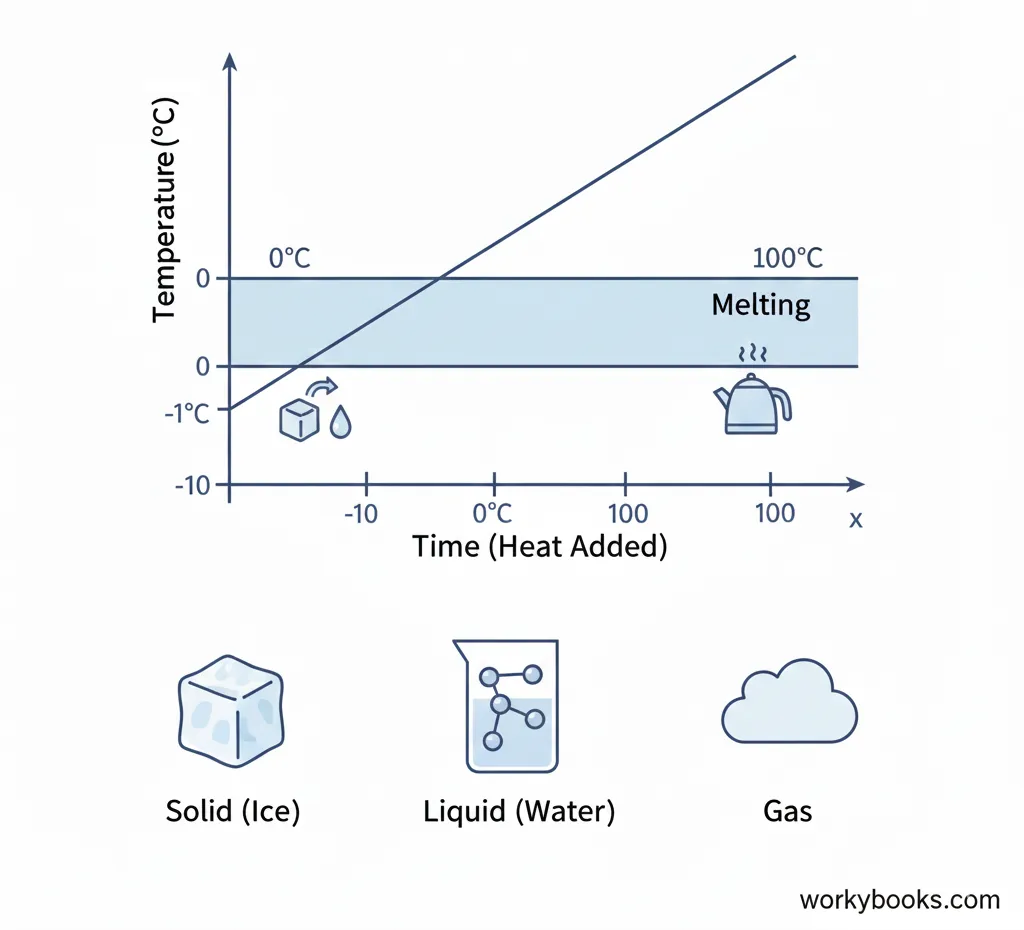
Visualizing how temperature changes as heat is added to ice, water, and steam.
Melting ice on a sidewalk is a common sight on a sunny winter day. This process demonstrates a key scientific concept: heat energy can change the state of matter. The study of how heat, or thermal energy, causes phase changes is essential for understanding natural phenomena and many technological applications. In this passage, we will explore how and why heat changes the state of substances, what happens at the molecular level, and how scientists identify these changes using heating curves and cooling curves.
How Thermal Energy Changes State
When a substance absorbs or loses thermal energy, its particles move faster or slower. For example, when ice absorbs heat, the molecules vibrate more rapidly. At the melting point, enough energy is provided to break the bonds holding the molecules in a solid structure. The ice turns to liquid water, but the temperature remains constant during this change. All the energy goes into breaking molecular bonds, not increasing temperature. The same principle applies at the boiling point. When water boils, the temperature holds steady until all water becomes steam. Only after the phase change is complete does the temperature start to rise again. Scientists use precise measurements to confirm that the temperature stays flat on a graph, called a heating curve, during these transitions.
Heating and Cooling Curves: Visualizing Phase Changes
Heating curves and cooling curves are graphs that show how the temperature of a substance changes as it is heated or cooled. On a heating curve for water, you see flat sections at 0°C (melting) and 100°C (boiling). These plateaus show where the state is changing, even though heat is still being added. The energy input during these periods is used to break or form molecular bonds, not raise the temperature. This observation helps explain why a pot of boiling water on a stove stays at 100°C until all the water has turned to steam.
Applications and Connections
Understanding heat and phase changes has important applications. In weather, the energy absorbed during evaporation cools the environment, which is why sweating helps us stay cool. Industrial processes like metal casting depend on precise control of melting and solidification. The concept also connects to the conservation of energy and the particle model of matter, which are core ideas in science. By studying heating and cooling curves, scientists can design better materials, improve climate models, and develop efficient energy systems.
In summary, heat energy drives changes of state by breaking or forming molecular bonds. During phase changes, temperature remains steady as energy is used in the transition. Heating and cooling curves are powerful tools for visualizing these changes and understanding the energy flow in matter. This knowledge is essential for both scientific research and everyday life.
Interesting Fact: The temperature of boiling water does not rise above 100°C at standard pressure, no matter how much heat you add, until all the water becomes steam!
What is the main reason temperature stays constant during a phase change?
Energy is used to break molecular bonds instead of raising temperature.All heat escapes to the environment.Heat energy stops entering the substance.The substance loses energy faster than it gains it.
According to the passage, what is a heating curve?
A graph that shows how temperature changes as a substance is heated.A tool for measuring solid objects.A type of thermometer.A physical change in a substance.
Which of the following is an example of a phase change?
Ice melting into liquid water.Iron being shaped into a nail.Water being stirred.Paper being cut into pieces.
What happens to the temperature of boiling water at 100°C until all the water becomes steam?
It stays at 100°C.It rises quickly.It falls to 0°C.It drops to room temperature.
What does the term 'thermal energy' mean as used in the passage?
The energy from heat that causes particles to move.Energy from sunlight.Electricity used in machines.Energy stored in food.
In the passage, what is meant by 'phase change'?
When a substance changes from solid, liquid, or gas to another state.When a substance changes color.When a substance is broken into pieces.When a substance is mixed with another.
Why does sweating help cool the human body, according to the passage?
Because energy is absorbed from the body during evaporation.Because sweating increases body temperature.Because sweat makes the skin sticky.Because sweat blocks the sun's rays.
A scientist observes a flat line on a heating curve while heating a substance. What is happening?
A phase change is occurring.The substance is cooling down.The experiment has failed.The thermometer is broken.
True or False: During melting, the temperature of a substance rises steadily until all the solid is gone.
TrueFalse
True or False: Heating and cooling curves can help scientists design better materials.
TrueFalse
Perfect For:
👩🏫 Teachers
• Reading comprehension practice
• Auto-graded assessments
• Literacy skill development
👨👩👧👦 Parents
• Reading practice at home
• Comprehension improvement
• Educational reading time
🏠 Homeschoolers
• Reading curriculum support
• Independent reading practice
• Progress monitoring
Reading Features:
📖
Reading Passage
Engaging fiction or nonfiction text
❓
Comprehension Quiz
Auto-graded questions
📊
Instant Feedback
Immediate results and scoring
📄
Printable Version
Download for offline reading
🔊
Read Aloud
Voice-over with word highlighting
Reviews & Ratings
No reviews yet. Be the first to share your experience!
Related Content
What Is an Endothermic Reaction?
This engaging science passage introduces middle school readers to the concept of endothermic reactions, aligned with NGS...
MS-PS3-44-PS3-34-PS3-2
What Is an Exothermic Reaction?
This science passage introduces students to the idea of exothermic reactions—chemical changes that release heat or light...
MS-PS3-44-PS3-34-PS3-2
Is Freezing Endothermic or Exothermic?
This clear and accessible passage helps students understand why freezing is an exothermic process, even though frozen ob...
MS-PS3-44-PS3-34-PS3-2
What Is Thermal Contraction?
This middle school science passage introduces the concept of thermal contraction, aligned with NGSS standard MS-PS1-4. I...
MS-PS3-44-PS3-34-PS3-2
What Is Gravitational Energy?
This engaging science passage for middle school students explores the concept of gravitational energy, a form of potenti...
MS-PS3-44-PS3-34-PS3-2
What Is Kinetic Energy?
This NGSS-aligned reading passage introduces 6th–8th grade students to the concept of kinetic energy—energy that an obje...
MS-PS3-44-PS3-34-PS3-2
Understanding Mechanical Energy
This science passage is crafted for 6th–8th grade students and focuses on mechanical energy—specifically the combination...
MS-PS3-44-PS3-34-PS3-2
Chemical Energy
This informational science passage on chemical energy is designed for middle school students and aligns with the NGSS st...
MS-PS3-44-PS3-34-PS3-2
Sublimation: The Solid-to-Gas Magic
This engaging NGSS-aligned reading passage explores the science of sublimation, a unique phase change where a solid turn...
MS-PS3-44-PS3-34-PS3-2
Scientific Theories
This reading passage for grades 6-8 introduces students to the concept of scientific theories, emphasizing that these ar...
MS-PS1-1MS-PS1-4MS-PS3-4SCIENCE AND ENGINEERING PRACTICES
Heat and Temperature
This comprehensive passage for grades 6-8 explores the important differences between heat and temperature, emphasizing t...
MS-PS3-3MS-PS3-4
Specific Heat
This comprehensive middle school science passage explores the concept of specific heat, the amount of energy required to...
MS-PS3-4
Thermal Energy
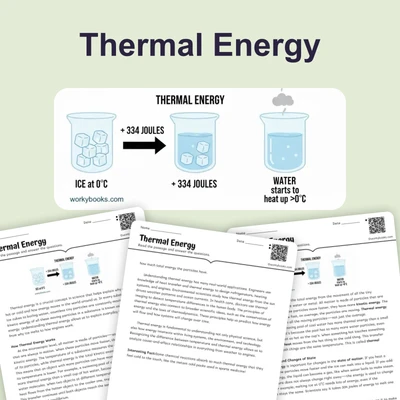
This comprehensive passage explores the concept of thermal energy, aligning with NGSS standards MS-PS3-3 and MS-PS3-4. S...
MS-PS3-3MS-PS3-4
Renewable vs. Nonrenewable Energy
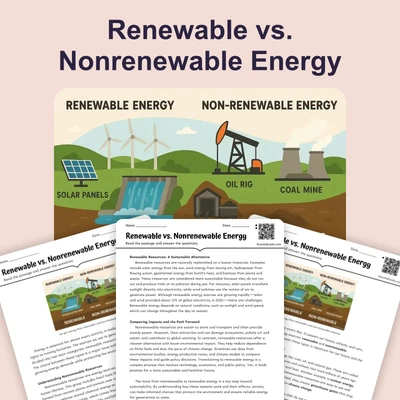
This engaging passage, aligned with NGSS standards MS-PS3-4, MS-ESS3-3, and MS-ESS3-4, helps middle school students diff...
MS-PS3-4MS-ESS3-3MS-ESS3-4
Fossil Fuels: Coal
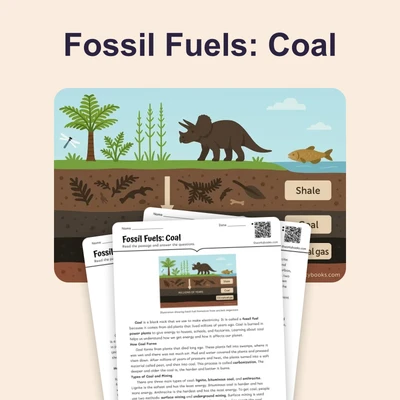
This middle school science reading passage explores the science behind coal, a major fossil fuel. Students will learn ho...
MS-PS3-4MS-ESS3-3MS-ESS3-4
Solar Energy
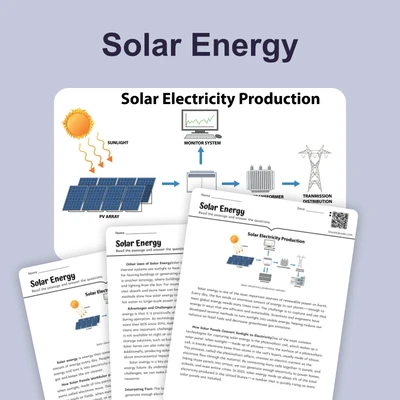
This engaging passage for grades 6-8 explores the science of solar energy, focusing on how sunlight is converted into el...
MS-PS3-4MS-ESS3-3MS-ESS3-4
Wind Energy
This comprehensive middle school science passage explores the scientific principles behind wind energy and how wind turb...
MS-PS3-4MS-ESS3-3MS-ESS3-4
Hydroelectric Energy
This comprehensive passage introduces middle school students to the science behind hydroelectric energy, directly aligni...
MS-PS3-4MS-ESS3-3MS-ESS3-4
Geothermal Energy
This comprehensive science passage introduces middle school students to the mechanisms and applications of geothermal en...