Renewable vs. Nonrenewable Energy — Reading Comprehension
Rate this|
21
Premium Resource
Present
Present in classroom. No work saved
Assign
Classroom with student accounts, Track progress
Quick Play
No student accounts, assign with a link
Grades
5
6
7
8
Standards
MS-PS3-4
MS-ESS3-3
MS-ESS3-4
PRINT+DIGITAL RESOURCE
This learning resource is available in interactive and printable formats. The interactive worksheet can be played online and assigned to students. The Printable PDF version can be downloaded and printed for completion by hand.
This engaging passage, aligned with NGSS standards MS-PS3-4, MS-ESS3-3, and MS-ESS3-4, helps middle school students differentiate between renewable and nonrenewable energy resources. The text defines both types, explains how they function, and analyzes their availability and environmental impact. Real-world examples such as solar, wind, fossil fuels, and nuclear energy are included to illustrate key concepts and mechanisms. The passage also discusses why the transition to renewable energy is crucial for a sustainable future and connects these ideas to broader scientific principles. Activities include a glossary, Spanish translation, multiple-choice quiz, writing prompts, and graphic organizers. All content is audio-integrated for accessibility. This resource is ideal for teachers seeking standards-based, interactive science curriculum for grades 6-8.
CONTENT PREVIEW
Expand content preview
We get energy from renewable and non-renewable sources
Energy is essential for almost every activity in modern society, from powering lights to running factories. The sources we use to generate this energy can be divided into two main categories: renewable resources and nonrenewable resources. The choice between these types is a major issue today, as communities try to meet growing energy demands while protecting the environment.
Understanding Nonrenewable Resources
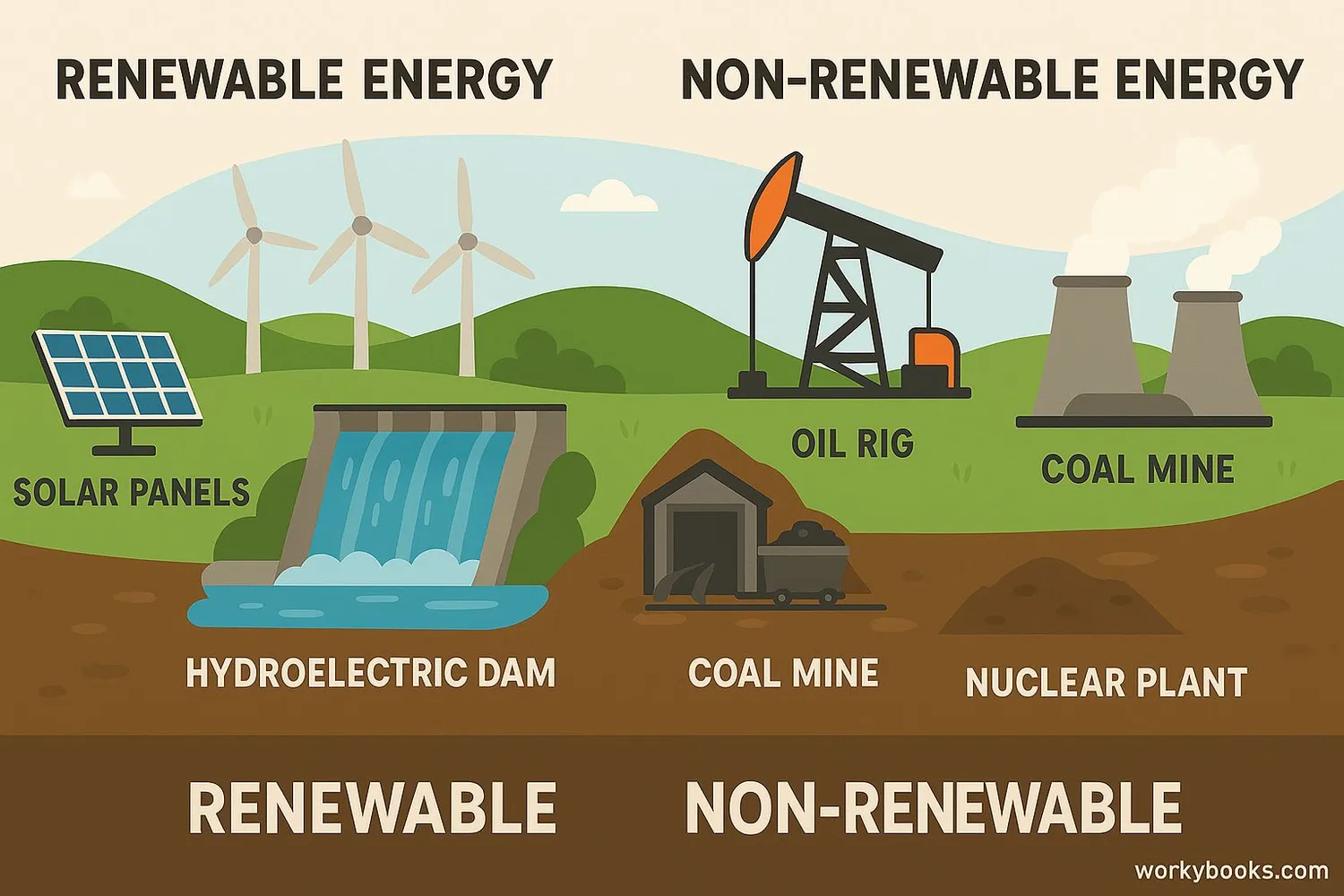
Nonrenewable resources are energy sources that cannot be replaced within a human lifetime. This group includes fossil fuels like coal, oil, and natural gas, which formed from ancient plants and animals over millions of years. When we burn these fuels, they release stored chemical energy as heat and light. Another nonrenewable resource is nuclear energy, which comes from splitting atoms of uranium. Nonrenewable resources are widely available and have powered industrial growth for over a century. However, using them creates significant environmental problems, such as air pollution and the emission of greenhouse gases. These gases trap heat in the atmosphere, causing climate change.
Renewable Resources: A Sustainable Alternative
Renewable resources are naturally replenished on a human timescale. Examples include solar energy from the sun, wind energy from moving air, hydropower from flowing water, geothermal energy from Earth's heat, and biomass from plants and waste. These resources are considered more sustainable because they do not run out and produce little or no pollution during use. For instance, solar panels transform sunlight directly into electricity, while wind turbines use the motion of air to generate power. Although renewable energy sources are growing rapidly—solar and wind provided about 12% of global electricity in 2022—there are challenges. Renewable energy depends on natural conditions, such as sunlight and wind speed, which can change throughout the day or season.
Comparing Impacts and the Path Forward
Nonrenewable resources are easier to store and transport and often provide steady power. However, their extraction and use damage ecosystems, pollute air and water, and contribute to global warming. In contrast, renewable resources offer a cleaner alternative with lower environmental impact. They help reduce dependence on finite fuels and slow the pace of climate change. Scientists use data from environmental studies, energy production rates, and climate models to compare these impacts and guide policy decisions. Transitioning to renewable energy is a complex process that involves technology, economics, and public policy. Yet, it holds promise for a more sustainable and healthier future.
The move from nonrenewable to renewable energy is a key step toward sustainability. By understanding how these systems work and their effects, society can make informed choices that protect the environment and ensure reliable energy for generations to come.
Interesting Fact: Less than 20% of the world's total energy comes from renewable resources today, but this percentage is rising every year as technology improves.
What are nonrenewable resources?
Energy sources that cannot be replaced within a human lifetimeEnergy sources that are naturally replenishedResources that always produce electricityResources made only from plants
Which of the following is a renewable resource?
CoalOilSolar energyNatural gas
What is the main environmental problem caused by burning fossil fuels?
They produce more sunlightThey create greenhouse gasesThey increase water supplyThey make plants grow faster
What does 'sustainable' mean in the context of energy resources?
Resources that are expensive to makeResources that can last for a long time without running outResources that are difficult to useResources that require fossil fuels
How do solar panels produce electricity?
By burning coalBy splitting atomsBy transforming sunlightBy using wind
What is a challenge of using renewable energy sources?
They always work at nightThey depend on natural conditions like sunlight and windThey create a lot of pollutionThey cannot be used for electricity
Which statement best describes the relationship between greenhouse gases and climate change?
Greenhouse gases trap heat and cause climate changeGreenhouse gases cool the Earth's surfaceGreenhouse gases are only produced by plantsClimate change reduces greenhouse gas levels
True or False: Renewable resources produce more pollution than nonrenewable resources.
TrueFalse
True or False: Nonrenewable resources can be replaced quickly by natural processes.
TrueFalse
Which of the following is a reason for transitioning to renewable energy?
To increase the use of fossil fuelsTo reduce greenhouse gas emissionsTo make energy less reliableTo pollute more water sources
Perfect For:
👩🏫 Teachers
• Reading comprehension practice
• Auto-graded assessments
• Literacy skill development
👨👩👧👦 Parents
• Reading practice at home
• Comprehension improvement
• Educational reading time
🏠 Homeschoolers
• Reading curriculum support
• Independent reading practice
• Progress monitoring
Reading Features:
📖
Reading Passage
Engaging fiction or nonfiction text
❓
Comprehension Quiz
Auto-graded questions
📊
Instant Feedback
Immediate results and scoring
📄
Printable Version
Download for offline reading
🔊
Read Aloud
Voice-over with word highlighting
Reviews & Ratings
No reviews yet. Be the first to share your experience!
Related Content
Natural Disaster: Volcanic Eruptions
Volcanoes can erupt with lava and ash, changing the landscape. While dangerous, they also create fertile land and new la...
RI.3.1RI.4.4RI.4.2RI.5.2
Human Impacts: Pollution
This middle school science reading passage, aligned with NGSS standards MS-LS2-4 and MS-ESS3-3, examines the mechanisms ...
MS-LS2-4MS-ESS3-3
Human Impacts: Habitat Destruction
This grade 6-8 science passage explores human impacts on ecosystems, focusing on habitat destruction as the leading caus...
MS-LS2-4MS-LS2-5MS-ESS3-3
Ecosystem Services
This engaging middle school science passage introduces students to the concept of ecosystem services, the vital benefits...
MS-LS2-5MS-ESS3-3
Environmental Problems and Solutions
This passage for grades 6-8 introduces major environmental problems such as habitat loss, pollution, climate change, inv...
MS-LS2-4MS-ESS3-3MS-ESS3-4
Remote Sensing
This middle school science passage introduces students to the concept of remote sensing—the collection of information ab...
MS-ESS3-3MS-PS4-2MS-ETS1-1MS-ETS1-3
Geographic Information Systems (GIS)
This engaging middle school science passage introduces students to Geographic Information Systems (GIS), aligning with N...
MS-ESS3-3MS-ETS1-1MS-ETS1-2MS-ETS1-3
Fossil Fuels: Coal
This middle school science reading passage explores the science behind coal, a major fossil fuel. Students will learn ho...
MS-PS3-4MS-ESS3-3MS-ESS3-4
Solar Energy
This engaging passage for grades 6-8 explores the science of solar energy, focusing on how sunlight is converted into el...
MS-PS3-4MS-ESS3-3MS-ESS3-4
Wind Energy
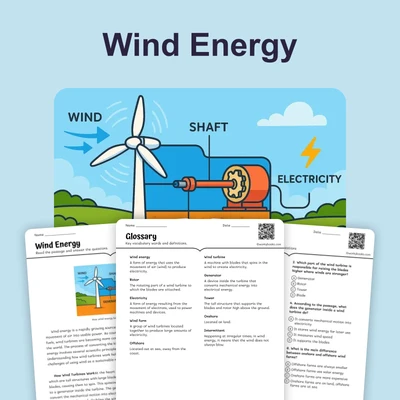
This comprehensive middle school science passage explores the scientific principles behind wind energy and how wind turb...
MS-PS3-4MS-ESS3-3MS-ESS3-4
Hydroelectric Energy
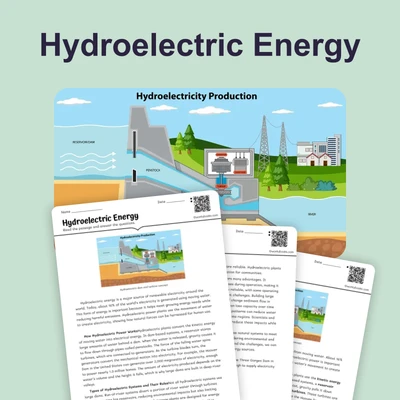
This comprehensive passage introduces middle school students to the science behind hydroelectric energy, directly aligni...
MS-PS3-4MS-ESS3-3MS-ESS3-4
Geothermal Energy
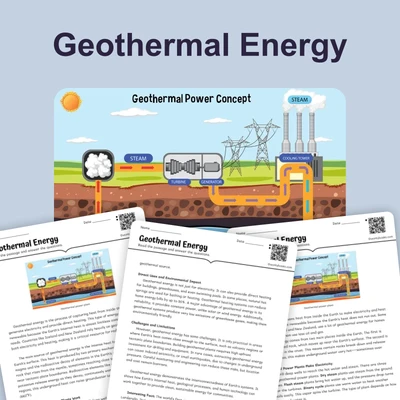
This comprehensive science passage introduces middle school students to the mechanisms and applications of geothermal en...
MS-PS3-4MS-ESS3-3MS-ESS3-4
Biomass and Biofuels
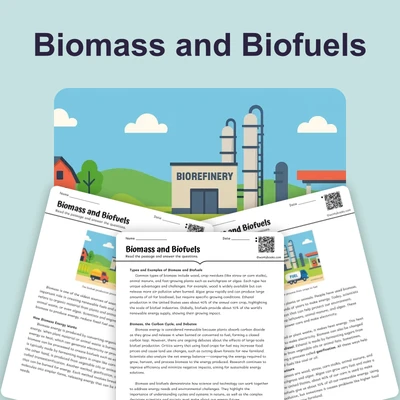
This NGSS-aligned passage introduces grades 6-8 students to the science of biomass and biofuels, explaining how organic ...
MS-PS3-4MS-ESS3-3MS-ESS3-4
Nuclear Energy as a Resource
This NGSS-aligned informational science passage, designed for grades 6-8, explores nuclear energy as a resource in the c...
MS-PS3-4MS-ESS3-3MS-ESS3-4
Water Quality
This middle school science reading passage covers the topic of water quality, aligned with NGSS standards MS-ESS3-1 and ...
MS-ESS3-1MS-ESS3-3
Florida Everglades
This comprehensive passage introduces middle school students to the Florida Everglades, a distinctive wetland ecosystem ...
MS-LS2-1MS-LS2-4MS-ESS3-3MS-ESS3-4
Congo Rainforest
This middle school science passage explores the Congo Rainforest—Earth’s second-largest rainforest, located in Central A...
MS-LS2-1MS-ESS3-3
Nuclear Power Plants
This comprehensive reading passage introduces middle school students (grades 6-8) to the science of nuclear power plants...
MS-PS3-4MS-ESS3-3
Nuclear Safety and Waste
This middle school science passage explores the critical topic of nuclear safety and waste management, aligned with NGSS...