Fossil Fuels: Coal
Interactive passage with audio narration, comprehension questions, and printable PDF.
By completing this purchase you agree to our Terms of Use and Privacy Policy. Your subscription renews automatically until you cancel. You can cancel anytime from your account settings. All sales are final and non-refundable. Digital content is available for download in your account immediately upon purchase.
What's included
Fossil Fuels: Coal preview and details
About this printable Fossil Fuels: Coal science reading passage, NGSS-aligned (Grades 5-8)
Sample passage and quiz from Fossil Fuels: Coal
Reading passage and comprehension quiz preview
Fossil Fuels: Coal
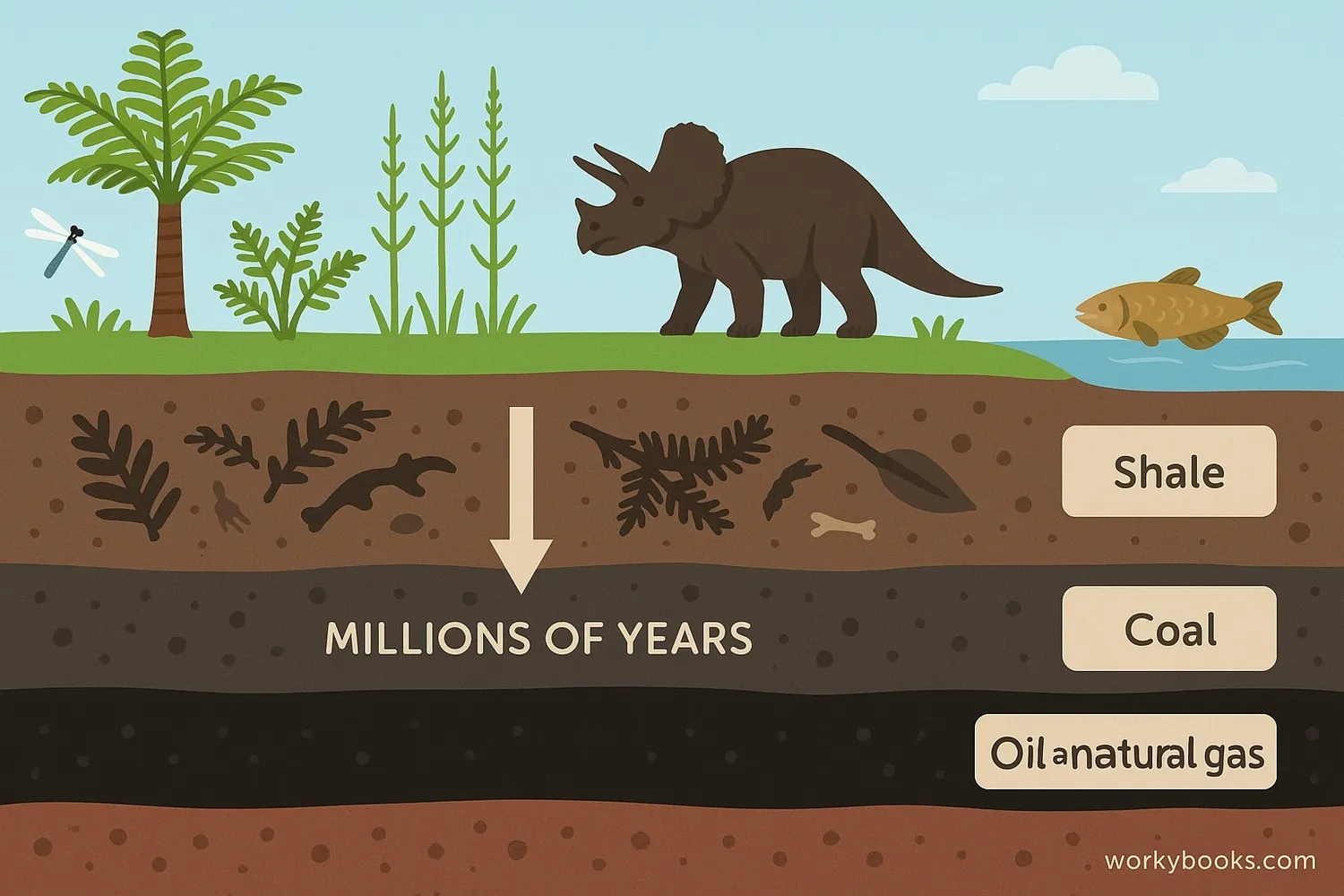
Coal is one of the most important energy sources used around the world today. It is a type of fossil fuel that provides about 27% of the world’s energy. Coal is burned in power plants to generate electricity for homes, schools, and businesses. Understanding how coal forms and is used helps us make decisions about energy and the environment.
How Coal Forms Over Millions of Years
Coal forms through a process called carbonization. Millions of years ago, dense forests and swamps covered much of the Earth. When these ancient plants died, they fell into wet, oxygen-poor environments like swamps. Over time, layers of mud and water covered the plant matter, preventing it from rotting completely. As more layers piled up, the pressure and temperature increased. This caused the plants to slowly change into peat, then into coal. This transformation takes at least 1 million years. The deeper the coal is buried and the longer it is exposed to heat and pressure, the harder and more energy-rich it becomes.
Different Types of Coal and Mining Methods
Coal is classified into three main types: lignite, bituminous coal, and anthracite. Lignite is the softest and contains the least energy. Bituminous coal is harder and provides much more energy. Anthracite is the hardest and contains the most carbon, making it the most efficient for burning. Coal is extracted from the ground using two main methods: surface mining and underground mining. Surface mining is used when coal is close to the surface. Large machines remove the soil and rock to expose the coal. Underground mining is used for deep coal seams. Miners create tunnels to reach the coal layers far below the ground. Both methods can affect the environment and the safety of workers.
How Coal Power Plants Work and Their Impacts
Most coal is used to produce electricity in power plants. In these plants, crushed coal is burned in a boiler to heat water and create steam. The steam turns a turbine, which spins a generator to produce electricity. This process is efficient, and coal power plants can run day and night. Coal is abundant and cheap, and the infrastructure is already built in many places. However, burning coal releases pollutants, such as sulfur dioxide and nitrogen oxides, into the air. It also emits large amounts of carbon dioxide, a greenhouse gas that contributes to climate change. Mining coal can destroy habitats and pose health risks to workers.
Coal illustrates the complex relationship between energy needs, technology, and environmental impact. By understanding how coal forms, how it is mined, and how it is used, scientists and citizens can make informed choices about our energy future. Advances in technology and alternative energy sources may reduce our dependence on coal in the future, but for now, it remains a key part of the world’s energy system.
Interesting Fact: Some of the oldest coal deposits are over 300 million years old, dating back to the Carboniferous Period when giant plants and trees dominated Earth’s landscapes.
Comprehension quiz (10 questions)
1. What is coal mainly used for today?
2. Which process turns ancient plant material into coal over millions of years?
3. What are the three main types of coal mentioned in the passage?
4. What is the primary advantage of coal as an energy source according to the passage?
5. Which mining method is used when coal is close to the surface?
6. What does 'greenhouse gas' mean as used in the passage?
7. Why does burning coal contribute to climate change?
8. How do coal power plants generate electricity?
9. Coal is a fossil fuel. (True/False)
10. Surface mining has no impact on the environment. (True/False)
Perfect for the way you teach
- Build comprehension skills
- Auto-graded quiz
- Differentiated reading
- Read together at home
- Improve fluency
- Quiet reading time
- Reading curriculum support
- Independent practice
- Track Lexile growth