Reading PassagePremium

Ancestral Puebloan Cliff Dwellings

Interactive passage with audio narration, comprehension questions, and printable PDF.

No ratings yet
Grades 5–8ReadingElaSocial-studiesHistoryEnglish · SpanishInteractive · Printable
Aligned toCA.HSS.6.2CCSS.RI.6.1CCSS.RI.6.4CCSS.W.6.2
Just this resource
$1.50
One-time purchase
Best value
Unlock everything
$49.99$29.99/yr
40% off until Aug 1 — 10,000+ resources
Renews at $49.99/year.
Unlock above to use these actions

What's included

Reading passage
Audio narration
Comprehension quiz
Writing activity
Glossary & flashcards
Differentiated version
Spanish translation

Ancestral Puebloan Cliff Dwellings preview and details

About this printable Ancestral Puebloan Cliff Dwellings reading passage (Grades 5-8)

This engaging history reading passage explores the Ancestral Puebloans' cliff dwellings built between 1190 and 1300 CE in Mesa Verde and the Four Corners region. Students will learn about the sophisticated stone masonry, multi-story construction, and passive solar heating used by the Puebloans. The passage examines how environmental adaptation, defense, and social organization shaped these remarkable communities. Aligned with CA HSS and Common Core standards, this resource includes a glossary, multiple-choice quiz, writing prompts, graphic organizers, and both English and Spanish versions. It supports disciplinary literacy and critical thinking, making it ideal for world history classrooms. Read aloud audio and a Spanish translation are included for accessibility and language development.
Written by Workybooks TeamPublished by Workybooks
Preview

Sample passage and quiz from Ancestral Puebloan Cliff Dwellings

Reading passage and comprehension quiz preview

Ancestral Puebloan Cliff Dwellings
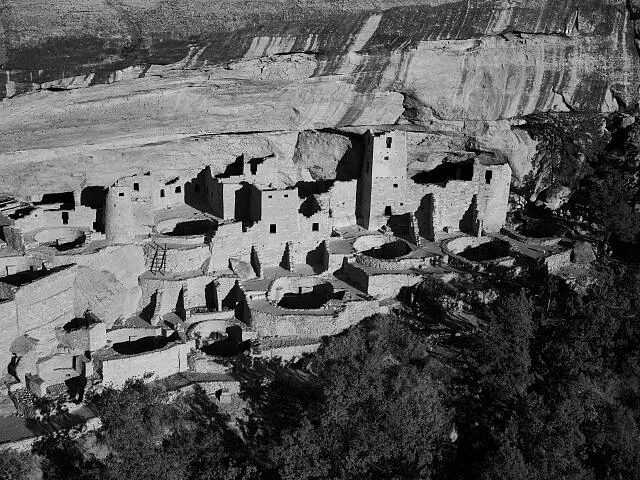
Black-and-white images of cliff dwellings at Mesa Verde National Park in Montezuma County, Colorado. The park protects some of the best-preserved ancestral Puebloan archeological sites in the United States

"Black-and-white images of cliff dwellings at Mesa Verde National Park in Montezuma County, Colorado. The park protects some of the best-preserved ancestral Puebloan archeological sites in the United States" by Highsmith, Carol M., 1946- / Library of Congress. 

The Ancestral Puebloans were a Native American people who lived in the Four Corners region of the southwestern United States between 1190 and 1300 CE. They are recognized for building remarkable cliff dwellings—multi-story homes constructed within natural caves and along cliff faces. Mesa Verde, located in present-day Colorado, is one of the most famous sites where these structures have been preserved. These cliff dwellings reflect the Ancestral Puebloans' advanced skills in stone masonry and their ability to adapt to their environment.

Construction of these dwellings required careful planning and collaboration. The Puebloans used sandstone blocks and a clay-based mortar to build thick walls that could support multiple levels. Archaeologists have discovered surviving beams of wood—called vigas—which supported the roofs and floors. Rooms were arranged around open courtyards, and some dwellings contained as many as 150 rooms. Ladders connected different floors and allowed residents to move quickly between rooms or escape in case of danger.

The location of these cliff dwellings was strategic. Built high into the cliffs, they offered protection from invaders and harsh weather. Openings often faced south, a design that provided passive solar heating: the sun warmed the rooms during winter while overhangs provided shade in summer. This adaptation shows how closely the Ancestral Puebloans observed and responded to their environment. Archaeological evidence, such as the presence of kivas—underground ceremonial rooms—reveals the importance of community rituals and spiritual life in their society.

Daily life in these villages was organized and cooperative. People shared tasks like farming, weaving, and pottery-making. The social structure included leaders, craft specialists, and religious figures. Over time, the Ancestral Puebloans developed more complex societies, but around 1300 CE, most cliff dwellings were abandoned. Scholars believe this may have been caused by climate change, drought, or resource shortages, although the exact reasons are still debated. The descendants of the Ancestral Puebloans, such as the Hopi and Zuni, continue many of their traditions today.

Cliff dwellings like those at Mesa Verde demonstrate the ingenuity and resilience of the Ancestral Puebloans. Their architecture combined technology, art, and environmental adaptation, leaving a lasting legacy in North American history. These structures connect us to broader themes of human innovation and the relationship between people and their environment.

Interesting Fact: Archaeologists have found fingerprints of builders pressed into the mortar of Mesa Verde's walls, giving us a direct connection to the people who built these homes.

Comprehension quiz (8 questions)

1. Where is Mesa Verde located?

Colorado
Arizona
Utah
New Mexico

2. What material did Puebloans mainly use?

Sandstone
Marble
Adobe bricks
Granite

3. What is a kiva?

Underground ceremonial room
Stone wall
Wooden ladder
Pottery vessel

4. Why did cliff dwellings face south?

To get sunlight in winter
For better farming
To avoid animals
To see the river

5. What was a likely reason for abandonment?

Drought and resource shortage
Invasion by Romans
Discovery of gold
Natural disasters

6. What does the presence of kivas show?

Importance of ritual and community
Need for more storage
Extra living space
Food preservation

7. Cliff dwellings had up to 150 rooms.

True
False

8. What is 'passive solar heating'?

Sunlight heats homes naturally
Using fire to cook
Making pottery with sun
Heating water with stones
Who it's for

Perfect for the way you teach

Teachers
  • Build comprehension skills
  • Auto-graded quiz
  • Differentiated reading
Parents
  • Read together at home
  • Improve fluency
  • Quiet reading time
Homeschoolers
  • Reading curriculum support
  • Independent practice
  • Track Lexile growth
Topics

Reviews & Ratings

No reviews yet. Be the first to share your experience!

More reading you might love

19 more
Passage
Early Human Cognition - reading educational content
Grades 6–8

Early Human Cognition

ancient history · CA HSS 6.1

$1.50
Passage
Aristophanes Greek Comedy Writer - reading educational content
Grades 6–8

Aristophanes Greek Comedy Writer

ancient history · 6.4.1

$1.50
Passage
Confucius and His Teachings - reading educational content
Grades 6–8

Confucius and His Teachings

ancient history · CA HSS 6.6.7

$1.50
Passage
Lao Tzu and Daoism - reading educational content
Grades 6–8

Lao Tzu and Daoism

ancient history · CA HSS 6.6.3

$1.50
Passage
Dead Sea Scrolls Discovery - reading educational content
Grades 6–8

Dead Sea Scrolls Discovery

ancient history · CA HSS 6.1

$1.50
Passage
Theocracy in the Ancient World - reading educational content
Grades 6–8

Theocracy in the Ancient World

ancient history · CA HSS 6.2.4

$1.50
Passage
Democracy in Ancient Athens - reading educational content
Grades 6–8

Democracy in Ancient Athens

ancient history · CA HSS 6.4

$1.50
Passage
Rosetta Stone Decoded - reading educational content
Grades 6–8

Rosetta Stone Decoded

ancient history · CA HSS 6.2

$1.50
Passage
Pemmican Indigenous Food - reading educational content
Grades 5–8

Pemmican Indigenous Food

us history · 6.1.1

$1.50
Passage
Ancient Taxes and Tribute - reading educational content
Grades 6–8

Ancient Taxes and Tribute

ancient history · CA HSS 6.2

$1.50
Passage
First Farming Villages - reading educational content
Grades 6–8

First Farming Villages

ancient history · CA HSS 6.1.1

$1.50
Passage
King Solomon and the First Temple - reading educational content
Grades 6–8

King Solomon and the First Temple

ancient history · CA HSS 6.2

$1.50
Passage
King David of Israel - reading educational content
Grades 6–8

King David of Israel

ancient history · CA HSS 6.2

$1.50
Passage
Livy the Roman Historian - reading educational content
Grades 6–8

Livy the Roman Historian

ancient history · CA HSS 6.7

$1.50
Passage
Core Beliefs of Daoism - reading educational content
Grades 6–8

Core Beliefs of Daoism

ancient history · CA HSS 6.6

$1.50
Passage
Ancient World Literature - reading educational content
Grades 6–8

Ancient World Literature

ancient history · CA HSS 6.1

$1.50
Passage
Saladin and Richard the Lionheart - reading educational content
Grades 5–8

Saladin and Richard the Lionheart

world history · CA HSS 7.2

$1.50
Passage
Inuit Snow Goggles - reading educational content
Grades 5–8

Inuit Snow Goggles

us history · CA HSS 6.1

$1.50
Passage
Wild Rice of the Great Lakes - reading educational content
Grades 5–8

Wild Rice of the Great Lakes

us history · CA.HSS.6.1

$1.50
Copyright © 2026 Workybooks. Made with ♥ in California.