Democracy in Ancient Athens
Interactive passage with audio narration, comprehension questions, and printable PDF.
By completing this purchase you agree to our Terms of Use and Privacy Policy. Your subscription renews automatically until you cancel. You can cancel anytime from your account settings. All sales are final and non-refundable. Digital content is available for download in your account immediately upon purchase.
What's included
Part of this bundle

Democracy in Ancient Athens preview and details
About this printable Democracy in Ancient Athens reading passage (Grades 6-8)
Sample passage and quiz from Democracy in Ancient Athens
Reading passage and comprehension quiz preview
Democracy in Ancient Athens
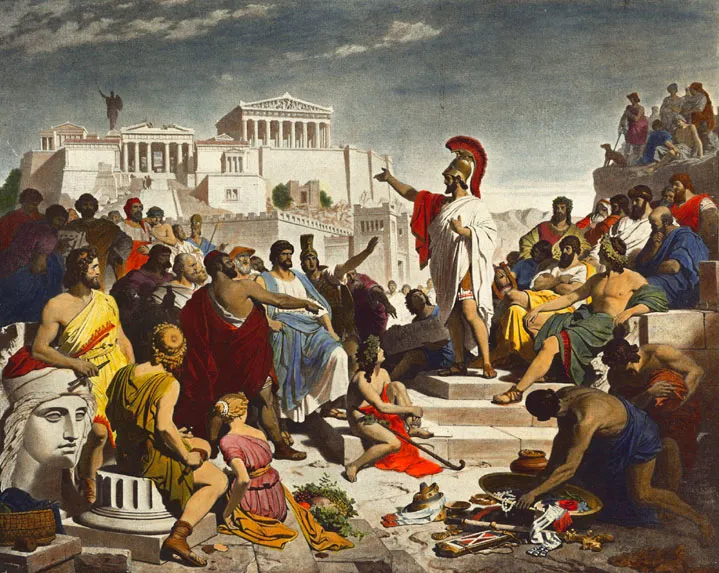
"Athenian democracy" by Philipp Foltz / Wikimedia Commons (Public domain).
Democracy began in the ancient Greek city-state of Athens around 508 BCE, changing how people participated in government. In Athens, power did not rest with a king or small group. Instead, Athenian citizens gathered to make decisions about their laws and leaders. This system, known as direct democracy, allowed citizens to vote on issues themselves, rather than through representatives.
The Assembly, or “Ekklesia,” was central to Athenian democracy. Any male citizen over 18 could attend meetings, which took place about 40 times a year on the Pnyx hill. At these gatherings, citizens debated new laws, military matters, and even ostracism, which was the temporary removal of a citizen from Athens for ten years. Votes were often done by a show of hands or by using stones. The historian Thucydides described the Assembly’s debates and how ordinary citizens shaped state policy. Archaeological discoveries at the Pnyx, such as stone speaker’s platforms, confirm the Assembly’s importance.
Leadership in Athens was different from monarchies. Instead of inherited power, many officials were chosen by lottery to make government more fair. The most respected leader was the strategos, or general, elected by citizens for military leadership. Pericles, who served as strategos for over 15 years, increased citizen participation and built public buildings like the Parthenon. However, not everyone had a voice. Only free adult male citizens could vote—women, slaves, and foreigners were excluded. This reflected the social hierarchy of Athenian society.
Athenian democracy changed over time. At first, only a small group could vote, but reforms by leaders like Cleisthenes and Pericles expanded participation. During the 5th century BCE, Athens faced wars and internal conflict, yet the Assembly continued to meet. Some decisions, like condemning Socrates, show democracy’s strengths and its limits. The system inspired debates about justice, equality, and citizenship that still influence governments today.
The geography of Athens, with its central meeting places and open spaces, helped direct democracy thrive. Citizens lived close enough to gather easily for discussions. Although Athens eventually fell to outside powers, its experiment with democracy left a major impact. Modern democracies borrow ideas from Athens, such as jury trials and public debate, but now include more people as citizens.
Today, studying Athenian democracy helps us understand how people can shape their governments. The ideas of citizen participation, debate, and voting continue to inspire societies around the world.
Interesting Fact: In some Assembly votes, Athenians dropped pieces of broken pottery called ostraka into containers to decide who would be exiled from the city.
Comprehension quiz (8 questions)
1. When did democracy begin in Athens?
2. What was the Assembly called in Greek?
3. Who could vote in ancient Athens?
4. Why did some officials use a lottery?
5. What is ostracism?
6. How did geography help democracy in Athens?
7. Athens used direct democracy. True or false?
8. What is the meaning of 'hierarchy'?
Perfect for the way you teach
- Build comprehension skills
- Auto-graded quiz
- Differentiated reading
- Read together at home
- Improve fluency
- Quiet reading time
- Reading curriculum support
- Independent practice
- Track Lexile growth