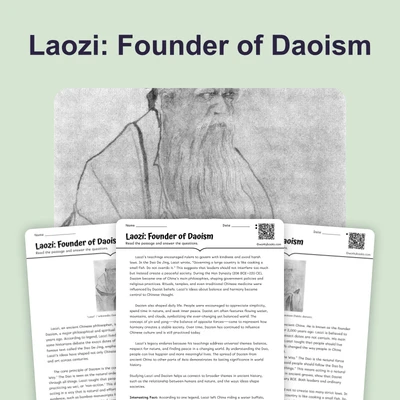
This passage introduces students to Daoism, one of the major philosophies of ancient China, focusing on its origins, teachings, and influence on society. Students will explore primary sources like the Dao De Jing, analyze how Daoism encouraged harmony with nature, and examine its impact on Chinese art, governance, and daily life. The passage includes a glossary of key academic vocabulary, reading comprehension questions, and graphic organizers to help students analyze cause-and-effect relationships and chronological developments. Spanish translation and read aloud audio support diverse learners. This passage aligns with California HSS 6.6 and CCSS RI.6-8, making it ideal for exploring the connections between geography, belief systems, and ancient civilizations. Students will also practice historical thinking skills by evaluating sources, connecting Daoist ideas to broader themes, and understanding continuity and change over time.
Written by Workybooks TeamPublished by Workybooks
Preview
Sample passage and quiz content
CONTENT PREVIEW
Expand content preview
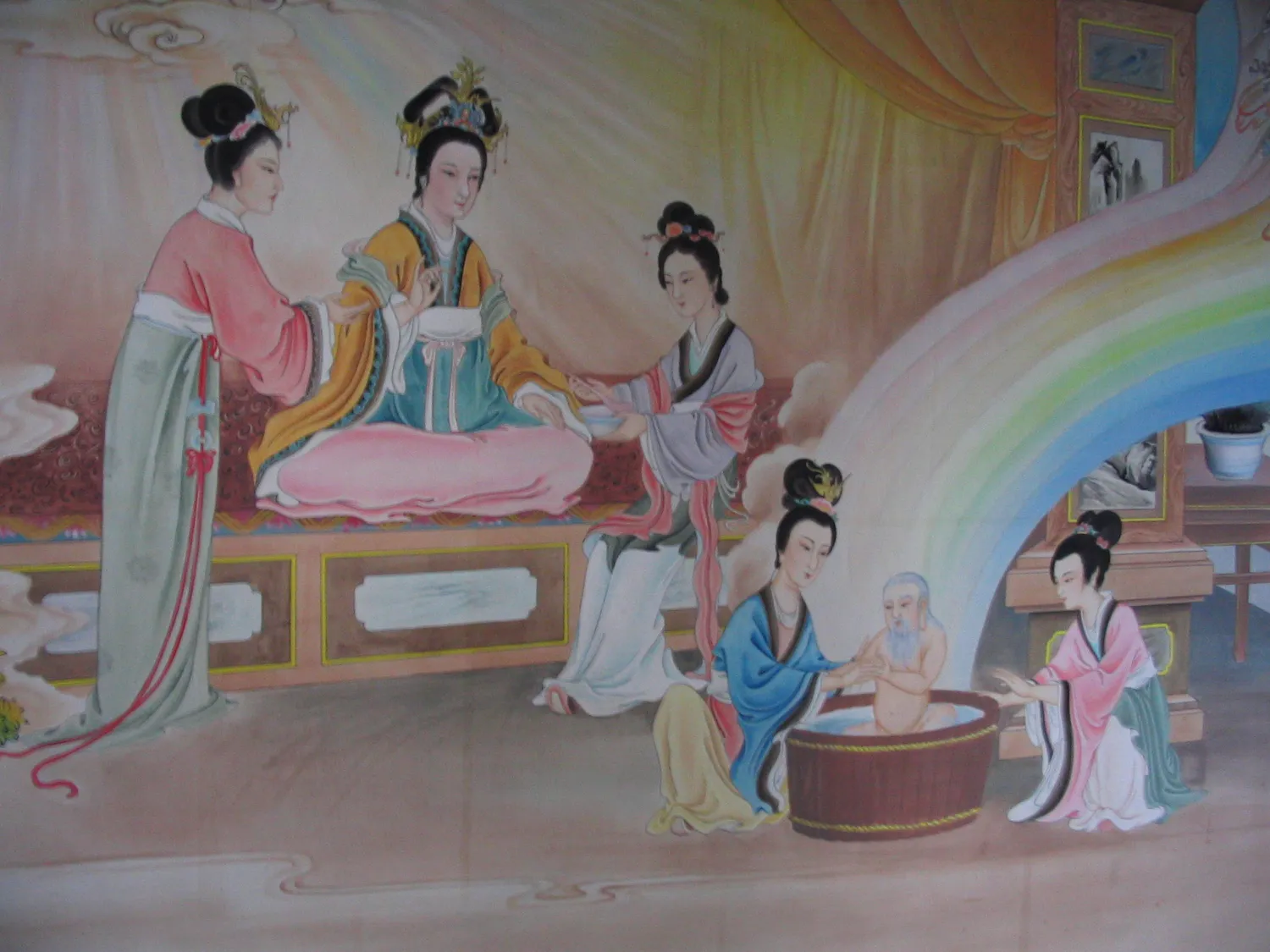
Detail of a wall painting depicting Laozi as a baby. Laozi is considered to be the founder and that who revealed Daoism (Taoism). Gray Goat Temple (Qingyanggong), Chengdu, Sichuan, China.(photo: Felix Andrews (Floybix)). / Wikimedia Commons .
Daoism, also known as Taoism, is an important philosophy that shaped the culture and history of ancient China. Daoism teaches that people should live in harmony with the natural world and follow the Dao, or "the Way." This belief system emerged during a time of great change in China, around the 6th century BCE, and continues to influence Chinese society today.
The beginnings of Daoism are closely connected to a legendary figure named Laozi, who is said to have lived during the Zhou dynasty. Laozi is credited with writing the Dao De Jing, a short book filled with poetic guidance on how to live simply and peacefully. The Dao De Jing encourages people to avoid excess and conflict, and instead, to embrace simplicity and natural balance. For example, one line from the Dao De Jing says, “A journey of a thousand miles begins with a single step,” reminding readers to value patience and steady progress.
Daoism teaches that the universe is governed by natural forces like yin and yang. Yin and yang represent pairs of opposite but complementary forces, such as dark and light, or female and male. Daoists believe these forces must remain balanced for harmony to exist in the world. Archaeological discoveries, such as ancient yin-yang symbols carved on bronze vessels, show how these ideas were present in daily life and religious practices. Daoist thinkers encouraged rulers to govern with kindness and not to force their will on the people, believing that gentle leadership would create a more peaceful society.
Daoism’s focus on nature and simplicity had many effects on Chinese civilization. Artists and poets were inspired by Daoist ideas to create paintings and poems that celebrated mountains, rivers, and quiet landscapes. Daoists often lived in small communities close to nature, practicing meditation and searching for spiritual immortality. Some Daoist priests became important advisors to emperors, shaping laws and rituals. Over centuries, Daoism blended with other traditions like Confucianism and Buddhism, but its influence on Chinese culture continued. Even today, Daoist festivals and temples can be found throughout China.
Daoism demonstrates how a belief system can shape not only religious practice, but also art, government, and everyday life. Its teachings about balance and respect for nature still encourage people to find harmony within themselves and with the world. Daoism’s lasting legacy reminds us to look for connections between humans and the environment, both in the past and today.
This study of Daoism connects to broader themes in ancient history, such as the development of belief systems, the impact of geography on culture, and how societies seek order and meaning.
Interesting Fact: Laozi’s birth is shrouded in legend—some stories say he was born already wise and with white hair!
When did Daoism begin?
6th century BCE2nd century CE3rd century BCE1st century CE
Who wrote the Dao De Jing?
LaoziConfuciusHan FeiziSun Tzu
What do yin and yang represent?
Opposite forcesOne godA cityA dynasty
What did Daoist artists focus on?
Mountains and riversBattlesPalacesShips
How did Daoism influence rulers?
Encouraged gentle leadershipTaught strict lawsSupported expansionPromoted war
Why did Daoists value simplicity?
To avoid conflictTo gain powerTo become richTo travel far
Daoism influenced art and daily life. True or false?
TrueFalse
What does 'immortality' mean in Daoism?
Living foreverBeing a kingBuilding wallsLearning to write
Who it's for
Perfect for the way you teach
Teachers
Build comprehension skills
Auto-graded quiz
Differentiated reading
Parents
Read together at home
Improve fluency
Quiet reading time
Homeschoolers
Reading curriculum support
Independent practice
Track Lexile growth
Topics
Daoismancient ChinaLaoziharmonyphilosophynatureDao De Jinghistory reading passage
Reviews & Ratings
No reviews yet. Be the first to share your experience!
More reading you might love
19 more
Great Wall of China
This engaging history reading passage explores the dramatic rise of Qin Shi Huang, the First Emperor of China, and the o...
CA HSS 6.6RI.6.1RI.6.2W.6.2
Life in Ancient China
This comprehensive history reading passage explores daily life and social structure in Ancient China, focusing on the ro...
CA HSS 6.6RH.6-8.1RH.6-8.2RH.6-8.4
Bronze in Ancient China
This passage explores the significance of bronze in Ancient China, focusing on its use in rituals, weapons, and expressi...
CA HSS 6.6RH.6-8.1RH.6-8.2RH.6-8.4
Han Dynasty Suspension Bridges
This passage explores the invention and impact of suspension bridges during the Han Dynasty in Ancient China, covering h...
CA HSS 6.6CCSS RH.6-8.1CCSS RH.6-8.4CCSS RH.6-8.7
Han Dynasty Wheelbarrow
This passage explores the invention and historical significance of the wheelbarrow during the Han dynasty in ancient Chi...
CA HSS 6.6CCSS RH.6-8.1RH.6-8.2RH.6-8.4
Empires Across the Ancient World
This history reading passage explores the rise, structure, and significance of ancient empires such as Rome, Persia, Han...
CA HSS 6.66.7CCSS.RH.6-8.1CCSS.RH.6-8.2
Shang Dynasty
This comprehensive history reading passage explores the Shang Dynasty, recognized as China's first historical dynasty. S...
CA HSS 6.6RI.6.1W.6.2SL.6.1
Geography of Ancient China
This passage examines the geographic advantages and challenges faced by Ancient China, exploring how natural features li...
CA HSS 6.6RH.6-8.2RH.6-8.4WHST.6-8.2
Zhou Dynasty and Mandate
This history reading passage explores the Zhou Dynasty and the Mandate of Heaven, important concepts in Ancient China. S...
CA HSS 6.6RH.6-8.1RH.6-8.2RH.6-8.4
Early Human Cognition
This engaging reading passage explores the Cognitive Revolution, a major turning point in human history that occurred ar...
CA HSS 6.1CCSS.RI.6.1CCSS.RI.6.2CCSS.RI.6.4
Aristophanes Greek Comedy Writer
This engaging reading passage introduces students to Aristophanes, one of the most influential playwrights of Ancient Gr...
6.4.16.7CCSS.RI.6.1CCSS.RI.6.3
Confucius and His Teachings
This engaging history passage explores the life and teachings of Confucius, one of Ancient China's most influential phil...
CA HSS 6.6.7CCSS.RI.6.1CCSS.RI.6.3
Lao Tzu and Daoism
This engaging history reading passage focuses on Laozi, the legendary founder of Daoism, and explores his teachings and ...
CA HSS 6.6.3CCSS.RI.6.1CCSS.RI.6.3CCSS.RI.6.4
Dead Sea Scrolls Discovery
This passage explores the remarkable discovery of the Dead Sea Scrolls, one of history’s most significant archaeological...
CA HSS 6.1CCSS.RI.6.1CCSS.RI.6.3
Theocracy in the Ancient World
This engaging history reading passage explores the concept of theocracy in ancient civilizations, where priests and reli...
CA HSS 6.2.46.2.3CCSS.RI.6.1CCSS.RI.6.4
Democracy in Ancient Athens
This history reading passage explores the origins and practice of direct democracy in Ancient Athens, one of the world's...
CA HSS 6.4CCSS.RI.6.1CCSS.RI.6.3CCSS.RI.7.1
Rosetta Stone Decoded
This engaging history reading passage explores the remarkable discovery of the Rosetta Stone and its impact on the study...
CA HSS 6.27.1CCSS.RI.6.1CCSS.RI.7.1
Ancient Taxes and Tribute
This reading passage explores the origins and practices of taxation in ancient civilizations, focusing on how early gove...
CA HSS 6.2CCSS.RI.6.1CCSS.RI.6.4CCSS.W.6.2
First Farming Villages
This passage explores how the transition from hunter-gatherer societies to Neolithic villages marked a turning point in ...