Reading PassagePremium

Ancient Taxes and Tribute

Interactive passage with audio narration, comprehension questions, and printable PDF.

No ratings yet|
1
Grades 6–8ReadingElaSocial-studiesHistoryEnglish · SpanishInteractive · Printable
Aligned toCA HSS 6.2CCSS.RI.6.1CCSS.RI.6.4CCSS.W.6.2
Just this resource
$1.50
One-time purchase
Best value
Unlock everything
$49.99$24.99/yr
50% off until Sept 15 — 10,000+ resources
Renews at $49.99/year.

By completing this purchase you agree to our Terms of Use and Privacy Policy. Your subscription renews automatically until you cancel. You can cancel anytime from your account settings. All sales are final and non-refundable. Digital content is available for download in your account immediately upon purchase.

Unlock above to use these actions

What's included

Reading passage
Audio narration
Comprehension quiz
Writing activity
Glossary & flashcards
Differentiated version
Spanish translation

Ancient Taxes and Tribute preview and details

About this printable Ancient Taxes and Tribute reading passage (Grades 6-8)

This reading passage explores the origins and practices of taxation in ancient civilizations, focusing on how early governments in Mesopotamia, Egypt, and Rome collected money and goods from their people. Students will learn about methods of tax collection, the roles of scribes and officials, and the impact of taxes on social hierarchy and daily life. The passage uses evidence from primary sources and archaeology to show cause-and-effect relationships and the connection between geography and government systems. Activities include multiple-choice questions, a writing assessment, graphic organizers, and a timeline. The content is aligned with CA HSS 6.2 and CCSS RI.6.1, and is available with read aloud audio and Spanish translation, making it accessible to a wide range of learners. Explore how ancient societies managed resources and discover the enduring significance of taxes in shaping history.
Written by Workybooks TeamPublished by Workybooks
Preview

Sample passage and quiz from Ancient Taxes and Tribute

Reading passage and comprehension quiz preview

Paying Taxes in Ancient Times
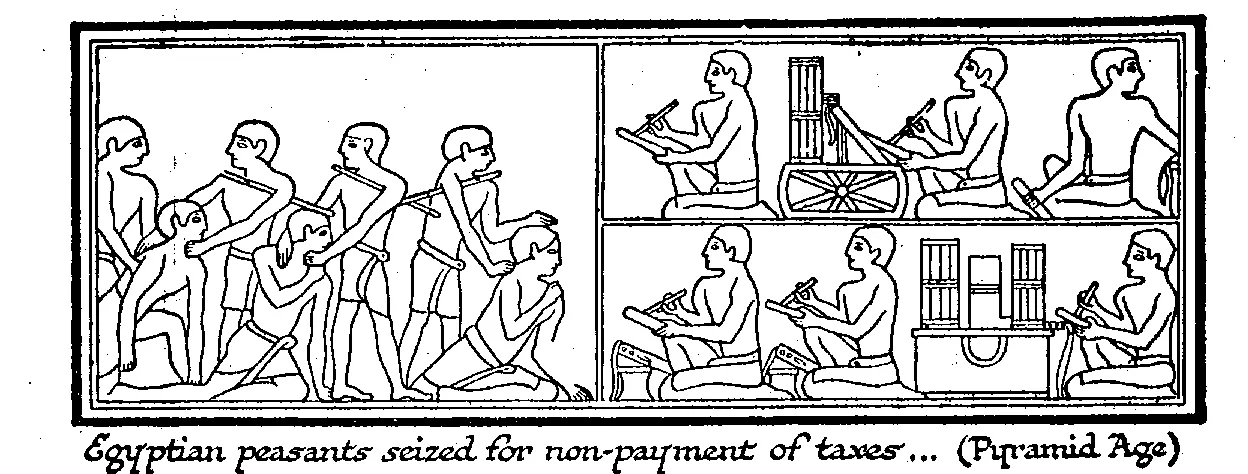
Wells egyptian peasants taxes

"Wells egyptian peasants taxes" by H. G. Wells / Source: Wikimedia Commons 

Throughout ancient history, governments used taxation to collect resources needed for building cities, supporting armies, and managing daily life. Civilizations such as Mesopotamia, Egypt, and Rome each developed unique systems for collecting taxes in response to their geography, economies, and social structures.

In ancient Mesopotamia, one of the world's earliest civilizations, taxation was already established by around 2500 BCE. City-states like Ur and Babylon required farmers to pay taxes in the form of grain or livestock. Scribes, who were trained to read and write cuneiform, kept detailed records on clay tablets. For instance, a famous tablet from Lagash (c. 2350 BCE) lists the amounts of barley owed by each household. Taxes supported temple construction, irrigation canals, and defense. The river valleys of the Tigris and Euphrates made agriculture productive, but also meant rulers needed taxes to maintain complex infrastructure.

In Egypt, tax collection was deeply connected to the annual flooding of the Nile. Every year, officials known as "scribes" measured the crops after the floodwaters receded and calculated taxes based on the harvest. Instead of coins, Egyptians often paid with grain, cattle, or labor. The Rosetta Stone (196 BCE) mentions tax exemptions given to certain priests, showing how taxes shaped social hierarchy. Pharaohs used tax revenue to build monuments like the pyramids and to support large government projects. Geography played a key role, as farmers depended on the river’s cycles and the government’s organization for survival.

In the Roman Empire, a more complex tax system developed. Citizens paid taxes in coins or goods, and provinces conquered by Rome sent tribute to the capital. Roman tax collectors, called "publicani," sometimes abused their power, leading to complaints and reforms. Evidence from ancient letters and inscriptions reveals disputes about fairness and corruption. Over time, Rome’s vast network required more sophisticated methods, including censuses and written records. Taxes supported roads, aqueducts, and the military, but could also lead to public unrest when rates were high or collection was harsh.

Although the details varied, taxation was a feature of most ancient civilizations. Tax systems reflected and reinforced the social order, with peasants and common people carrying much of the burden. Over centuries, changes in tax policies responded to shifting economic, political, and environmental challenges. Understanding ancient taxes helps historians see how governments managed resources and shaped societies.

Learning about ancient taxation connects to broader themes of authority, social order, and the development of government—topics that continue to shape our world today.

Interesting Fact: In ancient Egypt, tax collectors used ropes to measure farmers' fields and calculated taxes based on the size and quality of the land.

Comprehension quiz (8 questions)

1. What did Mesopotamian city-states collect as tax?

Grain or livestock
Gold coins
Pottery
Jewelry

2. Who kept tax records in Egypt?

Pharaohs
Scribes
Priests
Soldiers

3. What did conquered Roman provinces send to Rome?

Tribute
Weapons
Artists
Merchants

4. Why did Egyptians pay taxes in grain?

Coins were rare
Grain was valuable
Grain was easier to count
It was tradition

5. What role did geography play in taxes?

Affected crops and collection
Changed language
Influenced clothing
Determined religion

6. How did Roman tax collectors cause unrest?

Unfair collection
Building aqueducts
Hiring soldiers
Writing laws

7. Taxation was used to support armies. True or false?

True
False

8. What is a 'hierarchy'?

System of ranking people
Type of tax
Ancient tool
River flood
Who it's for

Perfect for the way you teach

Teachers
  • Build comprehension skills
  • Auto-graded quiz
  • Differentiated reading
Parents
  • Read together at home
  • Improve fluency
  • Quiet reading time
Homeschoolers
  • Reading curriculum support
  • Independent practice
  • Track Lexile growth
Topics

Reviews & Ratings

No reviews yet. Be the first to share your experience!

More reading you might love

19 more
Passage
Farming in Ancient Mesopotamia - reading educational content
Grades 5–8

Farming in Ancient Mesopotamia

ancient history · CA HSS 6.2+4

$1.50
Passage
Mesopotamian Irrigation Systems - reading educational content
Grades 5–8

Mesopotamian Irrigation Systems

ancient history · CA HSS 6.2+4

$1.50
Passage
Egypt's New Kingdom - reading educational content
Grades 5–8

Egypt's New Kingdom

ancient history · CA HSS 6.2+2

$1.50
Passage
How Mesopotamia Was Ruled - reading educational content
Grades 5–8

How Mesopotamia Was Ruled

ancient history · CA HSS 6.2+3

$1.50
Passage
Epic of Gilgamesh - reading educational content
Grades 5–8

Epic of Gilgamesh

ancient history · CA HSS 6.2+3

$1.50
Passage
Legacy of Ancient Civilizations - reading educational content
Grades 5–8

Legacy of Ancient Civilizations

ancient history · CA HSS 6.2+2

$1.50
Passage
Ancient Egyptian Afterlife - reading educational content
Grades 5–8

Ancient Egyptian Afterlife

ancient history · CA HSS 6.2+2

$1.50
Passage
Comparing Ancient Religions and Beliefs - reading educational content
Grades 5–8

Comparing Ancient Religions and Beliefs

ancient history · CA HSS 6.2+3

$1.50
Passage
Rosetta Stone Decoded - reading educational content
Grades 6–8

Rosetta Stone Decoded

ancient history · CA HSS 6.2+4

$1.50
Passage
Inventions of Ancient Mesopotamia - reading educational content
Grades 5–8

Inventions of Ancient Mesopotamia

ancient history · CA HSS 6.2+5

$1.50
Passage
Ancient Coins and Barter - reading educational content
Grades 6–8

Ancient Coins and Barter

ancient history · CA HSS 6.2+2

$1.50
Passage
Neolithic Tools - reading educational content
Grades 6–8

Neolithic Tools

ancient history · CA HSS 6.2+2

$1.50
Passage
Family Life in Ancient Civilizations - reading educational content
Grades 6–8

Family Life in Ancient Civilizations

ancient history · CA HSS 6.2+3

$1.50
Passage
Roles of Women in Ancient Societies - reading educational content
Grades 5–8

Roles of Women in Ancient Societies

ancient history · CA HSS 6.2+4

$1.50
Passage
Mesopotamia Ziggurats - reading educational content
Grades 5–8

Mesopotamia Ziggurats

ancient history · CA HSS 6.2+3

$1.50
Passage
Egyptian Social Classes - reading educational content
Grades 5–8

Egyptian Social Classes

ancient history · CA HSS 6.2+5

$1.50
Passage
King Solomon and the First Temple - reading educational content
Grades 6–8

King Solomon and the First Temple

ancient history · CA HSS 6.2+4

$1.50
Passage
King David of Israel - reading educational content
Grades 6–8

King David of Israel

ancient history · CA HSS 6.2+3

$1.50
Passage
Mesopotamian Math and Astronomy - reading educational content
Grades 5–8

Mesopotamian Math and Astronomy

ancient history · CA HSS 6.2+1

$1.50
Copyright © 2026 Workybooks. Made with ♥ in California.