Polytheism and Monotheism in Ancient Times — Reading Comprehension
Rate this
Premium Resource
Present
Present in classroom. No work saved
Assign
Classroom with student accounts, Track progress
Quick Play
No student accounts, assign with a link
Grades
5
6
7
8
PRINT+DIGITAL RESOURCE
This learning resource is available in interactive and printable formats. The interactive worksheet can be played online and assigned to students. The Printable PDF version can be downloaded and printed for completion by hand.
This passage explores the religious beliefs of ancient civilizations, focusing on the differences and similarities between polytheism and monotheism. Students will learn how societies like Mesopotamia and Egypt worshipped many gods, while ancient Israel developed the idea of one God. The text analyzes primary sources, archaeological findings, and explains the causes and effects of changing religious systems. It connects religious beliefs to geography, daily life, and social hierarchy, encouraging students to think like historians. Activities and organizers help students deepen understanding. The passage is aligned with CA HSS 6.2 and CCSS RH.6-8.1, and includes read aloud audio and Spanish translation for accessibility. Key academic vocabulary is highlighted and explained. This resource is perfect for students studying the development of ancient civilizations and their belief systems.
CONTENT PREVIEW
Expand content preview
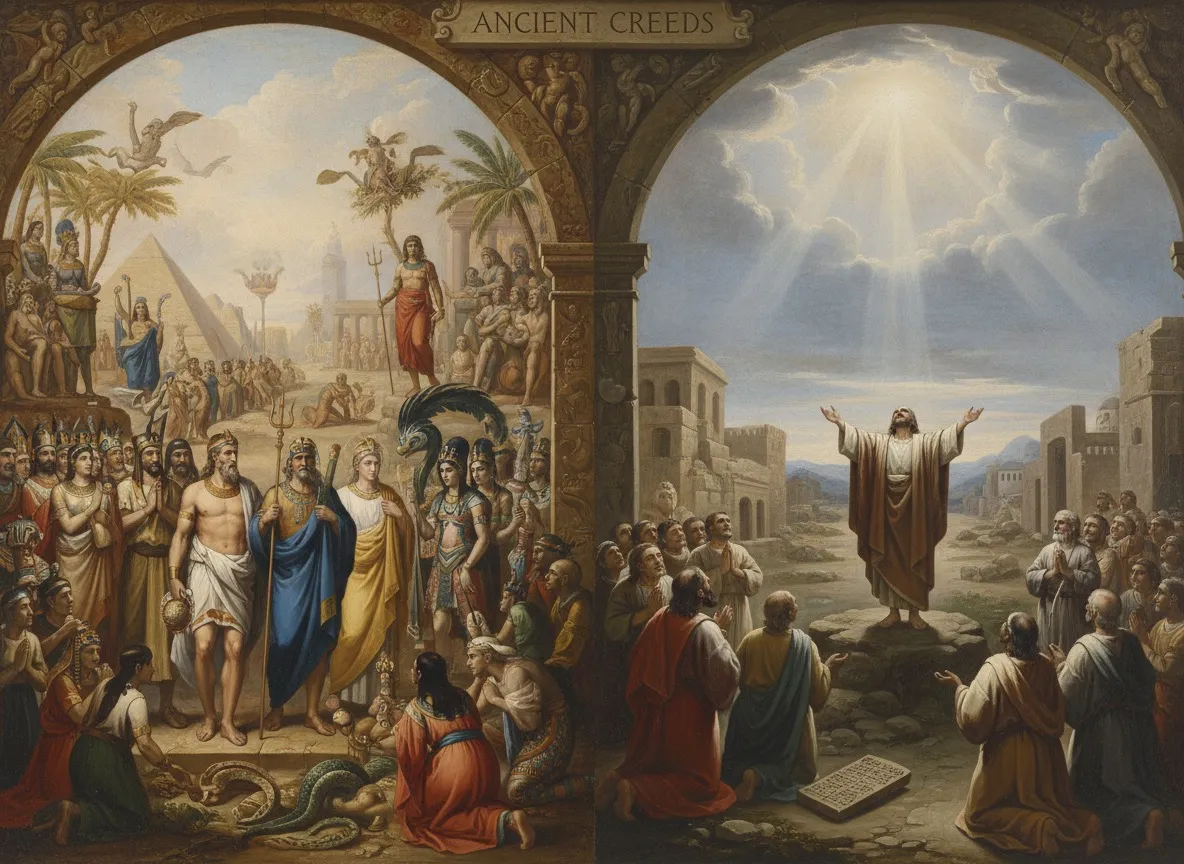
Polytheism and monotheism belief systems shaped how ancient people understood nature, society, and their place in the universe.
Polytheism and monotheism were two main types of religious beliefs in the ancient world. These belief systems shaped how ancient people understood nature, society, and their place in the universe. By studying the evidence left behind, historians can compare how different civilizations worshipped their gods and how these beliefs influenced daily life and culture.
In many early civilizations, polytheism was common. This means people believed in and worshipped many gods, each with special powers and responsibilities. For example, in ancient Mesopotamia (around 3000 BCE), the Sumerians built ziggurats—huge temples—dedicated to gods like Anu (sky god) and Enlil (god of air). Archaeologists have found cuneiform tablets describing rituals and myths about these deities. In Egypt, the pharaohs were believed to be connected to gods such as Ra, Osiris, and Isis. Wall paintings in tombs show offerings to many gods, and the famous Book of the Dead describes the journey to the afterlife, guided by multiple divine beings. These examples show that religion was deeply linked to social hierarchy and government. The king or pharaoh often claimed a special relationship with the gods, which helped justify their power.
Monotheism, or belief in a single god, developed later and in fewer places. One of the earliest examples is found in ancient Israel. According to archaeological and textual evidence, such as the Hebrew Bible (Old Testament), the Israelites began to worship one god, Yahweh, around 1200 BCE. This idea was especially important during the Babylonian Exile (6th century BCE), when Jewish leaders emphasized the worship of only one god to maintain their identity. Unlike polytheistic societies, monotheistic religions often required followers to reject other gods. This created strong community bonds but sometimes led to conflict with neighboring cultures.
The shift from polytheism to monotheism was not sudden or complete. For example, the Egyptian pharaoh Akhenaten tried to promote the worship of one god, Aten, around 1350 BCE. However, after his death, Egypt quickly returned to its traditional gods. In Mesopotamia, while local gods were important, rulers sometimes claimed their main god was superior, but they did not reject other deities. Geography played a role as well: the unpredictable floods of Mesopotamia may have encouraged beliefs in many powerful gods, while the Israelites’ experience as a smaller group led them to unite around a single deity.
These ancient belief systems have had a lasting impact. Polytheistic religions influenced art, literature, and social order in many cultures, while monotheism laid foundations for modern religions like Judaism, Christianity, and Islam. By examining how people explained the mysteries of life through religion, historians gain insight into ancient societies’ values and priorities.
Transition: Understanding ancient religious beliefs helps us see how ideas about power, community, and the supernatural shaped civilizations throughout history.
Interesting Fact: The world’s oldest known temple complex, Göbekli Tepe in modern-day Turkey, was built around 9600 BCE, but archaeologists still debate which gods, if any, were worshipped there.
Which civilization built ziggurats?
MesopotamiaAncient IsraelAncient GreeceRome
Who was the sky god in Mesopotamia?
AnuRaYahwehAten
When did Israelites begin worshipping Yahweh?
Around 1200 BCE3000 BCE6th century BCE1350 BCE
Why did Egyptian pharaohs claim ties to gods?
To justify their powerTo travel abroadTo build pyramidsTo write cuneiform
How did geography influence Mesopotamian religion?
Unpredictable floods inspired belief in many godsIt made them monotheistsIt stopped ritualsIt led to writing
What effect did monotheism have on Israelites?
Created strong community bondsEnded all conflictsStarted polytheismBuilt ziggurats
Polytheism means belief in many gods.
TrueFalse
What is a 'deity'?
A god or goddessA writing toolA buildingA river
Perfect For:
👩🏫 Teachers
• Reading comprehension practice
• Auto-graded assessments
• Literacy skill development
👨👩👧👦 Parents
• Reading practice at home
• Comprehension improvement
• Educational reading time
🏠 Homeschoolers
• Reading curriculum support
• Independent reading practice
• Progress monitoring
Reading Features:
📖
Reading Passage
Engaging fiction or nonfiction text
❓
Comprehension Quiz
Auto-graded questions
📊
Instant Feedback
Immediate results and scoring
📄
Printable Version
Download for offline reading
🔊
Read Aloud
Voice-over with word highlighting
Reviews & Ratings
No reviews yet. Be the first to share your experience!
Related Content
Ancient Civilizations and the Environment
This engaging history reading passage explores how ancient civilizations such as Mesopotamia, Egypt, and the Maya adapte...
Gender Roles in Ancient Civilizations
This engaging history reading passage explores the roles of men and women in various ancient civilizations, including Me...
Writing Prompts Ancient Civilizations
Step into the shoes of an archaeologist with this engaging worksheet focused on ancient civilizations. Students will be ...
W.5.2.A-2W.5.1.CW.5.1.D
Power and Authority in Ancient Civilizations
This passage explores the roles of men in positions of power within ancient civilizations, focusing on their authority i...
Evidence in Ancient History
This engaging history reading passage investigates how archaeologists and historians discover clues about how ancient pe...
Ancient Monarchy
This reading passage explores the concept of monarchy in ancient civilizations, focusing on the origins, structure, and ...
Ancient Theocracy
This engaging history reading passage explores the concept of theocracy in ancient civilizations, where priests and reli...
Ancient Mathematics
This passage explores the essential role of mathematics in ancient civilizations, including Mesopotamia, Egypt, Greece, ...
Ancient Canaan
This educational passage explores the land of Canaan, the historical homeland of the ancient Israelites. Students will l...
Ancient Money Barter
This passage explores the fascinating evolution from barter to the earliest coins in ancient civilizations, focusing on ...
Ancient Science and Medicine
This comprehensive reading passage explores the development of science and medicine in ancient civilizations, including ...
Ancient Literature
This passage explores the importance of ancient stories and poems from civilizations such as Greece, India, and Israel. ...
Ancient Agriculture Farming
This passage explores the transformative impact of farming on ancient societies, examining how the Neolithic Revolution ...
Ancient Writing Systems
This engaging history reading passage explores the origins and evolution of ancient writing systems, including cuneiform...
Geography of Ancient Israel
This passage explores the rich geography of Ancient Israel, focusing on how landforms, climate, and natural resources sh...
Slavery Across Civilizations
This detailed history reading passage explores the role and impact of slavery across several ancient civilizations, incl...
Social Classes in Ancient Societies
This passage explores the concept of social hierarchies in ancient civilizations, focusing on why societies such as Meso...
Social structures in Ancient World
This passage explores the organization and significance of family life in ancient societies, focusing on how extended fa...
Women in Ancient Societies
This reading passage explores the complex roles of women in the ancient world, focusing on civilizations such as Mesopot...