Social Classes in Ancient Societies — Reading Comprehension
Rate this
Premium Resource
Present
Present in classroom. No work saved
Assign
Classroom with student accounts, Track progress
Quick Play
No student accounts, assign with a link
Grades
5
6
7
8
PRINT+DIGITAL RESOURCE
This learning resource is available in interactive and printable formats. The interactive worksheet can be played online and assigned to students. The Printable PDF version can be downloaded and printed for completion by hand.
This passage explores the concept of social hierarchies in ancient civilizations, focusing on why societies such as Mesopotamia, Egypt, and India developed different social classes. Students will learn how geography, economic needs, and government structures shaped these hierarchies. The passage includes examples from archaeological sources, such as the Code of Hammurabi and Egyptian tomb paintings, and examines the roles of rulers, priests, merchants, and farmers. Activities include a reading comprehension quiz, writing prompts, graphic organizers, and a timeline to support analytical thinking. The passage is aligned with CA HSS 6.2 and CCSS RH.6-8.1 standards. Read aloud audio and a Spanish translation are provided, making this an accessible and rigorous resource for history learning. Keywords include social classes, ancient government, and social structure.
CONTENT PREVIEW
Expand content preview
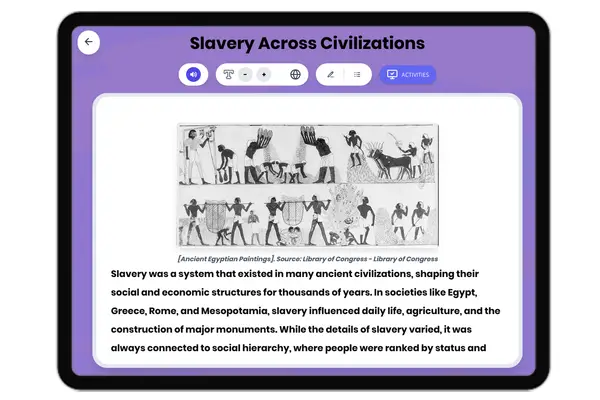
[Ancient Egyptian Paintings]. Source: Library of Congress
Throughout ancient civilizations, people were divided into groups known as social hierarchies. These hierarchies, or ranked social classes, developed for many reasons, including economic needs, geography, and government organization. By studying artifacts and written records, historians have learned how social hierarchies shaped daily life in places such as Mesopotamia, Egypt, and India.
In Mesopotamia, one of the earliest civilizations (around 3500 BCE), the social structure was organized in layers. At the top were kings, who claimed divine power and led the city-states. Below them were priests, who controlled temples and religious ceremonies, and were considered important because people believed they could communicate with the gods. Next came skilled artisans and merchants, followed by farmers and laborers. The lowest class included enslaved people, often prisoners of war. The famous Code of Hammurabi (c. 1754 BCE), an ancient legal code, described different punishments based on a person's social class, showing how laws reinforced hierarchy.
Ancient Egypt also had a well-defined social structure. Pharaohs ruled as god-kings and were at the top of society. Nobles and priests managed land and led religious rituals, while scribes kept records and helped organize government. Farmers made up most of the population and worked the land along the Nile River. The construction of the pyramids, for example, depended on this organized labor. Archaeological evidence, such as tomb paintings, shows people of higher rank drawn larger than others—a visual symbol of their importance. Over time, Egyptian society remained stable, but changes did occur, such as during periods when foreign rulers took power or when pharaohs granted freedoms to certain groups.
In India, the caste system developed as a rigid social hierarchy. People were divided into groups by birth, such as Brahmins (priests), Kshatriyas (warriors), Vaishyas (merchants), and Shudras (laborers). This structure influenced daily life, including jobs, marriage, and religious practices. Even today, the legacy of these ancient social hierarchies can be seen in some cultural traditions.
Social hierarchies helped ancient societies organize their work, distribute resources, and provide order. However, they also limited opportunities for many people and often led to inequality. By comparing the social classes of different civilizations and examining primary sources, historians can understand both the benefits and drawbacks of these systems. The study of ancient social hierarchies shows how geography, religion, and government shaped human societies and continue to influence the modern world.
Understanding why societies created social classes helps explain broader themes in history, such as power, justice, and human rights.
Interesting Fact: In ancient Egypt, scribes were so respected that they were sometimes buried with their own writing tools, symbols of their special role in society.
Who was at the top in Mesopotamia?
KingsFarmersMerchantsArtisans
What document showed social classes in law?
Code of HammurabiRosetta StoneEpic of GilgameshRigveda
Who built most of Egypt's pyramids?
Farmers and laborersPharaohsPriestsNobles
Why did social hierarchies develop?
Economic, geographic, government needsOnly for tradeFor warsBy accident
How did Egyptian art show hierarchy?
Larger figures for higher rankEveryone same sizeOnly animals drawnNo people shown
What was a result of social classes?
Organized work and inequalityNo governmentEnd of farmingEqual rights
The caste system started in Mesopotamia. True or false?
TrueFalse
What is a 'scribe'?
Person who writes recordsFarmerKingBuilder
Perfect For:
👩🏫 Teachers
• Reading comprehension practice
• Auto-graded assessments
• Literacy skill development
👨👩👧👦 Parents
• Reading practice at home
• Comprehension improvement
• Educational reading time
🏠 Homeschoolers
• Reading curriculum support
• Independent reading practice
• Progress monitoring
Reading Features:
📖
Reading Passage
Engaging fiction or nonfiction text
❓
Comprehension Quiz
Auto-graded questions
📊
Instant Feedback
Immediate results and scoring
📄
Printable Version
Download for offline reading
🔊
Read Aloud
Voice-over with word highlighting
Reviews & Ratings
No reviews yet. Be the first to share your experience!
Related Content
Ancient Civilizations and the Environment
This engaging history reading passage explores how ancient civilizations such as Mesopotamia, Egypt, and the Maya adapte...
Gender Roles in Ancient Civilizations
This engaging history reading passage explores the roles of men and women in various ancient civilizations, including Me...
Writing Prompts Ancient Civilizations
Step into the shoes of an archaeologist with this engaging worksheet focused on ancient civilizations. Students will be ...
W.5.2.A-2W.5.1.CW.5.1.D
Power and Authority in Ancient Civilizations
This passage explores the roles of men in positions of power within ancient civilizations, focusing on their authority i...
Evidence in Ancient History
This engaging history reading passage investigates how archaeologists and historians discover clues about how ancient pe...
Ancient Monarchy
This reading passage explores the concept of monarchy in ancient civilizations, focusing on the origins, structure, and ...
Ancient Theocracy
This engaging history reading passage explores the concept of theocracy in ancient civilizations, where priests and reli...
Ancient Mathematics
This passage explores the essential role of mathematics in ancient civilizations, including Mesopotamia, Egypt, Greece, ...
Ancient Canaan
This educational passage explores the land of Canaan, the historical homeland of the ancient Israelites. Students will l...
Ancient Money Barter
This passage explores the fascinating evolution from barter to the earliest coins in ancient civilizations, focusing on ...
Ancient Science and Medicine
This comprehensive reading passage explores the development of science and medicine in ancient civilizations, including ...
Ancient Literature
This passage explores the importance of ancient stories and poems from civilizations such as Greece, India, and Israel. ...
Ancient Agriculture Farming
This passage explores the transformative impact of farming on ancient societies, examining how the Neolithic Revolution ...
Ancient Writing Systems
This engaging history reading passage explores the origins and evolution of ancient writing systems, including cuneiform...
Geography of Ancient Israel
This passage explores the rich geography of Ancient Israel, focusing on how landforms, climate, and natural resources sh...
Slavery Across Civilizations
This detailed history reading passage explores the role and impact of slavery across several ancient civilizations, incl...
Social structures in Ancient World
This passage explores the organization and significance of family life in ancient societies, focusing on how extended fa...
Polytheism and Monotheism in Ancient Times
This passage explores the religious beliefs of ancient civilizations, focusing on the differences and similarities betwe...
Women in Ancient Societies
This reading passage explores the complex roles of women in the ancient world, focusing on civilizations such as Mesopot...