Ancient Civilizations and the Environment
Interactive passage with audio narration, comprehension questions, and printable PDF.
By completing this purchase you agree to our Terms of Use and Privacy Policy. Your subscription renews automatically until you cancel. You can cancel anytime from your account settings. All sales are final and non-refundable. Digital content is available for download in your account immediately upon purchase.
What's included
Ancient Civilizations and the Environment preview and details
About this printable Ancient Civilizations and the Environment reading passage (Grades 5-8)
Sample passage and quiz from Ancient Civilizations and the Environment
Reading passage and comprehension quiz preview
Human-Environment Interaction Ancient World
![[The hanging gardens of Babylon]](https://assets.workybooks.com/INTERACTIVE/media/pd--The-hanging-gardens-of-Babylon--1762603265584-381776429.webp)
Source: Library of Congress
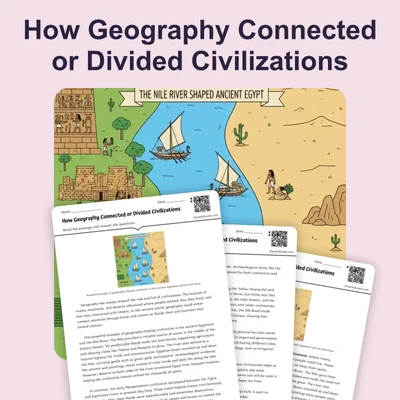
Throughout history, ancient civilizations have transformed their environments to meet their needs, shaping the landscapes in ways that still affect us today. From fertile river valleys to dense rainforests, people developed unique solutions to challenges posed by their geographic settings.
One key example is Mesopotamia, located between the Tigris and Euphrates Rivers around 3500 BCE. Early city-states like Uruk built complex irrigation systems to control flooding and supply water for crops. Archaeological evidence shows massive canals and levees, revealing advanced engineering. These projects allowed farmers to produce surplus food and support urban growth. However, over time, intensive farming led to salinization—the buildup of salt in the soil—which reduced crop yields and contributed to the decline of some cities.
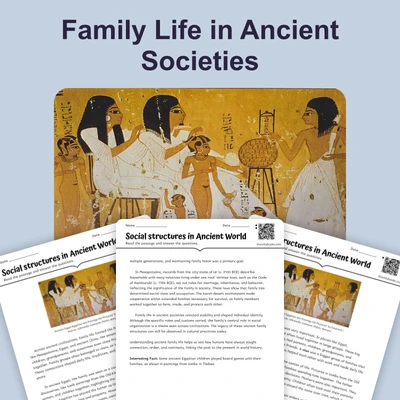
In ancient Egypt (c. 3100 BCE), the Nile River was central to civilization. Egyptians relied on annual floods to fertilize the land, but they also constructed basins and channels to store and distribute water. Hieroglyphic records and remains of ancient dams show how Egyptians adapted to changing flood patterns. These innovations improved food security, but later, as populations grew, pressure on the land increased, leading to overuse and some soil erosion.
Farther away, the ancient Maya (c. 250–900 CE) built cities in the rainforests of Mesoamerica. To sustain large populations, they cleared trees for farming and constructed reservoirs to store rainwater during dry seasons. Archaeologists have uncovered evidence of widespread deforestation and soil depletion from ancient pollen samples and city ruins. While these changes allowed for urban growth, deforestation also made the land less able to recover from drought, contributing to the Maya civilization’s eventual decline.
These examples show that ancient peoples altered their environments with both positive and negative consequences. While creative solutions supported agriculture and city life, overuse of resources sometimes led to environmental challenges or collapse. Understanding how geography, technology, and society interacted in the past helps us see how people’s choices shaped history.
The ways ancient civilizations managed their environments connect to broader themes in world history, such as adaptation, innovation, and sustainability.
Interesting Fact: The Hanging Gardens of Babylon, one of the Seven Wonders of the Ancient World, were said to be an early example of advanced irrigation—though historians still debate if they truly existed!
Comprehension quiz (8 questions)
1. Which rivers bordered Mesopotamia?
2. What system helped Egyptians store water?
3. Which civilization cleared rainforests?
4. How did irrigation impact Mesopotamia?
5. What was a negative effect in Maya cities?
6. Why did Egyptians build water channels?
7. Ancient people never changed their environment. True or false?
8. What does 'salinization' mean?
Perfect for the way you teach
- Build comprehension skills
- Auto-graded quiz
- Differentiated reading
- Read together at home
- Improve fluency
- Quiet reading time
- Reading curriculum support
- Independent practice
- Track Lexile growth