Gender Roles in Ancient Civilizations — Reading Comprehension
Rate this
Premium Resource
Present
Present in classroom. No work saved
Assign
Classroom with student accounts, Track progress
Quick Play
No student accounts, assign with a link
Grades
6
7
8
PRINT+DIGITAL RESOURCE
This learning resource is available in interactive and printable formats. The interactive worksheet can be played online and assigned to students. The Printable PDF version can be downloaded and printed for completion by hand.
This engaging history reading passage explores the roles of men and women in various ancient civilizations, including Mesopotamia, Egypt, Greece, and China. Students will examine how gender shaped expectations, responsibilities, and opportunities in daily life. The passage provides evidence from archaeological and primary sources, discusses causes and effects, and highlights the impact of geography and social hierarchy. Activities include a multiple-choice quiz, writing prompts, and graphic organizers to promote analysis and historical thinking. The resource is aligned with CA HSS 6.2 and RH.6-8.1 standards and includes read aloud audio and a full Spanish translation for accessibility. This passage is ideal for deepening students' understanding of world history and the complexities of ancient societies.
CONTENT PREVIEW
Expand content preview
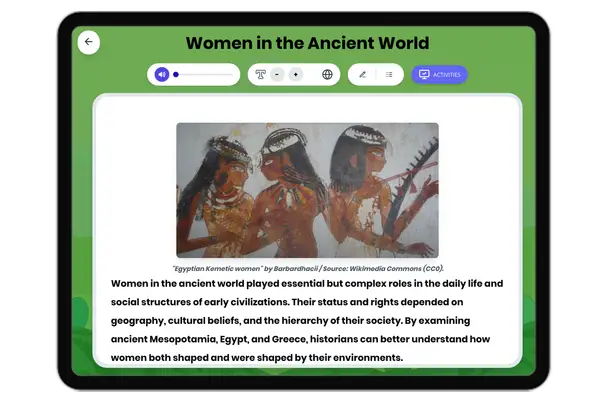
"Egyptian Kemetic women" by Barbardhacii / Source: Wikimedia Commons (CC0).
Throughout ancient history, men and women held different roles, expectations, and rights within their societies. These roles were shaped by geography, religion, and social hierarchy. Examining the experiences of men and women in civilizations such as Mesopotamia, Egypt, Greece, and China reveals both similarities and differences in daily life and status.
In Mesopotamia, one of the earliest civilizations (c. 3500 BCE), men typically worked as farmers, soldiers, or scribes, while women managed households and raised children. The Code of Hammurabi, a famous set of laws from Babylon around 1754 BCE, reflects these expectations. For example, it outlined strict rules for marriage and property, usually giving men more authority. However, archaeological evidence shows some women owned property and ran businesses, demonstrating that roles were not always fixed. In ancient Egypt, women could inherit land, serve as priestesses, and sometimes rule as pharaoh, such as Hatshepsut (ruled c. 1478–1458 BCE). Yet, most political and religious leaders were men, and the family remained the center of social life.
Ancient Greece displayed both continuity and change in gender roles. In Athens, men dominated public life, voting in assemblies and participating in the arts, while women were largely confined to the home and rarely received formal education. However, in Sparta, women enjoyed more freedom, including owning land and participating in physical training. Primary sources, like the works of historian Herodotus, describe Spartan women as outspoken and influential. Despite some differences, most Greek city-states expected women to focus on family and household duties, while men led military and civic affairs.
In ancient China, Confucian philosophy deeply influenced gender roles, stressing respect for elders and clear social order. Men were seen as heads of the family and held government positions, while women's main responsibilities were within the home. The practice of foot binding (starting around the 10th century CE but rooted in earlier ideas about femininity) symbolized the restrictions placed on women. Yet, some women became respected poets, artists, or even rulers, showing that cultural expectations could be challenged.
These patterns reveal cause-and-effect relationships: as societies became more complex, roles were formalized in laws and traditions. Geography also played a part; for example, Egypt's stable environment may have allowed women more rights than in war-torn regions. Over time, some roles changed, but many expectations about men and women continued for centuries, shaping social structure and daily life.
Understanding the roles of men and women in ancient civilizations helps us analyze how traditions, power, and identity were constructed. These patterns continue to influence societies today and are key to studying world history.
Interesting Fact: In ancient Sparta, women could own and inherit property, a rare right in the ancient world.
When was the Code of Hammurabi written?
c. 1754 BCEc. 3500 BCEc. 800 BCEc. 1478 BCE
Who could become pharaoh in ancient Egypt?
Only menOnly womenBoth men and womenNo one
What was rare for women in Sparta?
Owning propertyWorking as soldiersStaying at homeBecoming scribes
Why did geography matter for women's rights?
It changed laws and traditionsIt made people moveIt caused warsIt stopped farming
How did Confucianism affect gender roles in China?
Men led family and governmentWomen led armiesWomen attended schoolsMen did housework
What does 'structure' mean in the passage?
How something is organizedA buildingA type of foodA famous law
Women could own property in Sparta. True or false?
TrueFalse
What is a 'primary source'?
Original evidence from the pastA modern textbookA future predictionA fictional story
Perfect For:
👩🏫 Teachers
• Reading comprehension practice
• Auto-graded assessments
• Literacy skill development
👨👩👧👦 Parents
• Reading practice at home
• Comprehension improvement
• Educational reading time
🏠 Homeschoolers
• Reading curriculum support
• Independent reading practice
• Progress monitoring
Reading Features:
📖
Reading Passage
Engaging fiction or nonfiction text
❓
Comprehension Quiz
Auto-graded questions
📊
Instant Feedback
Immediate results and scoring
📄
Printable Version
Download for offline reading
🔊
Read Aloud
Voice-over with word highlighting
Reviews & Ratings
No reviews yet. Be the first to share your experience!
Related Content
Ancient Civilizations and the Environment
This engaging history reading passage explores how ancient civilizations such as Mesopotamia, Egypt, and the Maya adapte...
Writing Prompts Ancient Civilizations
Step into the shoes of an archaeologist with this engaging worksheet focused on ancient civilizations. Students will be ...
W.5.2.A-2W.5.1.CW.5.1.D
Power and Authority in Ancient Civilizations
This passage explores the roles of men in positions of power within ancient civilizations, focusing on their authority i...
Ancient Monarchy
This reading passage explores the concept of monarchy in ancient civilizations, focusing on the origins, structure, and ...
Evidence in Ancient History
This engaging history reading passage investigates how archaeologists and historians discover clues about how ancient pe...
Ancient Theocracy
This engaging history reading passage explores the concept of theocracy in ancient civilizations, where priests and reli...
Ancient Mathematics
This passage explores the essential role of mathematics in ancient civilizations, including Mesopotamia, Egypt, Greece, ...
Ancient Canaan
This educational passage explores the land of Canaan, the historical homeland of the ancient Israelites. Students will l...
Ancient Money Barter
This passage explores the fascinating evolution from barter to the earliest coins in ancient civilizations, focusing on ...
Ancient Science and Medicine
This comprehensive reading passage explores the development of science and medicine in ancient civilizations, including ...
Ancient Literature
This passage explores the importance of ancient stories and poems from civilizations such as Greece, India, and Israel. ...
Ancient Agriculture Farming
This passage explores the transformative impact of farming on ancient societies, examining how the Neolithic Revolution ...
Ancient Writing Systems
This engaging history reading passage explores the origins and evolution of ancient writing systems, including cuneiform...
Geography of Ancient Israel
This passage explores the rich geography of Ancient Israel, focusing on how landforms, climate, and natural resources sh...
Slavery Across Civilizations
This detailed history reading passage explores the role and impact of slavery across several ancient civilizations, incl...
Social Classes in Ancient Societies
This passage explores the concept of social hierarchies in ancient civilizations, focusing on why societies such as Meso...
Social structures in Ancient World
This passage explores the organization and significance of family life in ancient societies, focusing on how extended fa...
Polytheism and Monotheism in Ancient Times
This passage explores the religious beliefs of ancient civilizations, focusing on the differences and similarities betwe...
Women in Ancient Societies
This reading passage explores the complex roles of women in the ancient world, focusing on civilizations such as Mesopot...