Slavery Across Civilizations — Reading Comprehension
Rate this
Premium Resource
Present
Present in classroom. No work saved
Assign
Classroom with student accounts, Track progress
Quick Play
No student accounts, assign with a link
Grades
5
6
7
8
PRINT+DIGITAL RESOURCE
This learning resource is available in interactive and printable formats. The interactive worksheet can be played online and assigned to students. The Printable PDF version can be downloaded and printed for completion by hand.
This detailed history reading passage explores the role and impact of slavery across several ancient civilizations, including Egypt, Greece, Rome, and Mesopotamia. Students will examine how slavery shaped social hierarchies, economies, and daily life using specific archaeological and primary source evidence. The passage is aligned to CA HSS 6.2, 6.7 and Common Core ELA standards CCSS RI.6-8.1, providing rigorous content with academic vocabulary, read aloud audio, and a full Spanish translation. Activities include a multiple-choice quiz, writing prompts, and graphic organizers focusing on cause and effect, change over time, and comparisons among civilizations. This lesson helps students analyze the complexities of ancient societies while building critical ELA skills. The resource is ideal for world history and ancient civilizations units, supporting diverse learners with a differentiated version and glossary.
CONTENT PREVIEW
Expand content preview
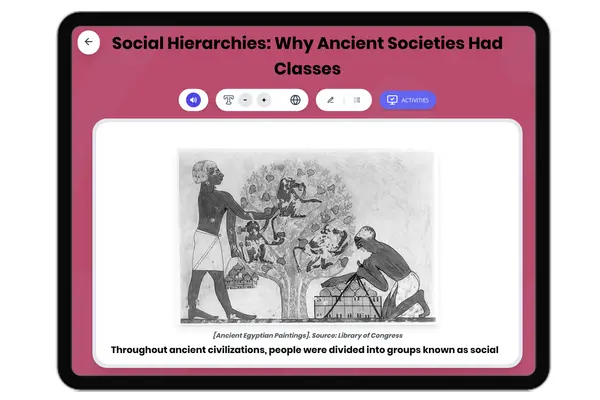
[Ancient Egyptian Paintings]. Source: Library of Congress - Library of Congress
Slavery was a system that existed in many ancient civilizations, shaping their social and economic structures for thousands of years. In societies like Egypt, Greece, Rome, and Mesopotamia, slavery influenced daily life, agriculture, and the construction of major monuments. While the details of slavery varied, it was always connected to social hierarchy, where people were ranked by status and power.
In ancient Egypt, slavery began as early as 3000 BCE. Archaeological evidence, such as wall paintings from the tomb of Rekhmire, shows enslaved workers transporting stones for temple construction. Most slaves in Egypt were prisoners of war or people who owed debts. The pharaoh used slave labor for building projects, including the great pyramids. However, Egyptian slaves sometimes had rights, like owning property or marrying free people, depending on their role.
In Mesopotamia, the earliest written laws, such as the Code of Hammurabi (around 1754 BCE), regulated slavery. Slaves could be bought, sold, or inherited. Some were captured during wars, while others became enslaved due to unpaid debts. Records from city-states like Babylon describe slaves working in households, farming, or building canals. Despite their low status, some Mesopotamian slaves could eventually buy their freedom, a process called manumission.
Ancient Greece and Rome developed slavery into a central part of their societies. In Athens, as many as one-third of the population were slaves. Greek slaves worked in homes, silver mines, and as tutors. In Sparta, a group called helots were forced to farm for the ruling class. Roman slavery reached its peak between the 2nd century BCE and 4th century CE, with millions enslaved across the empire. Some Roman slaves were prisoners from conquered lands, while others were born into slavery. Roman slaves performed many tasks—from hard labor in fields and quarries to skilled work as doctors or teachers. Ancient authors like Pliny the Elder described the lives of slaves in detail, noting both harsh punishments and rare opportunities for advancement.
Over time, the practice of slavery continued but also changed. Some societies, such as Rome, eventually allowed slaves to earn or be granted freedom. The reasons for slavery often depended on geography, warfare, and economics. Slavery affected not only the enslaved but also the free population, shaping attitudes about labor, human rights, and social mobility.
Understanding slavery across civilizations helps historians see both the similarities and differences in ancient societies. It also reveals how deeply social structures and geography influenced people's lives.
Interesting Fact: The Code of Hammurabi included specific punishments for harming slaves, showing that even ancient laws recognized their importance to society.