Animal Claws: Tools for Survival — Reading Comprehension
Rate this
Premium Resource
Present
Present in classroom. No work saved
Assign
Classroom with student accounts, Track progress
Quick Play
No student accounts, assign with a link
Grades
6
PRINT+DIGITAL RESOURCE
This learning resource is available in interactive and printable formats. The interactive worksheet can be played online and assigned to students. The Printable PDF version can be downloaded and printed for completion by hand.
This educational content features an engaging reading passage, "Animal Claws: Tools for Survival," designed for Grade 3 students. It explores how various animals utilize their claws as essential external structures for defense and obtaining resources, aligning with NGSS LS1.A: Structure and Function. The passage, enriched with SEO keywords like 'animal claws,' 'survival,' 'defense,' and 'animal adaptations,' uses simple language to explain complex biological concepts. It is accompanied by comprehension questions, including literal, inferential, and application-based tasks, a vocabulary glossary, and short answer questions to deepen understanding. All components are audio-integrated for enhanced learning accessibility.
CONTENT PREVIEW
Expand content preview
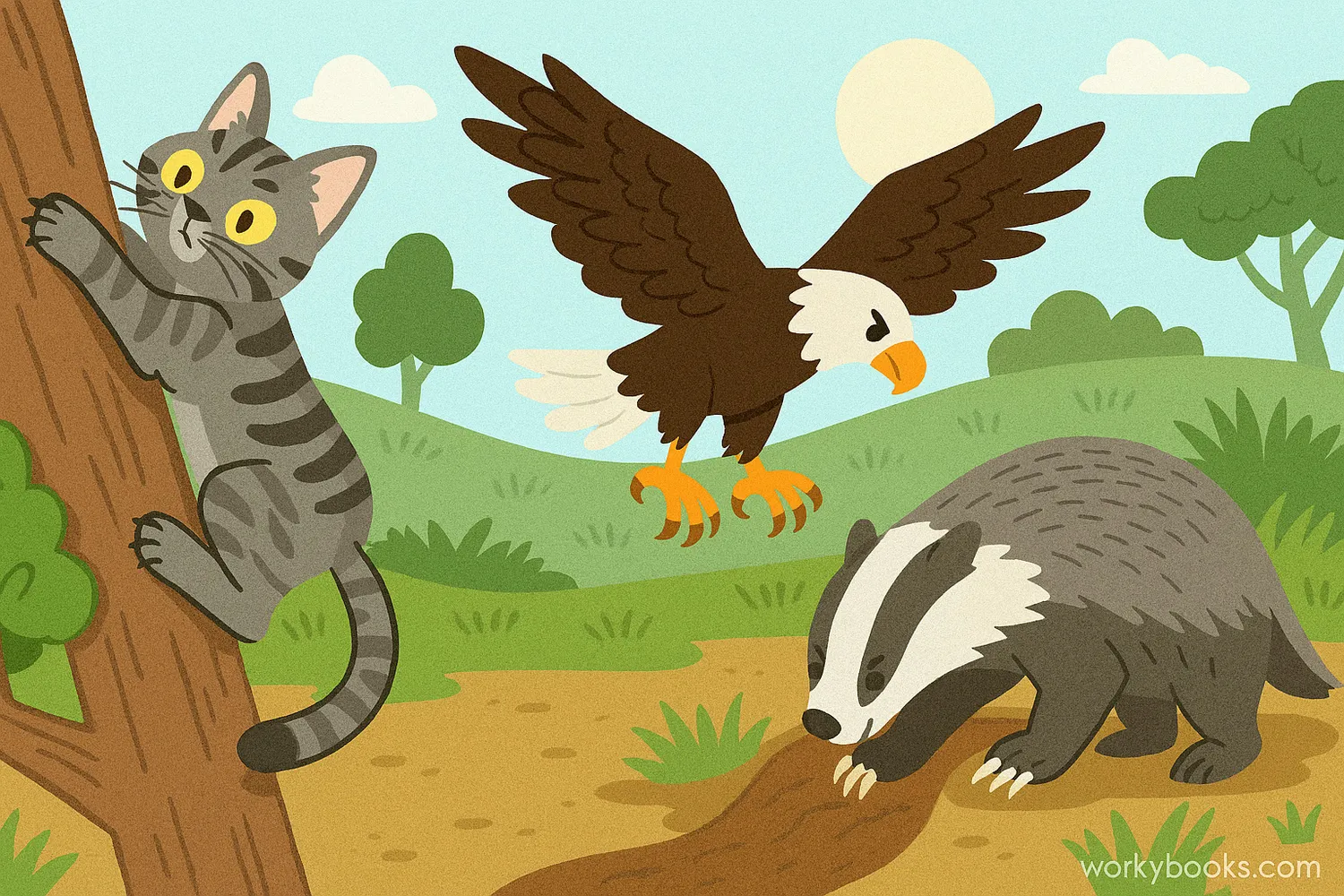
Cat climbing, eagle snatching fish, badger digging—all using claws as nature’s tools.
What Are Claws?
Many animals have special body parts called claws. Claws are hard, curved structures that grow from the toes of animals. They are made of keratin, which is the same tough material found in our fingernails.
Which Animals Have Claws?
Mammals like cats, dogs, bears, and sloths all have claws. Birds such as eagles, owls, and chickens have sharp claws called talons. Reptiles, including lizards and turtles, and even some amphibians, also have claws. Each type of animal has claws that help them survive in different ways.
Types of Claws and Their Jobs
Claws come in many shapes and sizes. Sharp, curved claws help animals climb trees or catch prey. Flat and wide claws are perfect for digging. Some animals, like cats, have retractable claws, which means they can pull them in and hide them. Others, like dogs, have claws that stay out all the time.
Claws are like built-in tools that animals carry everywhere! Animals use claws for hunting, defending themselves, digging, climbing, grooming, and gripping things.
Claws, Hooves, and Nails
Claws, hooves, and nails are all made of keratin, but they have different shapes for different jobs. Hooves are hard and flat for running, while nails are flat and thin for picking things up. Claws are curved and sharp for gripping and tearing.
How Claws Grow
Claws grow all the time, just like our nails do. They get worn down when animals walk, hunt, or climb, so they usually do not get too long.
Why Are Claws Important?
Claws are an important adaptation. They help animals survive by allowing them to catch food, escape danger, and care for themselves.
Interesting Fact: Sloth claws can grow up to 4 inches long, and an eagle’s talons can grip with 400 pounds of pressure!
What are claws made of?
KeratinBoneSkinFeathers
Which animal has retractable claws?
CatDogBearChicken
What are bird claws called?
TalonsHoovesNailsHorns
Why do animals use claws?
For huntingFor flyingFor swimmingFor sleeping
Which is NOT true about claws?
Claws are used for climbingClaws help animals surviveClaws are always flatClaws can be sharp or wide
What happens when animals use their claws?
Claws wear downClaws fall offClaws turn blueClaws become feathers
Claws help animals survive. True or false?
TrueFalse
What does 'adaptation' mean?
A special feature to surviveA type of animalA sharp clawA food source
Perfect For:
👩🏫 Teachers
• Reading comprehension practice
• Auto-graded assessments
• Literacy skill development
👨👩👧👦 Parents
• Reading practice at home
• Comprehension improvement
• Educational reading time
🏠 Homeschoolers
• Reading curriculum support
• Independent reading practice
• Progress monitoring
Reading Features:
📖
Reading Passage
Engaging fiction or nonfiction text
❓
Comprehension Quiz
Auto-graded questions
📊
Instant Feedback
Immediate results and scoring
📄
Printable Version
Download for offline reading
🔊
Read Aloud
Voice-over with word highlighting
Reviews & Ratings
No reviews yet. Be the first to share your experience!
Related Content
The Nature of Life Science
This passage, aligned with NGSS MS-LS1-1, introduces students in grades 6-8 to the foundational concepts of life science...
MS-LS1-1
Science Vocabulary
This worksheet on domain-specific words will help students learn some science vocabulary. Students will be asked to matc...
L.3.6L.3.4.A
The Science of Hibernation
This educational module, featuring an audio-integrated reading passage titled 'The Science of Hibernation,' is designed ...
Simple Machines Science Report
This science writing task requires students to clearly explain how three simple machines work using precise domain-speci...
W.5.4
Adaptation
This engaging middle school science passage explores adaptation, focusing on how inherited traits enable organisms to su...
MS-LS4-4MS-LS4-6
Desert Rain Frog Behavioral Adaptations
Dive into the fascinating world of the Desert Rain Frog and discover its incredible unique adaptations for survival in a...
Animal Adaptations Word Sort
This engaging word sort activity helps students understand the difference between physical and behavioral adaptations in...
Herbivore Adaptations
This engaging reading passage, integrated with audio, delves into the fascinating world of herbivore adaptations. Studen...
Ocean Animal Adaptations
Students will read a passage that provides information about various adaptations that marine animals have developed to t...
W.4.9.B
Nocturnal Adaptations of the Strange Aye-Aye
This engaging reading passage, integrated with audio, takes grade 5 students on a journey to discover the fascinating no...
Early Life Forms and Their Adaptations
This educational passage focuses on early life forms and their basic adaptations, supporting NGSS standard 3-LS4-2 for e...
RI.3.3RI.4.3RI.5.33-LS4-2
Binturong Adaptations
This engaging, audio-integrated reading passage, 'Binturong Adaptations,' for Grade 6 students delves into the fascinati...
Barnacle Biology and Adaptations
Dive into the intriguing world of barnacles with this engaging Grade 6 reading passage. Students will learn about these ...
Whale Blubber: Function and Adaptation
This engaging, audio-integrated reading passage, 'Whale Blubber Function and Adaptation,' introduces young learners to t...
Mountain Animal Adaptations
This reading comprehension worksheet focuses on the topic of animal adaptations for survival in mountainous environments...
W.4.9.B
Amur Leopard Adaptations
This engaging, audio-integrated reading passage, 'Amur Leopard Adaptations,' is designed for Grade 6 science students. I...
Climate Zone Adaptations Word Sort
This word sort activity examines how plants and animals adapt to different climate conditions. Students sort 12 differen...
Plant Adaptations for Survival
This NGSS-aligned word sort activity, suitable for kindergarten, focuses on plant survival adaptations, helping students...
K-LS1-1
The Pumpkin Life Cycle
This informational worksheet explores the pumpkin lifecycle, guiding students through procedural steps in a scientific t...
RI.2.3RI.2.10
What Is Earth Science?
This engaging middle school science passage introduces students to the field of Earth science, aligning with NGSS standa...