Animals That Hibernate
Interactive passage with audio narration, comprehension questions, and printable PDF.
By completing this purchase you agree to our Terms of Use and Privacy Policy. Your subscription renews automatically until you cancel. You can cancel anytime from your account settings. All sales are final and non-refundable. Digital content is available for download in your account immediately upon purchase.
What's included
Animals That Hibernate preview and details
About this printable Animals That Hibernate science reading passage, NGSS-aligned (Grade 6)
Sample passage and quiz from Animals That Hibernate
Reading passage and comprehension quiz preview
Animals That Hibernate
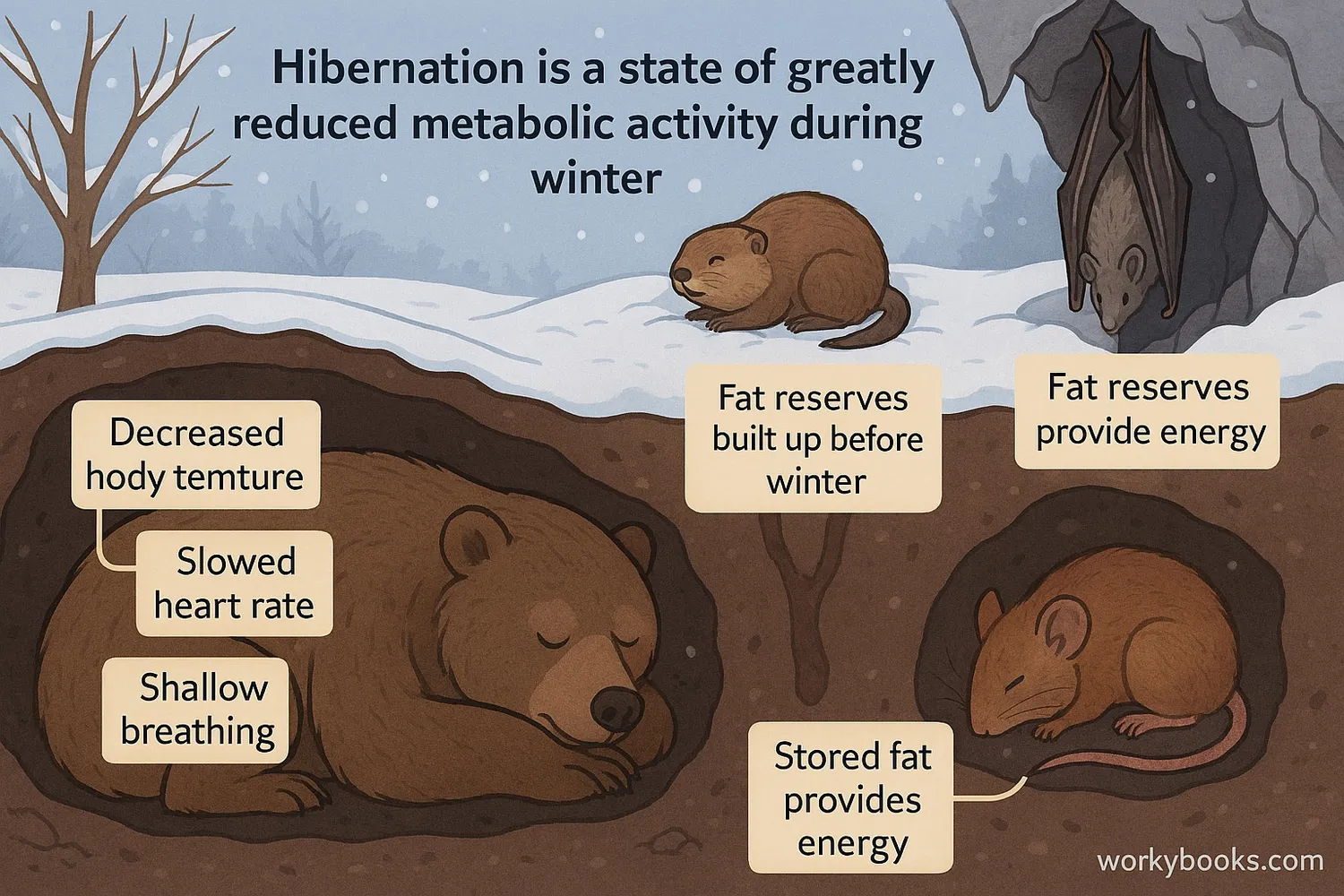
Imagine waking up to a world covered in snow, food is scarce, and the air bites with a chilling cold. How do some animals survive these harsh conditions? Many animals have an amazing strategy called hibernation. This isn't just a long sleep; it's a special survival tactic that allows animals to conserve energy when food is hard to find and temperatures drop dramatically. During hibernation, an animal's body undergoes significant changes to stay alive.
One of the most important changes is a decrease in metabolism, which is the chemical process that keeps an organism alive. An animal's heart rate slows down, its breathing becomes very shallow, and its body temperature drops significantly, sometimes even to just above freezing. This slowed-down state is called torpor. By reducing their metabolic rate, hibernators use much less energy than they would if they stayed active. Think of it like a computer going into 'sleep mode' to save battery life.
Before winter arrives, animals that hibernate prepare by eating a lot and building up fat reserves. These fat reserves act as fuel, providing the energy they need to survive for weeks or even months without eating. Bears are well-known hibernators, but many other animals, like groundhogs, bats, and some species of mice, also hibernate. Each species has unique adaptations – special features or behaviors – that help them hibernate successfully. For example, some bats can lower their body temperature close to the air temperature of their cave, making them incredibly efficient energy savers.
Genetic variations within a population play a crucial role in hibernation. Some individual animals might have genetic traits that allow them to store more fat efficiently, or to enter a deeper state of torpor. These variations can increase an individual's probability of surviving a harsh winter. If an animal survives, it's more likely to reproduce and pass on those beneficial traits to its offspring. This is how natural selection works; traits that help an organism survive in its environment become more common over time. Therefore, the ability to hibernate is a powerful survival mechanism against the cold and scarcity of food in winter environments, demonstrating how genetic traits enhance an animal's ability to thrive.
Interesting Fact: Some amphibians and reptiles also enter a similar state of inactivity called brumation during cold periods, though it's not exactly the same as mammalian hibernation.
Comprehension quiz (10 questions)
1. What is the primary purpose of hibernation?
2. True or False: Hibernation is just a normal long sleep.
3. Which of these is NOT an example of a hibernator mentioned?
4. What happens to an animal's metabolism during hibernation?
5. Why do animals build up fat reserves before winter?
6. How do genetic variations affect survival in hibernating animals?
7. What is 'torpor' in the context of hibernation?
8. Which scenario best describes natural selection?
9. A bat that can lower its body temperature more than others would likely have what advantage?
10. What word means 'special features or behaviors that help an animal'?
Perfect for the way you teach
- Build comprehension skills
- Auto-graded quiz
- Differentiated reading
- Read together at home
- Improve fluency
- Quiet reading time
- Reading curriculum support
- Independent practice
- Track Lexile growth