Animals With Webbed Feet
Interactive passage with audio narration, comprehension questions, and printable PDF.
By completing this purchase you agree to our Terms of Use and Privacy Policy. Your subscription renews automatically until you cancel. You can cancel anytime from your account settings. All sales are final and non-refundable. Digital content is available for download in your account immediately upon purchase.
What's included
Animals With Webbed Feet preview and details
About this printable Animals With Webbed Feet science reading passage, NGSS-aligned (Grade 6)
Sample passage and quiz from Animals With Webbed Feet
Reading passage and comprehension quiz preview
Animals With Webbed Feet
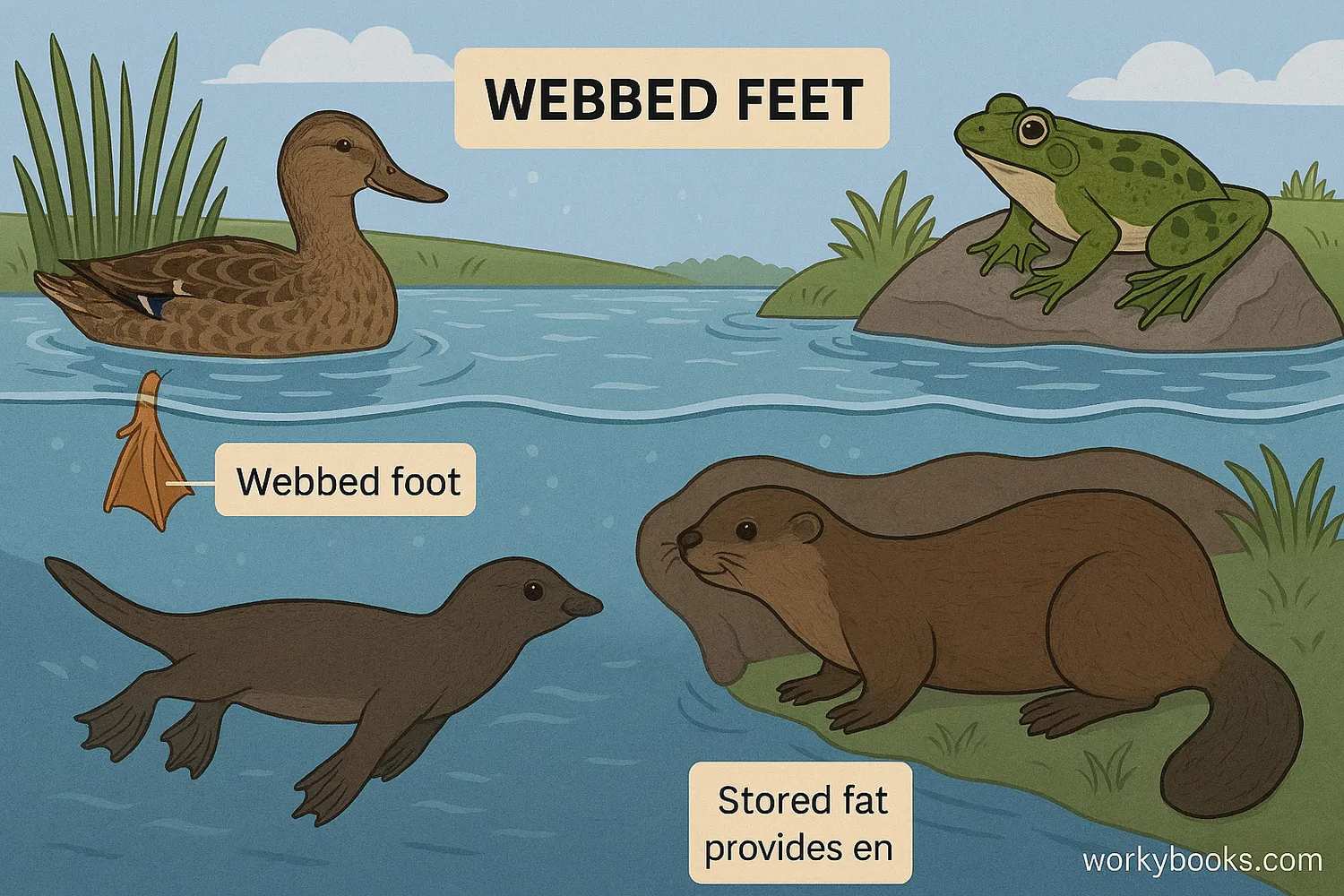
Imagine trying to move quickly through water without the right tools. It would be tough, wouldn't it? For many animals, the ability to navigate aquatic environments is essential for finding food, escaping predators, and building nests. One incredible adaptation that helps some animals thrive in water is having webbed feet.
What exactly are webbed feet? They are feet where the skin stretches between the toes, much like the webbing of a glove between your fingers. This creates a larger surface area than individual toes alone. Think of it like a natural paddle! This unique trait is a fantastic example of a genetic variation that has developed over millions of years, giving these animals a significant advantage.
Ducks are perhaps the most famous example of animals with webbed feet. When a duck pushes its foot backward in the water, the web spreads out, pushing a large amount of water. This creates more propulsion, making the duck an efficient swimmer. When the duck brings its foot forward, the web folds, reducing drag. This clever design allows them to glide effortlessly through ponds and rivers, catching fish, insects, and plants. Many other waterfowl, like geese and swans, also share this amazing feature, helping them survive in their wetland habitat.
But it's not just birds! Animals like beavers and otters, which are mammals, also have webbed feet. Beavers use their webbed hind feet like powerful rudders and paddles to swim through water while constructing their dams and lodges. Otters, known for their playful nature, use their webbed feet to chase fish and move with remarkable agility underwater. Even some amphibians, like certain species of frogs, have webbed feet to help them swim and even jump more effectively in moist environments. The ability to swim efficiently increases their probability of catching food and escaping danger.
Having webbed feet is a perfect example of how specific physical characteristics, or traits, can increase an individual's chances of surviving and reproducing in a particular environment. Without this adaptation, many of these animals would struggle to find food or avoid predators in aquatic settings, showing how evolution shapes life to fit its surroundings.
Interesting Fact: The largest animal with webbed feet is the polar bear, whose large, partially webbed paws act like snowshoes on land and paddles in the water!
Comprehension quiz (10 questions)
1. What is the primary function of webbed feet?
2. Which animal is NOT mentioned as having webbed feet in the passage?
3. Why do webbed feet create a larger surface area?
4. How do webbed feet help ducks move efficiently?
5. What kind of environment do webbed feet mostly help animals survive in?
6. How does having webbed feet increase an animal's probability of survival?
7. Webbed feet are an example of an adaptation.
8. Why is the ability to fold the web important?
9. A beaver's webbed feet act like what in water?
10. What is the meaning of 'adaptation' as used in the passage?
Perfect for the way you teach
- Build comprehension skills
- Auto-graded quiz
- Differentiated reading
- Read together at home
- Improve fluency
- Quiet reading time
- Reading curriculum support
- Independent practice
- Track Lexile growth