Apollo 11 Moon Rocks
Interactive passage with audio narration, comprehension questions, and printable PDF.
By completing this purchase you agree to our Terms of Use and Privacy Policy. Your subscription renews automatically until you cancel. You can cancel anytime from your account settings. All sales are final and non-refundable. Digital content is available for download in your account immediately upon purchase.
What's included
Apollo 11 Moon Rocks preview and details
About this printable Apollo 11 Moon Rocks reading passage (Grades 5-8)
Sample passage and quiz from Apollo 11 Moon Rocks
Reading passage and comprehension quiz preview
Apollo 11 Moon Rocks
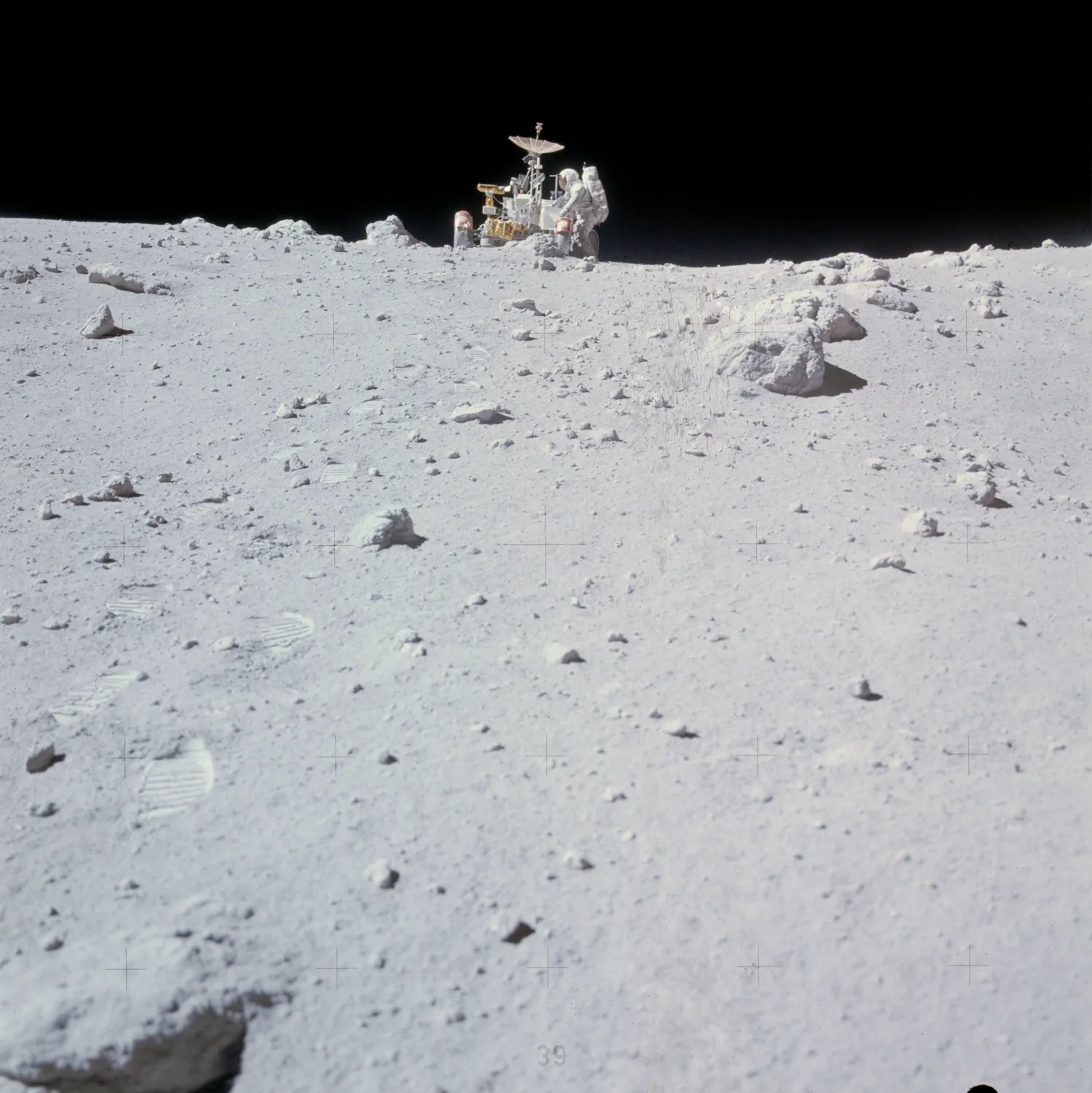
"Astronaut Charles Duke works at front of Lunar Roving Vehicle" by NASA Johnson Space Center / Wikimedia Commons (Public domain).
The Apollo missions to the Moon between 1969 and 1972 resulted in the collection of approximately 47 pounds (21 kilograms) of lunar rocks, soil, and dust. These lunar samples became some of the most valuable scientific materials ever studied. Before astronauts brought these rocks back to Earth, scientists could only guess about the Moon’s composition and history by observing it from afar. The return of these physical samples gave researchers a unique opportunity to answer important questions about our closest celestial neighbor.
Scientists examined the mineral content, age, and structure of the lunar rocks using advanced laboratory techniques. For example, radiometric dating showed that some Moon rocks are over 4 billion years old, making them older than most rocks on Earth. The Moon’s rocks are mostly made of basalt and anorthosite, which are also found on Earth, but in different proportions. This evidence suggests that the Moon and Earth may have formed from the same material after a giant impact, a theory supported by many geologists. The lack of water and organic material in lunar samples also provides clues about the Moon’s geological history.
Primary sources, such as astronaut logs and photographs, combined with the study of lunar rocks, allowed scientists to reconstruct the Moon’s past. For example, the presence of tiny glass beads in the soil revealed that volcanic eruptions once occurred on the Moon. Another discovery was that the upper layer of lunar soil, called regolith, is rich in small fragments produced by millions of years of meteorite impacts. The differences in rock types collected from various landing sites, such as Mare Tranquillitatis and the Lunar Highlands, helped researchers map the Moon’s surface and understand its diversity.
The study of lunar samples had a lasting impact on science. It led to new hypotheses about the origin and evolution of the Moon and Earth. The findings also inspired further space exploration, including robotic missions and plans for future lunar bases. By analyzing rocks collected decades ago, scientists continue to make new discoveries that change our understanding of the solar system.
The analysis of Moon rocks demonstrates how collecting evidence and using primary sources are essential skills in world history and science. These discoveries connect to broader themes of exploration, scientific inquiry, and humanity’s ongoing quest to understand the universe.
Interesting Fact: Some small pieces of the Apollo lunar rocks have been displayed in museums and even given as goodwill gifts to countries around the world.
Comprehension quiz (8 questions)
1. How many pounds of lunar samples were collected?
2. Which missions collected Moon rocks?
3. What rock types were mainly found on the Moon?
4. Why are lunar samples valuable to scientists?
5. What did glass beads in lunar soil show?
6. How did lunar samples help science?
7. Moon rocks are older than most on Earth. True or false?
8. What is regolith?
Perfect for the way you teach
- Build comprehension skills
- Auto-graded quiz
- Differentiated reading
- Read together at home
- Improve fluency
- Quiet reading time
- Reading curriculum support
- Independent practice
- Track Lexile growth