Code of Hammurabi
Interactive passage with audio narration, comprehension questions, and printable PDF.
By completing this purchase you agree to our Terms of Use and Privacy Policy. Your subscription renews automatically until you cancel. You can cancel anytime from your account settings. All sales are final and non-refundable. Digital content is available for download in your account immediately upon purchase.
What's included
Part of this bundle

Code of Hammurabi preview and details
About this printable Code of Hammurabi reading passage (Grades 5-8)
Sample passage and quiz from Code of Hammurabi
Reading passage and comprehension quiz preview
Code of Hammurabi
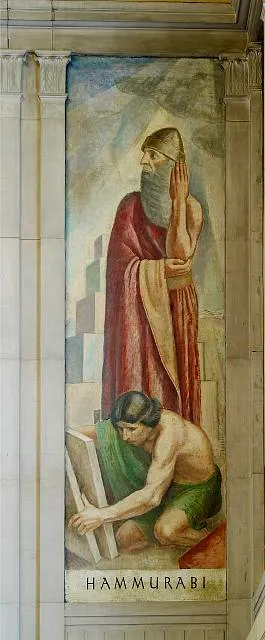
Source: Library of Congress - Highsmith, Carol M., 1946-
Hammurabi was the sixth king of the Babylonian Empire in ancient Mesopotamia, ruling from 1792 to 1750 BCE. During his reign, he created one of the world's earliest and most famous written codes of law, known as Hammurabi's Code. This collection of 282 laws was engraved on a tall stone called a stele and placed in a public space in the city of Babylon. The laws were written in the wedge-shaped script known as cuneiform, making them accessible to those who could read.
Hammurabi's goal was to unify his growing empire and maintain order among its diverse people. Mesopotamia, located between the Tigris and Euphrates Rivers, was home to many different city-states and cultures. The Code was designed to create a common system of justice across all these groups. The phrase "an eye for an eye" comes from one of its most famous laws, meaning that the punishment should fit the crime. For example, if someone broke another person's bone, their own bone could be broken in return. However, the Code was not always equal. Punishments often depended on a person's social status. For instance, harming a nobleman was punished more harshly than harming a commoner or a slave.
Primary sources, such as the actual stone stele discovered in 1901 at Susa (in modern-day Iran), show that Hammurabi's laws covered many aspects of daily life. The Code included rules about trade, marriage, theft, and even irrigation, reflecting the needs of a society living in a land where water was precious. For example, one law stated that if a builder constructed a house that collapsed and killed the owner, the builder could be put to death. This shows how the Code aimed to hold people responsible for their actions and protect the community.
Over time, Hammurabi's Code became a model for later legal systems, influencing laws in the ancient Near East and beyond. The Code also reveals the social hierarchy of Babylonian society, with different laws for nobles, free citizens, and slaves. While some punishments seem harsh by today's standards, they were meant to deter crime and ensure stability. Archaeologists and historians continue to study the Code to learn about justice and daily life in early civilizations.
The significance of Hammurabi's Code lies not only in its detailed laws but also in its effort to create fairness and order in a complex society. Its principles of proportional justice and public law set the foundation for many future legal traditions. Understanding Hammurabi's Code helps us see how ancient peoples responded to challenges of governance, geography, and social diversity.
This topic connects to broader themes of how societies develop rules to solve problems, maintain order, and reflect their values across time and place.
Interesting Fact: The top of Hammurabi’s stele shows him receiving the laws from Shamash, the Babylonian god of justice, highlighting the connection between law and religion in Mesopotamia.
Comprehension quiz (8 questions)
1. Who was Hammurabi?
2. How many laws in Hammurabi’s Code?
3. Where was Hammurabi’s Code found in 1901?
4. What does 'an eye for an eye' mean?
5. Why did Hammurabi make his Code?
6. How did social status affect punishment?
7. Hammurabi’s Code was written in cuneiform. True or false?
8. What is a 'stele'?
Perfect for the way you teach
- Build comprehension skills
- Auto-graded quiz
- Differentiated reading
- Read together at home
- Improve fluency
- Quiet reading time
- Reading curriculum support
- Independent practice
- Track Lexile growth