This passage explores the ancient West African kingdoms before the arrival of Islam, focusing on their political systems, trade networks, technological innovations, and social hierarchies. Students will learn about the Nok culture, the early city-states along the Niger River, and the rise of the Ghana Kingdom. The text integrates key vocabulary such as 'archaeology,' 'artifacts,' and 'trade networks,' with specific archaeological evidence and primary sources. Activities include a multiple-choice quiz, explanatory writing prompts, graphic organizers, and a timeline. The content is aligned with CA HSS 6.2.3 and CCSS RH.6-8.1, ensuring students build historical thinking skills while mastering informational text standards. A Spanish translation and read aloud audio are provided to support diverse learners. This passage is ideal for units on ancient civilizations, African history, and world history, helping students connect geography, culture, and human achievements in early West Africa.
West Africa in 300 CE was home to powerful kingdoms and cultures that flourished long before the spread of Islam. This region, marked by the vast Sahara Desert and the fertile Niger River, saw the development of complex societies with advanced skills in ironworking, trading, and government. Archaeological discoveries, such as ancient artifacts and city ruins, provide evidence about these early civilizations and their achievements.
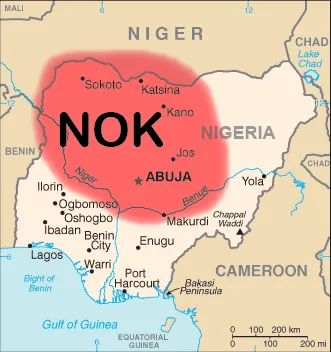
The Nok culture, which existed from about 1000 BCE to 300 CE in what is now Nigeria, is one of the earliest known West African societies. The Nok people are famous for their remarkable terracotta sculptures, which have been uncovered by archaeologists. These sculptures, along with iron tools and farming implements, show that the Nok had specialized skills and social organization. Archaeological evidence suggests they practiced agriculture and used iron technology to make farming more efficient. Their villages were likely ruled by local leaders, and trade with neighboring communities was common.
Further west, along the Niger River, city-states such as Djenné-Djenno began to emerge by 250 BCE. These settlements grew because of their location near fertile land and important trade routes. Excavations at Djenné-Djenno have revealed evidence of houses made from sun-dried mud bricks, large food storage areas, and a variety of tools and pottery. The people of these city-states established sophisticated trade networks that connected them to distant regions. Goods like gold, salt, and ivory moved along these routes, helping to create wealth and cultural exchange.
By 300 CE, the rise of the early Ghana Kingdom marked a significant change in West African history. Ghana’s rulers controlled trade across the Sahara, especially the exchange of gold and salt, which were both highly valued. The kingdom developed a clear social hierarchy, with kings and nobles at the top, followed by traders, artisans, farmers, and enslaved people. This structure helped maintain order and organize large-scale projects, such as building walls, governing cities, and protecting trade caravans. While written records from this era are rare, later Arab historians and archaeological studies provide important details about Ghana’s power and influence.
These early West African kingdoms adapted to their environment, using the Niger River and trade to grow and prosper. Their technologies and social systems set the foundations for later empires, such as Mali and Songhai. Understanding these civilizations gives insight into the diversity and achievements of Africa before Islam’s arrival.
The study of pre-Islamic West Africa connects to broader themes in ancient history, including the role of geography in shaping civilizations, the development of technology, and the importance of trade in cultural exchange.
Interesting Fact: The Nok people were among the first in sub-Saharan Africa to smelt iron, a technology that changed farming and warfare across the region.
What was the Nok culture known for?
Terracotta sculptures and ironworkingBuilding pyramidsWriting booksSailing ships
Which river was important to city-states?
NileAmazonNigerYangtze
What did the Ghana Kingdom control?
Trade of gold and saltSilk productionFish marketsTimber forests
Why did Djenné-Djenno grow?
Fertile land and trade routesTall mountainsLarge armiesDesert weather
How did iron tools help the Nok?
Made farming easierHelped build shipsCooked foodPainted art
What is a social hierarchy?
Ranking people by classA farming toolA trade routeA type of sculpture
The Nok used iron to make tools. True or false?
TrueFalse
What does 'artifacts' mean?
Objects from the pastMaps of riversStories about kingsNew inventions
Who it's for
Perfect for the way you teach
Teachers
Build comprehension skills
Auto-graded quiz
Differentiated reading
Parents
Read together at home
Improve fluency
Quiet reading time
Homeschoolers
Reading curriculum support
Independent practice
Track Lexile growth
Topics
West Africaancient kingdomsGhanaNoktradingironworkingarchaeologysocial hierarchyhistory reading passage
Reviews & Ratings
No reviews yet. Be the first to share your experience!
More reading you might love
19 more
Monarchy in the Ancient World
This reading passage explores the concept of monarchy in ancient civilizations, focusing on the origins, structure, and ...
CA HSS 6.2.36.2.4CCSS.RH.6-8.1CCSS.RH.6-8.2
Akhenaten the Heretic Pharaoh
This detailed history reading passage explores the dramatic religious changes introduced by Akhenaten, one of Egypt’s mo...
CA HSS 6.2.3RH.6-8.2RH.6-8.4WHST.6-8.2
Trade in Ancient Mesopotamia
This history reading passage explores the development and significance of trade networks among ancient Mesopotamian citi...
CA HSS 6.2.3TEKS 6.2ARI.6.1RI.6.4
Nubia's Gold and Trade Routes
This engaging passage explores the relationship between Ancient Egypt and the Kingdom of Kush (Nubia), focusing on why t...
CA HSS 6.2.3RI.6.3RI.6.4
Hatshepsut the Female Pharaoh
This engaging history reading passage explores Hatshepsut, one of ancient Egypt’s most remarkable rulers. Students will ...
CA HSS 6.2.3RH.6-8.1RH.6-8.2W.6-8.2
Tutankhamun the Boy King
This comprehensive passage explores the life and legacy of Tutankhamun, the famous boy pharaoh of Ancient Egypt, and the...
CA HSS 6.2.3RH.6-8.1RH.6-8.2RH.6-8.4
Zoroastrianism in Ancient Persia
This engaging history reading passage introduces students to Zoroastrianism, the ancient Persian state religion that sha...
CA HSS 6.2.3CCSS.RI.6.3CCSS.RI.6.4CCSS.W.6.2
Comparing Hinduism and Buddhism
This engaging history reading passage explores the similarities and differences between Hinduism and Buddhism, two major...
CA HSS 6.2.3RI.6.1RI.6.3W.6.2
Apollo 11 Moon Rocks
This world history reading passage explores the historic collection of 47 pounds of lunar samples brought back by astron...
CA HSS 6.2.3CCSS.RI.6.1CCSS.RI.6.4CCSS.RI.6.10
Africans and Filipinos in Early California
This history reading passage explores the important role of Africans and Filipinos in early California. Long before the ...
HSS 4.2.1RH.6-8.1
Bear Flag Revolt
This engaging history reading passage covers the Bear Flag Revolt, a pivotal moment during Westward Expansion when Ameri...
HSS 4.3.5RH.6-8.1
First California Constitution
This engaging history reading passage explores the creation of the First California Constitution in 1849, a pivotal even...
HSS 4.3.5RH.6-8.1
California Forty-Niners
This history reading passage explores the story of the California Forty-Niners, who rushed to California in 1849 in sear...
HSS 4.4.2RH.6-8.1
California Chinese Miners
This engaging history reading passage explores the experiences of Chinese miners during the California Gold Rush and Wes...
HSS 4.4.3RH.6-8.1
Effects of the Gold Rush
This engaging U.S. History reading passage explores the effects of the Gold Rush on California and the United States. Al...
HSS 4.4.4RH.6-8.1
Golden Spike 1869
This history reading passage explores the 1869 Golden Spike event that marked the completion of America's Transcontinent...
HSS 4.4.1RH.6-8.1
Newcomers to California
This engaging U.S. history reading passage explores the experiences of newcomers who arrived in California during the Pr...
HSS 4.4.4RH.6-8.1
1965 Immigration Act
This history reading passage explores the impact of the 1965 Immigration Act on the United States, focusing on how it he...
HSS 4.4.4RH.6-8.1
California's Water Challenges
This history reading passage explores the critical issue of water scarcity in California, a challenge with deep roots in...