This learning resource is available in interactive and printable formats. The interactive worksheet can be played online and assigned to students. The Printable PDF version can be downloaded and printed for completion by hand.
This reading passage, "The Difference Between Jellyfish and Fish," is designed for middle school students to clarify the common misconception that jellyfish are a type of fish. The text explains the fundamental biological differences between these two groups of marine animals, focusing on classification, anatomy, and movement. It highlights that jellyfish are invertebrates belonging to the phylum Cnidaria, while fish are vertebrates in the phylum Chordata. The passage details the simple body structure of a jellyfish, including its lack of a backbone, brain, and heart, and contrasts it with the complex organ systems and skeletal structure of a fish. This content aligns with NGSS standards related to the structure and function of organisms. The passage also includes relatable examples and a fun fact to enhance student engagement and comprehension, providing a solid foundation for understanding biological diversity and classification.
CONTENT PREVIEW
Expand content preview
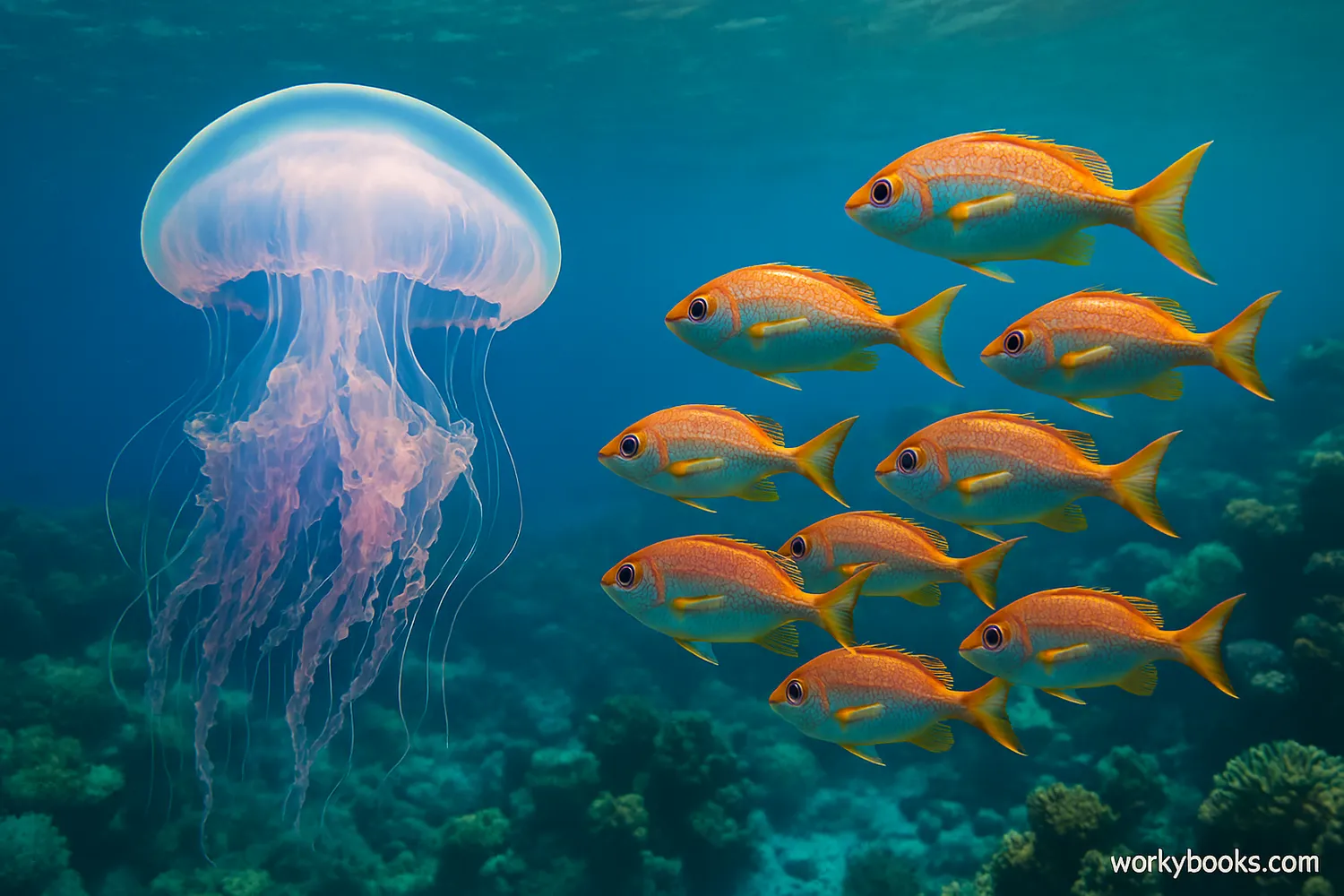
No, jellyfish are not fish. Despite their name, they are invertebrates, which means they lack a backbone. Fish, on the other hand, are vertebrates with an internal skeleton. Jellyfish are classified in the phylum Cnidaria, a group of aquatic animals that also includes corals and sea anemones. Fish are in the phylum Chordata.
The Difference Between Jellyfish and Fish
The primary distinction between jellyfish and fish lies in their fundamental biological classification and physical characteristics. Jellyfish are incredibly simple organisms, with a body composed of about 95% water. They don't have a brain, heart, lungs, or bones. Instead, they have a nerve net that helps them sense their environment and a simple gastrovascular cavity for digestion. Their movement is driven by the rhythmic pulsation of their bell-shaped body, which pushes water, but they are largely at the mercy of ocean currents.
Fish are far more complex. As vertebrates, they possess a backbone, a skull, and a complete internal skeleton made of either bone or cartilage. This skeletal structure provides support and allows for more complex, controlled movement. Fish also have well-developed organ systems, including a brain, heart, gills for respiration, and a complete digestive system. They use fins and a powerful tail for propulsion and steering, enabling them to actively swim against currents and hunt for food.
A key feature of jellyfish is their stinging cells, called cnidocytes, which are located on their tentacles. These cells contain tiny, venomous barbs used to paralyze or kill their prey. Fish, while many are predators, do not possess these specialized stinging cells. The differences in their anatomy, from the lack of a skeleton to their simple nervous system, highlight why jellyfish belong to a completely different phylum from fish and are more accurately referred to as "sea jellies."
Fun Fact: Some box jellyfish species have 24 eyes, including complex eyes with lenses and retinas, giving them 360-degree vision despite not having a brain to process the images.
Which of the following is a key difference between jellyfish and fish?
Jellyfish have gills, while fish do notFish are invertebrates, while jellyfish are notJellyfish lack a backbone, while fish have oneFish are composed of 95% water, while jellyfish are not
What phylum do jellyfish belong to?
ChordataVertebrataCnidariaMollusca
What is the main purpose of the cnidocytes on a jellyfish's tentacles?
To help the jellyfish breatheTo paralyze or kill preyTo help the jellyfish floatTo help the jellyfish see
Based on the passage, why are jellyfish considered simple organisms?
They are made of mostly waterThey do not have a skeleton or complex organsThey rely on ocean currents to moveThey have a bell-shaped body
How does the passage suggest the presence of an internal skeleton affects a fish's life?
It allows them to absorb more oxygenIt makes them more dependent on currentsIt gives them more controlled movementIt prevents them from living in shallow water
A scientist finds a new marine animal with gills and a backbone. According to the passage, this animal would most likely be classified as a:
CnidarianInvertebrateSea jellyFish
If a jellyfish is placed in a very strong current, what is most likely to happen based on the passage?
It will swim against the currentIt will be carried along by the currentIt will use its fins to steerIt will use its backbone for stability
Which of the following best explains why the term "sea jelly" is a more accurate name than "jellyfish"?
They are a different color from most fishThey are made of jelly, not fishThey are not actually a type of fishThey live in the sea, not in rivers
Perfect For:
👩🏫 Teachers
• Reading comprehension practice
• Auto-graded assessments
• Literacy skill development
👨👩👧👦 Parents
• Reading practice at home
• Comprehension improvement
• Educational reading time
🏠 Homeschoolers
• Reading curriculum support
• Independent reading practice
• Progress monitoring
Reading Features:
📖
Reading Passage
Engaging fiction or nonfiction text
❓
Comprehension Quiz
Auto-graded questions
📊
Instant Feedback
Immediate results and scoring
📄
Printable Version
Download for offline reading
🔊
Read Aloud
Voice-over with word highlighting
Reviews & Ratings
No reviews yet. Be the first to share your experience!
Related Content
Understanding Biological Evolution and Diversity
This passage addresses the NGSS standard 3-LS4-2 focusing on biological evolution and the unity and diversity of life. T...
RI.3.3RI.4.3RI.5.33-LS4-2
Theory of Evolution
This middle school science passage explains the theory of evolution and the concept of common ancestry, aligning with NG...
MS-LS4-1MS-LS4-2
Evidence for Evolution: Comparative Anatomy
This middle school science reading passage explores the evidence for evolution through comparative anatomy, aligning wit...
MS-LS4-2MS-LS4-3
The Nature of Life Science
This passage, aligned with NGSS MS-LS1-1, introduces students in grades 6-8 to the foundational concepts of life science...
MS-LS1-1
Human Evolution
This middle school science passage explains the scientific evidence for human evolution, aligning with NGSS standards MS...
MS-LS4-1MS-LS4-2
The Giant Isopod: Biological Evolution
This NGSS passage examines how giant isopods evolved for deep-sea survival, including slow metabolism for food scarcity,...
MS-LS4-4RI.6.3RI.7.3RI.8.8
Evidence for Evolution: The Fossil Record
This middle school science passage explains the importance of fossils as preserved evidence of ancient life and their ro...
MS-LS4-1
Science Vocabulary
This worksheet on domain-specific words will help students learn some science vocabulary. Students will be asked to matc...
L.3.6L.3.4.A
Simple Machines Science Report
This science writing task requires students to clearly explain how three simple machines work using precise domain-speci...
W.5.4
The Science of Hibernation
This educational module, featuring an audio-integrated reading passage titled 'The Science of Hibernation,' is designed ...
What is an amphibian
This audio-integrated reading passage, "The Life of Amphibians," is designed for 4th-grade students to explore the fasci...
The Levels of Australopithecus
This educational content offers an engaging, audio-integrated reading passage titled 'The Levels of Biological Classific...
The Pumpkin Life Cycle
This informational worksheet explores the pumpkin lifecycle, guiding students through procedural steps in a scientific t...
RI.2.3RI.2.10
The Nature of Science
This passage explores the nature of science for middle school students, aligning with NGSS standards MS-ETS1-4, MS-PS1-1...
MS-ETS1-4MS-PS1-1MS-LS1-1
What Is Earth Science?
This engaging middle school science passage introduces students to the field of Earth science, aligning with NGSS standa...
MS-ESS1MS-ESS2MS-ESS3SEP
The Life Cycle of an Angiosperm
This educational content package delves into the intriguing world of angiosperms and their complex life cycles, perfectl...
Citizen Science and Ecological Monitoring
This engaging passage for grades 6-8 introduces the concept of citizen science and its critical role in ecological monit...
MS-LS2-1
Tools and Technology in Earth Science
This middle school science reading passage explores the wide range of tools and technologies used in Earth science, from...
MS-ESS2-2MS-ESS3-2MS-ETS1-1MS-PS4-3
Barnacle Life Cycle
This audio-integrated reading passage, "Barnacle Life Cycle," delves into the intriguing growth and development of barna...
History of Life on Earth
This comprehensive middle school science reading passage provides an engaging overview of the history of life on Earth, ...