Abiogenesis vs. Biogenesis — Reading Comprehension
Rate this
Premium Resource
Present
Present in classroom. No work saved
Assign
Classroom with student accounts, Track progress
Quick Play
No student accounts, assign with a link
Grades
6
PRINT+DIGITAL RESOURCE
This learning resource is available in interactive and printable formats. The interactive worksheet can be played online and assigned to students. The Printable PDF version can be downloaded and printed for completion by hand.
This engaging and audio-integrated reading passage, 'Abiogenesis vs. Biogenesis,' delves into the fascinating question of how life began on Earth. Designed for Grade 6, it introduces students to two major scientific ideas: abiogenesis, the idea that life could arise from non-living matter, and biogenesis, the principle that life only comes from existing life. The passage explains historical experiments, like those by Francesco Redi and Louis Pasteur, which disproved spontaneous generation and supported biogenesis. It also touches upon current scientific understanding of how the very first life forms might have emerged on early Earth, linking directly to the NGSS standard LS4.A: Evidence of Common Ancestry and Diversity.
CONTENT PREVIEW
Expand content preview
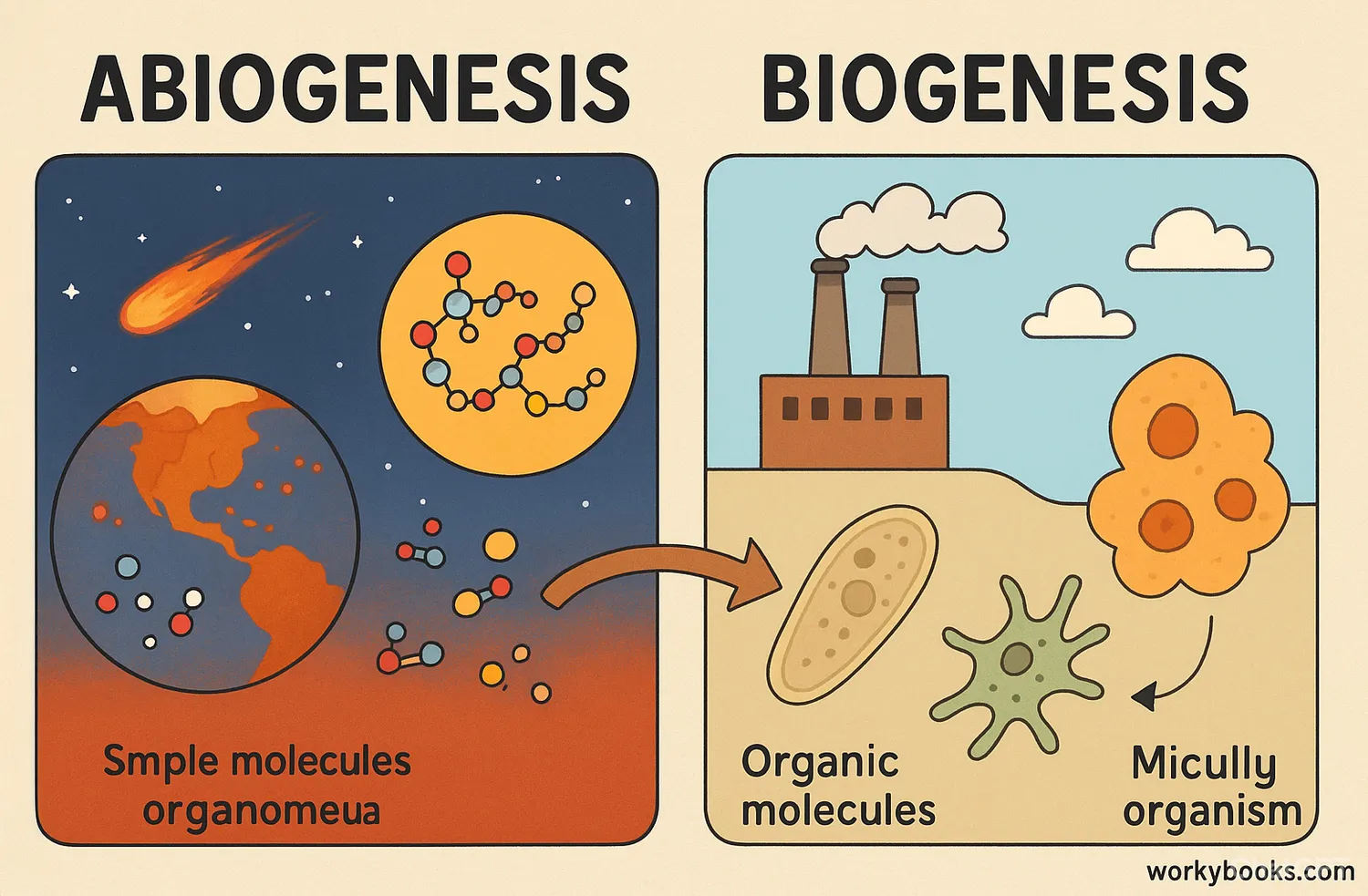
Abiogenesis begins with molecules, while biogenesis continues life from existing cells.
Imagine a world where the first living thing appeared. Where did it come from? Scientists have pondered this question for centuries, leading to two main ideas: abiogenesis and biogenesis. Understanding these helps us learn about the origin of life.
For a long time, many people believed in spontaneous generation. This was the idea that living things could appear suddenly from non-living matter. For example, people thought that maggots came from rotting meat, or that mice could appear from dirty hay. This idea is what we now call a form of abiogenesis – life arising from non-living things in everyday situations. This belief was common for many years, but scientific experiments began to challenge it.
One important scientist, Francesco Redi, performed an experiment in the 1600s. He put meat in three jars: one open, one sealed, and one covered with a fine mesh. Maggots only appeared on the meat in the open jar and on the mesh, where flies could land and lay eggs. This showed that maggots came from flies, not from the meat itself. Redi's work started to disprove spontaneous generation for larger organisms.
Later, in the 1800s, Louis Pasteur conducted famous experiments using swan-neck flasks. He boiled broth in these flasks to kill any existing microbes. The unique neck allowed air in but trapped dust and microbes. The broth remained clear, meaning no life grew. If the neck was broken, allowing dust and microbes to enter, the broth became cloudy with life. Pasteur's work strongly supported biogenesis, the idea that all life comes from other life. This means that living cells only come from pre-existing living cells.
So, if all life comes from other life, how did the very first life form on Earth begin? This is where modern scientific abiogenesis comes in. Scientists believe that billions of years ago, the conditions on early Earth were very different. There were no living things yet. Chemical reactions involving simple non-living molecules, like water, methane, and ammonia, could have slowly led to the formation of more complex organic molecules. Over vast amounts of time, these complex molecules might have organized themselves into self-replicating structures, eventually leading to the first primitive cells. This is a slow, complex process, not sudden spontaneous generation.
Studying abiogenesis helps us understand the incredible journey life took from simple chemicals to the diversity we see today. It's a continuous area of research in life science, looking for clues in ancient rocks and experiments in labs.
Interesting Fact: Scientists have found meteorites containing organic molecules, suggesting that some of the building blocks of life might have come to Earth from space!
Which scientist used swan-neck flasks?
Louis PasteurFrancesco RediCharles DarwinGregor Mendel
What did Francesco Redi study?
Maggots on meatBroth in flasksPlant growthAnimal behavior
Spontaneous generation means life comes from other life.
TrueFalse
Which term means all life comes from existing life?
BiogenesisAbiogenesisPhotosynthesisEvolution
How did Redi's experiment challenge spontaneous generation?
Showed flies laid eggsKilled all microbesUsed complex chemicalsBoiled the meat
What did Pasteur's experiment prove?
Broth needs airLife needs a neckLife comes from lifeDust creates life
What did scientists believe about early Earth?
Different conditionsFilled with lifeExactly like todayNo water existed
Why is abiogenesis today different from spontaneous generation?
Slow chemical processFaster life creationInvolves magicOnly in flasks
If a sealed container of sterile soup never grows mold, what idea does this support?