Australopithecus
Interactive passage with audio narration, comprehension questions, and printable PDF.
By completing this purchase you agree to our Terms of Use and Privacy Policy. Your subscription renews automatically until you cancel. You can cancel anytime from your account settings. All sales are final and non-refundable. Digital content is available for download in your account immediately upon purchase.
What's included
Australopithecus preview and details
About this printable Australopithecus science reading passage, NGSS-aligned (Grade 6)
Sample passage and quiz from Australopithecus
Reading passage and comprehension quiz preview
The Levels of Australopithecus
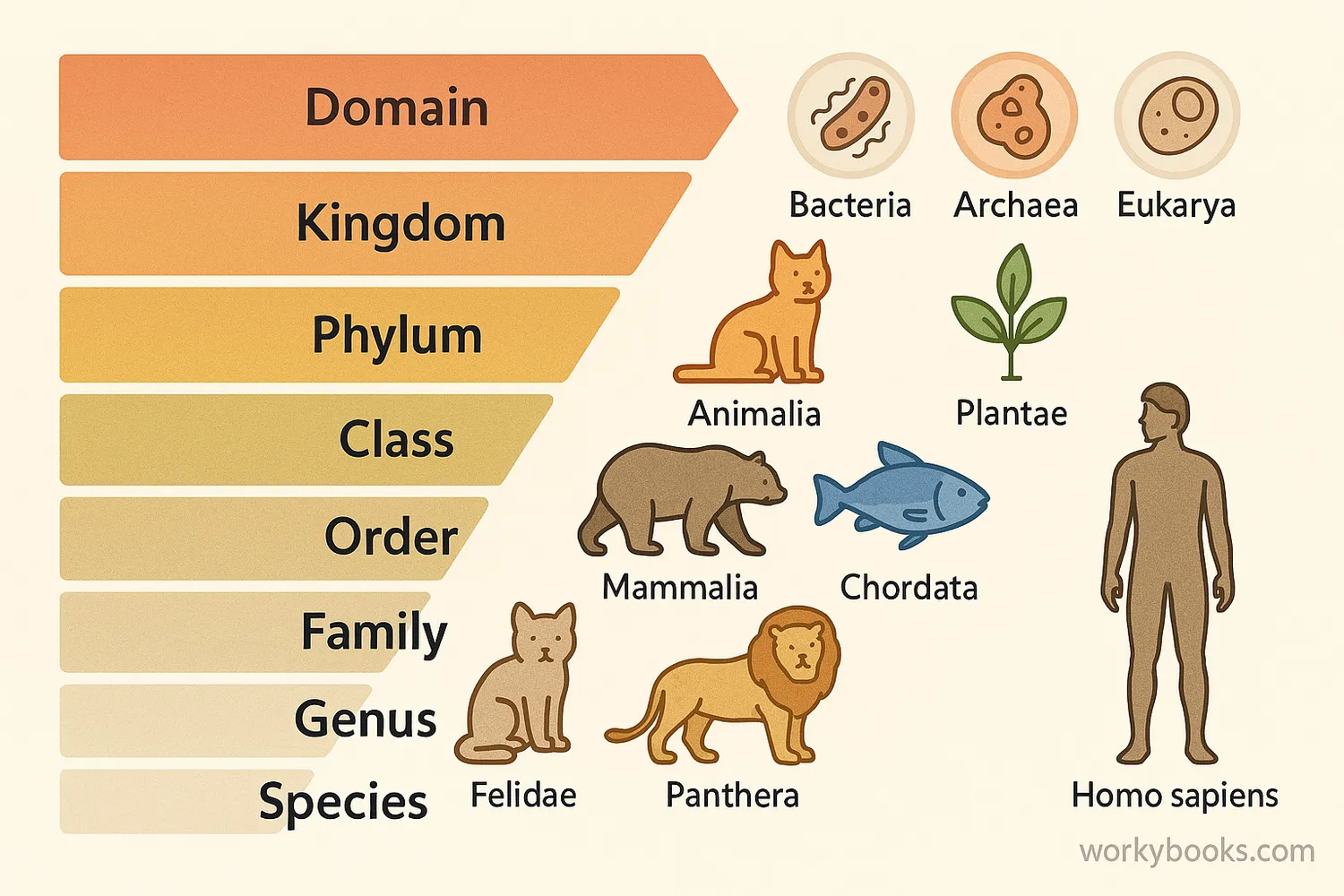
Imagine trying to find a specific book in a library that has millions of books, but no organization whatsoever. It would be nearly impossible! Just like libraries need systems to organize books, scientists need a way to organize the incredible diversity of living things on Earth. This system is called biological classification, and it helps us understand the relationships between different organisms.
The science of classifying living things is known as taxonomy. Scientists use a hierarchical system, meaning it has different levels, like a set of Russian nesting dolls. Each level gets more specific than the one before it. There are eight main levels of classification, starting with the broadest category and ending with the most specific. Let's explore these important levels!
The broadest level is Domain. All life on Earth falls into one of three domains: Bacteria, Archaea, or Eukarya. Below Domain comes Kingdom. For example, within the Eukarya domain, we find Kingdoms like Animalia (animals) and Plantae (plants). The next level is Phylum. Animals are divided into many phyla; for instance, Chordata includes all animals with a backbone.
After Phylum, we have Class. Mammals, birds, and fish are all classes within the phylum Chordata. Then comes Order. Carnivores (meat-eaters) belong to the Order Carnivora. Following Order is Family. Within the Order Carnivora, we have families like Felidae (cats) and Canidae (dogs).
The second to last level is Genus. A genus groups together very closely related species. For example, lions (Panthera leo) and tigers (Panthera tigris) both belong to the genus Panthera. Finally, the most specific level is Species. A species is a group of organisms that can reproduce with each other and have offspring that can also reproduce. For example, humans are Homo sapiens. This system of classification helps scientists keep track of the millions of different organisms and how they are related, making it easier to study life on Earth and understand biodiversity.
Interesting Fact: The scientific name for an organism, like Homo sapiens for humans, always uses the genus and species names together, written in italics.
Comprehension quiz (10 questions)
1. What is the science of classifying living things called?
2. Which of these is the broadest level of classification?
3. True or False: The classification system has eight main levels.
4. Which two classification levels make up an organism's scientific name?
5. If two animals belong to the same Family, they must also belong to the same:
6. Why is biological classification important for scientists?
7. Which group includes animals with a backbone?
8. What makes a group of organisms a 'species'?
9. If you discover a new organism, what is the first step in classifying it?
10. Which of the following would be the most difficult to classify if a scientist only knew its Genus?
Perfect for the way you teach
- Build comprehension skills
- Auto-graded quiz
- Differentiated reading
- Read together at home
- Improve fluency
- Quiet reading time
- Reading curriculum support
- Independent practice
- Track Lexile growth