This learning resource is available in interactive and printable formats. The interactive worksheet can be played online and assigned to students. The Printable PDF version can be downloaded and printed for completion by hand.
This engaging passage introduces students to the fascinating Abiogenesis Theory, explaining the scientific ideas about how life first arose from non-living matter on early Earth. Aligned with NGSS LS4.A: Evidence of Common Ancestry and Diversity, it uses simple language to define key terms like 'primordial soup' and 'organic molecules.' The passage is designed for Grade 6 reading level, making complex concepts accessible and exciting. Audio integration enhances the learning experience, helping students understand the processes by which life arose and the conditions that might have made it possible. Activities include comprehension questions, vocabulary practice, and short answer prompts to reinforce understanding of this foundational scientific concept.
CONTENT PREVIEW
Expand content preview
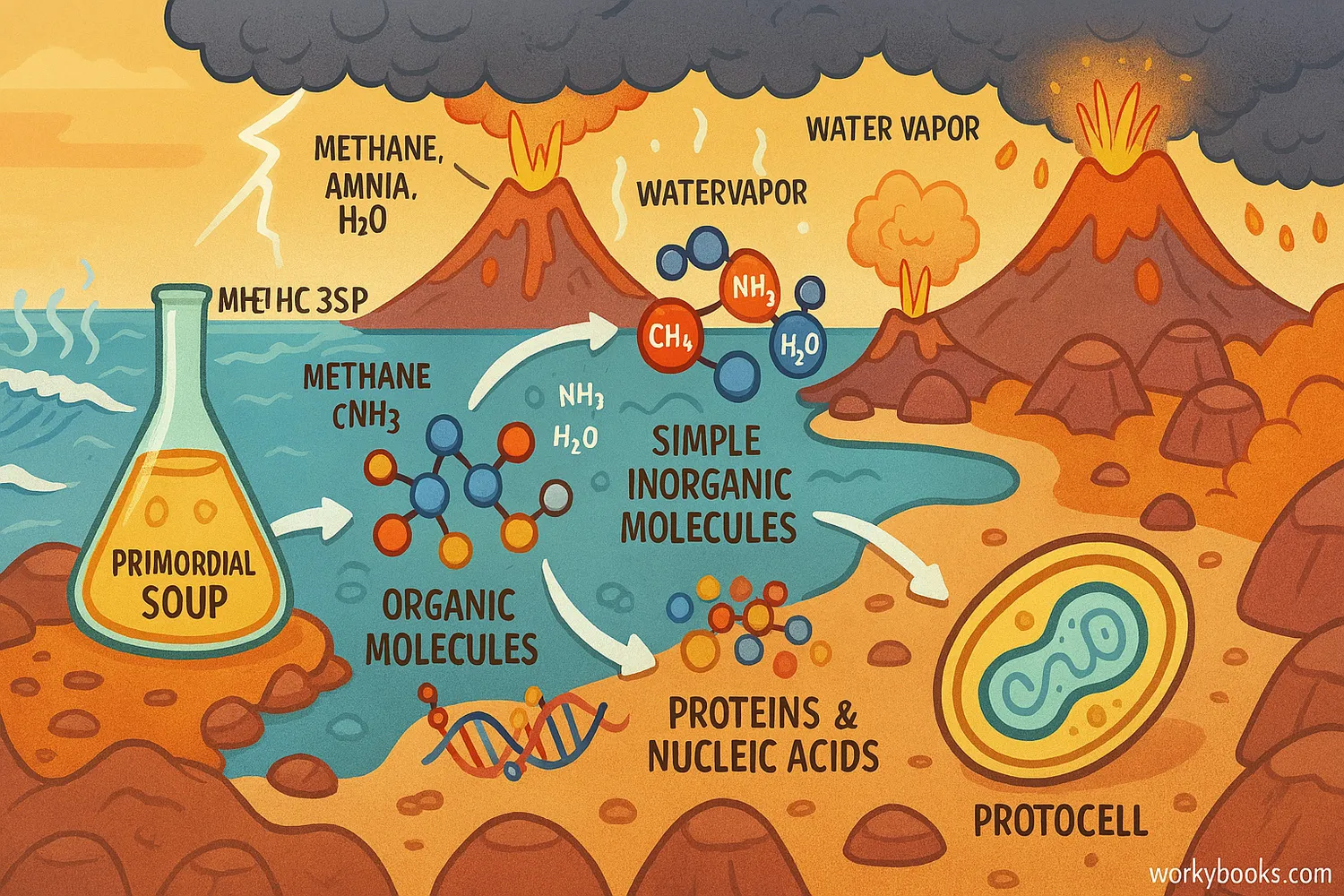
Abiogenesis: Life emerging from chemicals in Earth’s ancient oceans and volcanic atmosphere.
Imagine Earth billions of years ago. It was a very different place than it is today. No trees, no animals, not even tiny bacteria existed. The air was filled with gases, and volcanoes erupted often. Yet, somewhere in this ancient world, life began. This amazing idea is called the Abiogenesis Theory. It explores how living things could have developed from non-living chemicals.
Scientists believe that early Earth had special conditions. There was a lot of energy from lightning, volcanic eruptions, and harsh sunlight. The atmosphere contained gases like methane, ammonia, and water vapor. There was no oxygen like we have today. Many scientists think these early conditions were perfect for simple chemicals to react and form more complex ones.
One key idea is the "primordial soup." This refers to the oceans and ponds on early Earth, which were filled with these reacting chemicals. Think of it like a giant, warm chemical broth. Over long periods, these simple chemicals, also known as inorganic molecules, started to combine. They formed more complex organic molecules, like amino acids and nucleotides. These organic molecules are the basic building blocks of life, similar to how bricks are the building blocks of a house.
For life to truly begin, these building blocks needed to come together in specific ways. They had to form larger structures, such as proteins and nucleic acids (like DNA and RNA). Eventually, these complex molecules needed to be enclosed within a protective barrier, like a cell membrane. This barrier would create the first protocells – tiny, simple structures that could carry out basic life processes and, importantly, replicate themselves.
The Abiogenesis Theory suggests a slow, gradual process, not a sudden event. It's about chemistry becoming biology step by step. While scientists are still researching many parts of this theory, experiments like the Miller-Urey experiment have shown that organic molecules can indeed form from inorganic ones under early Earth conditions. This continuous research helps us understand the incredible journey life took from simple chemicals to the vast diversity we see today. It’s a fundamental part of understanding how all living things are connected through a common ancestor.
Interesting Fact: Some scientists propose that life might have actually started around deep-sea hydrothermal vents, where hot, mineral-rich water flows from cracks in the ocean floor.
Which of these gases was common on early Earth?
OxygenMethaneNitrogenCarbon Dioxide
What provided energy on early Earth?
WindVolcanoesIceRivers
The 'primordial soup' refers to early oceans filled with chemicals.
TrueFalse
Why was the lack of oxygen important on early Earth?
It made water colderAllowed complex molecules to formHelped plants growMade the sky blue
What is the main difference between inorganic and organic molecules in this context?
Organic are smallerInorganic are colorfulOrganic are life's building blocksInorganic are liquid
How do protocells relate to the beginning of life?
They were rocksThey ate chemicalsThey were first simple cellsThey were volcanoes
What does the Abiogenesis Theory mainly explain?
How planets formHow life evolvedHow life arose from non-lifeHow humans appeared
Which experiment showed organic molecules can form from inorganic ones?