The Miller-Urey Experiment — Reading Comprehension
Rate this
Premium Resource
Present
Present in classroom. No work saved
Assign
Classroom with student accounts, Track progress
Quick Play
No student accounts, assign with a link
Grades
6
PRINT+DIGITAL RESOURCE
This learning resource is available in interactive and printable formats. The interactive worksheet can be played online and assigned to students. The Printable PDF version can be downloaded and printed for completion by hand.
This engaging, audio-integrated reading passage, 'The Miller-Urey Experiment,' introduces 6th-grade students to a pivotal scientific experiment that explored the origin of life on Earth. It simplifies complex ideas about how life's building blocks, like amino acids, might have formed from the early Earth's atmosphere. The passage defines key terms such as 'primordial soup' and 'atmosphere,' making the science accessible. Aligned with NGSS LS4.A: Evidence of Common Ancestry and Diversity, it helps students understand the chemical synthesis process as a component of life's history. The passage is followed by comprehension activities, a glossary, and short answer questions to reinforce learning about this foundational scientific discovery.
CONTENT PREVIEW
Expand content preview
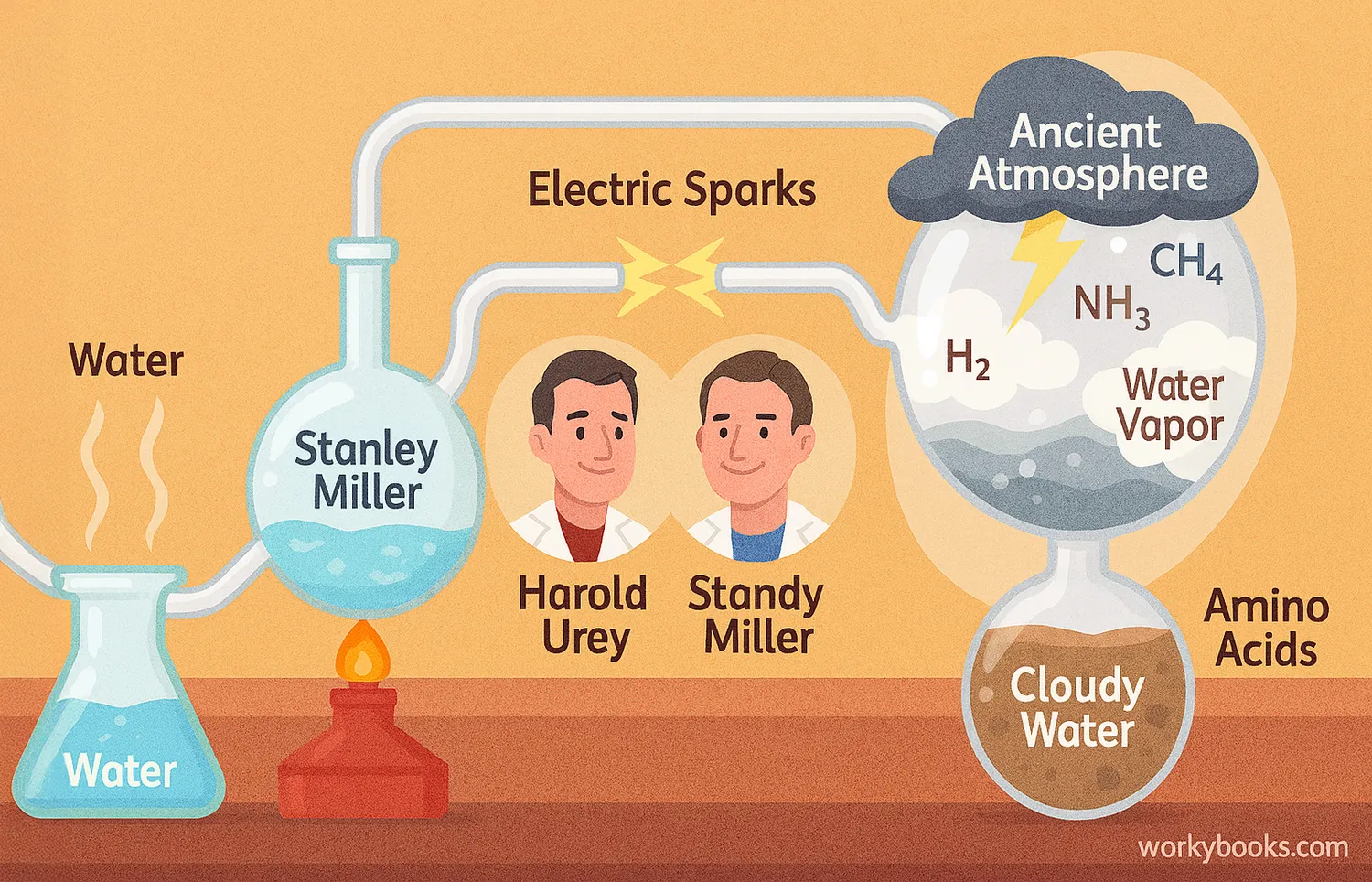
Early Earth simulation reveals amino acids in Miller-Urey experiment, hinting at life’s origins.
Imagine a time long, long ago, when Earth was a very different place. There were no plants, no animals, not even tiny bacteria. The sky was filled with gases, and oceans were forming. Scientists have long wondered how life first began on our planet. How did the simple chemicals present on early Earth turn into the complex molecules needed for life?
In the 1950s, two American scientists, Stanley Miller and Harold Urey, decided to create a miniature version of early Earth in their laboratory. Their goal was to see if the basic ingredients of life could form under conditions believed to exist billions of years ago. This groundbreaking project is known as the Miller-Urey experiment. They designed a special sealed apparatus, which looked a bit like a collection of glass tubes and flasks.
They filled one flask with water, representing the ancient oceans. Another flask contained a mixture of gases thought to be in Earth's early atmosphere: methane, ammonia, hydrogen, and water vapor. These gases did not include oxygen, which is vital for most life today but was scarce back then. To simulate lightning, which was common in early Earth's stormy skies, Miller and Urey sent electric sparks through the gas mixture.
The water in the 'ocean' flask was heated to create water vapor, which then circulated through the system with the other gases. After about a week, something remarkable happened. The water in the 'ocean' flask had changed color and become cloudy. When they analyzed this cloudy water, Miller and Urey made an exciting discovery. They found amino acids, which are often called the 'building blocks of life.'
Amino acids are essential for creating proteins, and proteins do almost all the work in cells. Finding them in their experiment suggested that life's basic ingredients could indeed have formed naturally from simple chemicals on early Earth. This idea is sometimes called the 'primordial soup' hypothesis, where the early oceans were a rich mixture of organic compounds.
While the Miller-Urey experiment doesn't tell us exactly how life started, it provided strong evidence that the chemical steps toward life are possible. It showed that non-living matter could produce organic molecules, paving the way for further research into the origin of life and how complex life evolved from simple beginnings. This experiment remains a cornerstone in the study of abiogenesis, the process by which life arises from non-living matter.
Interesting Fact: Although the original Miller-Urey experiment used a specific mix of gases, later experiments with different 'early Earth' atmospheres have also successfully produced amino acids and other important organic molecules.
Who conducted the Miller-Urey experiment?
Miller and UreyWatson and CrickPasteur and KochDarwin and Mendel
What did the experiment's water flask represent?
Ancient oceansEarth's coreModern riversCloud formations
Which gas was largely absent from early Earth's atmosphere in the experiment?
OxygenMethaneAmmoniaHydrogen
What did the electric sparks in the experiment simulate?
LightningVolcanoesSunlightOcean currents
The Miller-Urey experiment produced complex living organisms.
TrueFalse
Why is the discovery of amino acids important?
Building blocks of lifeMake oceans saltyFuel for lightningColor water cloudy
What does the 'primordial soup' hypothesis suggest?
Oceans had organic mixEarly Earth was coldVolcanoes created lifeLife started on land
What does 'abiogenesis' mean?
Life from non-living matterLife from existing lifeStudy of ancient plantsStudy of ocean life
Which part of the experiment simulated Earth's heat?