Blobfish Adaptations to Extreme Pressure — Reading Comprehension
Rate this
Premium Resource
Present
Present in classroom. No work saved
Assign
Classroom with student accounts, Track progress
Quick Play
No student accounts, assign with a link
Grades
6
PRINT+DIGITAL RESOURCE
This learning resource is available in interactive and printable formats. The interactive worksheet can be played online and assigned to students. The Printable PDF version can be downloaded and printed for completion by hand.
This engaging passage explores the fascinating world of the blobfish and its unique adaptations to the extreme pressure of the deep sea. Students will learn how the blobfish's internal and external structures support its survival, aligning with NGSS LS1.A: Structure and Function. Key concepts include buoyancy, density, and specialized body features that allow it to thrive in its environment. This resource is perfect for grade 5 students, offering an insightful look into marine biology and animal adaptations. The passage is designed for easy comprehension and includes audio integration to support diverse learning styles, covering important topics like deep-sea ecosystems and survival strategies.
CONTENT PREVIEW
Expand content preview
Blobfish survives deep-sea pressure with jelly-like body and natural buoyancy.
Meet the Blobfish The blobfish is a strange-looking fish found deep in the ocean off the coasts of Australia and New Zealand. It lives 2,000 to 4,000 feet under the sea, where the pressure is about 100 times stronger than at the ocean’s surface. At these depths, only animals with special adaptations can survive.
The Blobfish Mystery People often think blobfish look like melting blobs, but that’s only when they’re brought up to the surface! Deep underwater, the blobfish looks more like a regular fish with a big head. When it is brought to the surface, the lack of water pressure makes its jelly-like body collapse—almost like a balloon losing air. That’s why blobfish look so droopy and floppy when seen on land.
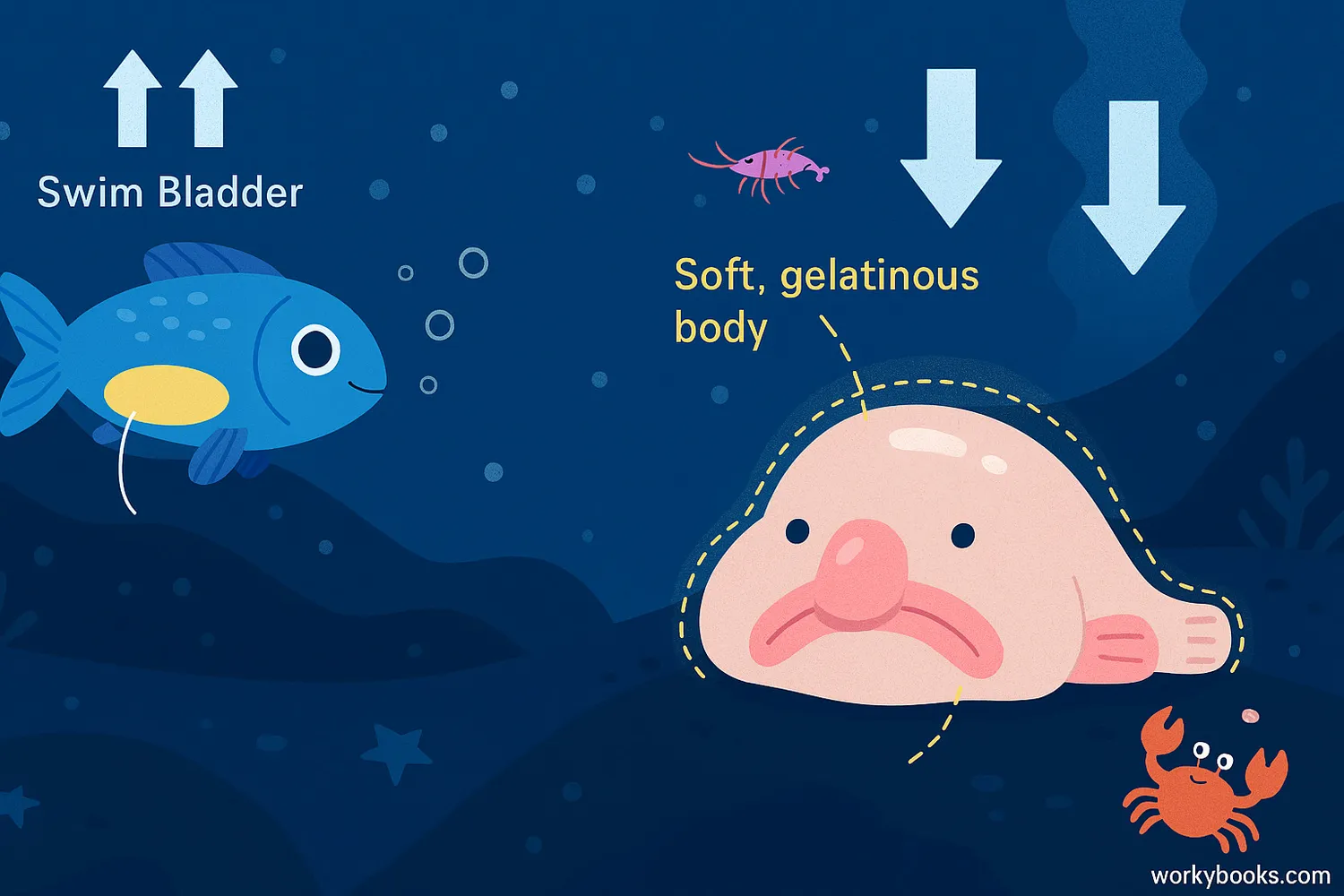
Super Survival Adaptations The blobfish has amazing adaptations for deep-sea life. Most fish have a swim bladder, an organ filled with gas to help them float. But in the deep sea, the pressure would crush a swim bladder, so blobfish don’t have one. Instead, their flesh is less dense than water. This means they can float effortlessly just above the sea floor without swimming much. Their soft, jelly-like body is perfect for handling the crushing pressure of the deep ocean. Blobfish also have huge mouths, so they can gulp up any food that drifts by—like crabs, sea urchins, or shellfish. They don’t chase their food; they just wait for it to come to them!
Family Life and Conservation Blobfish have an unusual parenting style for deep-sea fish. The females lay thousands of eggs and actually guard them, making sure the eggs are safe until they hatch. Sadly, blobfish are endangered because they are often caught by accident in fishing nets.
The Deep-Sea Float Comparison The blobfish is like a deep-sea float: it is built to work perfectly under high pressure, but when you take it out of its home, it falls apart—just like a water balloon with no air left.
Interesting Fact: Blobfish were once voted the “World’s Ugliest Animal,” but underwater, they look just like any other fish!
Where do blobfish live?
Deep sea off Australia/New ZealandRivers in AfricaArctic iceRainforests in Brazil
What is one main adaptation of blobfish?
Jelly-like bodyFur for warmthWings for flyingSharp claws
Why do blobfish look strange on land?
No deep-sea pressureThey are sickThey have no bonesThey stop eating
What would happen if a fish with a swim bladder lived deep?
It would be crushedIt would float betterIt would swim fasterIt would change color
How do blobfish eat?
Wait for food to float byChase fast preyEat only plantsUse sharp teeth to hunt
Why are blobfish endangered?
Caught in fishing netsThey eat plasticNo food in oceanToo many predators
Blobfish guard their eggs.
TrueFalse
What does 'dense' mean?
Tightly packedVery colorfulCovered in furAble to fly
Perfect For:
👩🏫 Teachers
• Reading comprehension practice
• Auto-graded assessments
• Literacy skill development
👨👩👧👦 Parents
• Reading practice at home
• Comprehension improvement
• Educational reading time
🏠 Homeschoolers
• Reading curriculum support
• Independent reading practice
• Progress monitoring
Reading Features:
📖
Reading Passage
Engaging fiction or nonfiction text
❓
Comprehension Quiz
Auto-graded questions
📊
Instant Feedback
Immediate results and scoring
📄
Printable Version
Download for offline reading
🔊
Read Aloud
Voice-over with word highlighting
Reviews & Ratings
No reviews yet. Be the first to share your experience!
Related Content
The Nature of Life Science
This passage, aligned with NGSS MS-LS1-1, introduces students in grades 6-8 to the foundational concepts of life science...
MS-LS1-1
Science Vocabulary
This worksheet on domain-specific words will help students learn some science vocabulary. Students will be asked to matc...
L.3.6L.3.4.A
The Science of Hibernation
This educational module, featuring an audio-integrated reading passage titled 'The Science of Hibernation,' is designed ...
Simple Machines Science Report
This science writing task requires students to clearly explain how three simple machines work using precise domain-speci...
W.5.4
Adaptation
This engaging middle school science passage explores adaptation, focusing on how inherited traits enable organisms to su...
MS-LS4-4MS-LS4-6
Desert Rain Frog Behavioral Adaptations
Dive into the fascinating world of the Desert Rain Frog and discover its incredible unique adaptations for survival in a...
Animal Adaptations Word Sort
This engaging word sort activity helps students understand the difference between physical and behavioral adaptations in...
Herbivore Adaptations
This engaging reading passage, integrated with audio, delves into the fascinating world of herbivore adaptations. Studen...
Ocean Animal Adaptations
Students will read a passage that provides information about various adaptations that marine animals have developed to t...
W.4.9.B
Nocturnal Adaptations of the Strange Aye-Aye
This engaging reading passage, integrated with audio, takes grade 5 students on a journey to discover the fascinating no...
Early Life Forms and Their Adaptations
This educational passage focuses on early life forms and their basic adaptations, supporting NGSS standard 3-LS4-2 for e...
RI.3.3RI.4.3RI.5.33-LS4-2
Binturong Adaptations
This engaging, audio-integrated reading passage, 'Binturong Adaptations,' for Grade 6 students delves into the fascinati...
Barnacle Biology and Adaptations
Dive into the intriguing world of barnacles with this engaging Grade 6 reading passage. Students will learn about these ...
Whale Blubber: Function and Adaptation
This engaging, audio-integrated reading passage, 'Whale Blubber Function and Adaptation,' introduces young learners to t...
Amur Leopard Adaptations
This engaging, audio-integrated reading passage, 'Amur Leopard Adaptations,' is designed for Grade 6 science students. I...
Mountain Animal Adaptations
This reading comprehension worksheet focuses on the topic of animal adaptations for survival in mountainous environments...
W.4.9.B
Climate Zone Adaptations Word Sort
This word sort activity examines how plants and animals adapt to different climate conditions. Students sort 12 differen...
Plant Adaptations for Survival
This NGSS-aligned word sort activity, suitable for kindergarten, focuses on plant survival adaptations, helping students...
K-LS1-1
The Pumpkin Life Cycle
This informational worksheet explores the pumpkin lifecycle, guiding students through procedural steps in a scientific t...
RI.2.3RI.2.10
What Is Earth Science?
This engaging middle school science passage introduces students to the field of Earth science, aligning with NGSS standa...