Blue Glaucus Atlanticus Diet and Habitat — Reading Comprehension
Rate this
Premium Resource
Present
Present in classroom. No work saved
Assign
Classroom with student accounts, Track progress
Quick Play
No student accounts, assign with a link
Grades
6
PRINT+DIGITAL RESOURCE
This learning resource is available in interactive and printable formats. The interactive worksheet can be played online and assigned to students. The Printable PDF version can be downloaded and printed for completion by hand.
This engaging reading passage, perfect for Grade 5 students, delves into the captivating world of the Blue Glaucus Atlanticus. Students will learn about this unique sea slug's diet, which includes venomous prey, and its open ocean habitat. The passage defines key terms like 'predator' and 'venomous' using simple language. Aligned with NGSS LS2.A: Interdependent Relationships, it highlights how organisms are connected in food webs. The content includes a reading passage and various activities (quizzes, glossary, short answer questions) to reinforce comprehension. All content is audio integrated for enhanced learning.
CONTENT PREVIEW
Expand content preview
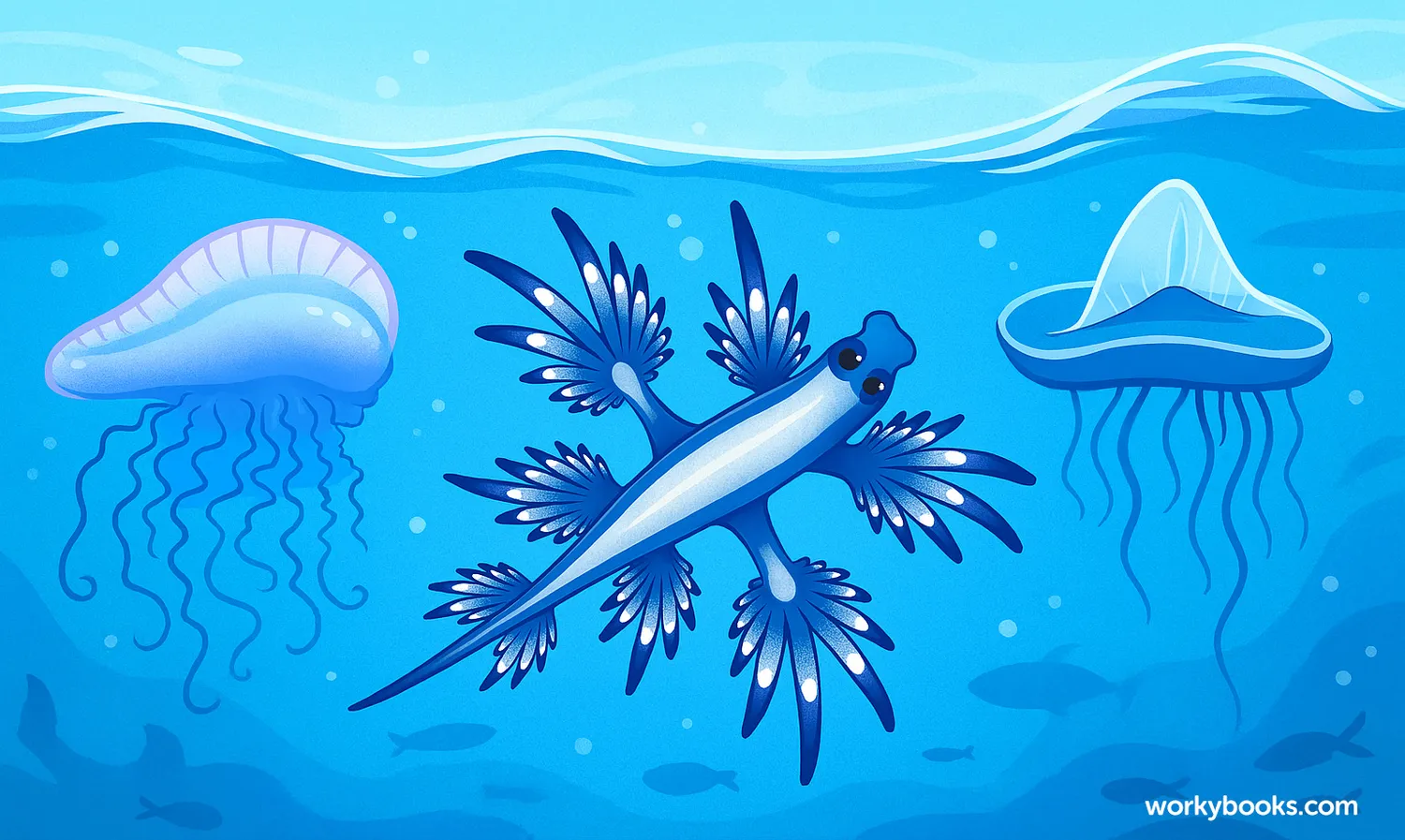
Blue Glaucus absorbs venom from prey for defense in the pelagic zone.
Meet the Blue Glaucus Atlanticus The blue glaucus, also known as the blue dragon or blue sea slug, is a tiny but fierce ocean animal. It grows only 1 to 1.5 inches long, but it has amazing powers that help it survive in the sea.
Where Does It Live? The blue glaucus is a surface dweller. It floats at the top of the ocean, in both tropical (warm) and temperate (mild) waters all around the world. You can find it in the Atlantic, Pacific, and Indian Oceans. The blue glaucus floats upside-down by holding an air bubble in its stomach, drifting wherever the wind and currents take it. It cannot swim against the waves, so it travels by floating along.
What Does It Eat? This small creature has a surprising diet! The blue glaucus eats the Portuguese man-o-war, a jellyfish-like animal that most creatures avoid because of its painful stings. The blue glaucus is immune to these stings. It also eats other floating stingers, like by-the-wind sailors and blue buttons.
Superpower: Stealing Venom When the blue glaucus eats its prey, it does not digest the stinging cells, called nematocysts. Instead, it moves these stinging cells to finger-like parts on its body called cerata. The blue glaucus can even make the stingers stronger than before! When a predator tries to attack, the blue glaucus uses the stolen stingers for protection. It’s like a tiny floating pirate—attacking dangerous prey, stealing their weapons, and using them against others.
How Does It Hide? The blue glaucus uses countershading to blend in. Its bright blue belly faces up toward the water, hiding it from above, while its silvery back faces down, camouflaging it from below. This helps it avoid predators from both directions.
Beach Safety Sometimes, blue glaucus wash up on beaches. Even after they die, their stingers can still hurt, so never touch one!
Interesting Fact: The blue glaucus can turn the stings of its prey into an even more powerful weapon for itself!
Where does the blue glaucus live?
At the ocean surfaceDeep in the sandOn rocksIn coral reefs
What does the blue glaucus eat?
Portuguese man-o-warSeaweedSmall fishShrimp
How does the blue glaucus protect itself?
Uses stolen stingersHides under rocksSwims fastBuilds a shell
Why is the blue glaucus called a 'pirate'?
Steals stingers from preyLives on a shipDigs for treasureWears an eyepatch
What would happen if the blue glaucus could not float?
It would sink and not surviveIt would swim fasterIt would eat moreIt would glow
Which body part stores stinging cells?
CerataShellTentacleFin
The blue glaucus can still sting after it dies.
TrueFalse
What does 'countershading' mean?
Different color on top and bottomHaving sharp teethMaking loud soundsMoving very quickly
Perfect For:
👩🏫 Teachers
• Reading comprehension practice
• Auto-graded assessments
• Literacy skill development
👨👩👧👦 Parents
• Reading practice at home
• Comprehension improvement
• Educational reading time
🏠 Homeschoolers
• Reading curriculum support
• Independent reading practice
• Progress monitoring
Reading Features:
📖
Reading Passage
Engaging fiction or nonfiction text
❓
Comprehension Quiz
Auto-graded questions
📊
Instant Feedback
Immediate results and scoring
📄
Printable Version
Download for offline reading
🔊
Read Aloud
Voice-over with word highlighting
Reviews & Ratings
No reviews yet. Be the first to share your experience!
Related Content
The Nature of Life Science
This passage, aligned with NGSS MS-LS1-1, introduces students in grades 6-8 to the foundational concepts of life science...
MS-LS1-1
Science Vocabulary
This worksheet on domain-specific words will help students learn some science vocabulary. Students will be asked to matc...
L.3.6L.3.4.A
The Science of Hibernation
This educational module, featuring an audio-integrated reading passage titled 'The Science of Hibernation,' is designed ...
Simple Machines Science Report
This science writing task requires students to clearly explain how three simple machines work using precise domain-speci...
W.5.4
Adaptation
This engaging middle school science passage explores adaptation, focusing on how inherited traits enable organisms to su...
MS-LS4-4MS-LS4-6
Desert Rain Frog Behavioral Adaptations
Dive into the fascinating world of the Desert Rain Frog and discover its incredible unique adaptations for survival in a...
Animal Adaptations Word Sort
This engaging word sort activity helps students understand the difference between physical and behavioral adaptations in...
Herbivore Adaptations
This engaging reading passage, integrated with audio, delves into the fascinating world of herbivore adaptations. Studen...
Ocean Animal Adaptations
Students will read a passage that provides information about various adaptations that marine animals have developed to t...
W.4.9.B
Early Life Forms and Their Adaptations
This educational passage focuses on early life forms and their basic adaptations, supporting NGSS standard 3-LS4-2 for e...
RI.3.3RI.4.3RI.5.33-LS4-2
Nocturnal Adaptations of the Strange Aye-Aye
This engaging reading passage, integrated with audio, takes grade 5 students on a journey to discover the fascinating no...
Binturong Adaptations
This engaging, audio-integrated reading passage, 'Binturong Adaptations,' for Grade 6 students delves into the fascinati...
Barnacle Biology and Adaptations
Dive into the intriguing world of barnacles with this engaging Grade 6 reading passage. Students will learn about these ...
Whale Blubber: Function and Adaptation
This engaging, audio-integrated reading passage, 'Whale Blubber Function and Adaptation,' introduces young learners to t...
Mountain Animal Adaptations
This reading comprehension worksheet focuses on the topic of animal adaptations for survival in mountainous environments...
W.4.9.B
Amur Leopard Adaptations
This engaging, audio-integrated reading passage, 'Amur Leopard Adaptations,' is designed for Grade 6 science students. I...
Climate Zone Adaptations Word Sort
This word sort activity examines how plants and animals adapt to different climate conditions. Students sort 12 differen...
Plant Adaptations for Survival
This NGSS-aligned word sort activity, suitable for kindergarten, focuses on plant survival adaptations, helping students...
K-LS1-1
The Pumpkin Life Cycle
This informational worksheet explores the pumpkin lifecycle, guiding students through procedural steps in a scientific t...
RI.2.3RI.2.10
What Is Earth Science?
This engaging middle school science passage introduces students to the field of Earth science, aligning with NGSS standa...