California Condor Adaptation and Survival — Reading Comprehension
Rate this
Premium Resource
Present
Present in classroom. No work saved
Assign
Classroom with student accounts, Track progress
Quick Play
No student accounts, assign with a link
Grades
6
PRINT+DIGITAL RESOURCE
This learning resource is available in interactive and printable formats. The interactive worksheet can be played online and assigned to students. The Printable PDF version can be downloaded and printed for completion by hand.
This educational content features a reading passage and activities about the California Condor's adaptation and survival, aligned with NGSS LS4.C: Adaptation. Students will discover how these magnificent birds have adapted to their environment, their role as scavengers, and the conservation efforts vital for their survival. The passage, enriched with SEO keywords, is designed for Grade 5 readers, explaining key terms like 'scavenger' and 'endangered species'. The accompanying activities, including multiple-choice questions, a glossary, and short answer questions, are audio integrated to support diverse learning styles. This resource provides a comprehensive look at how species change over time through adaptation.
CONTENT PREVIEW
Expand content preview
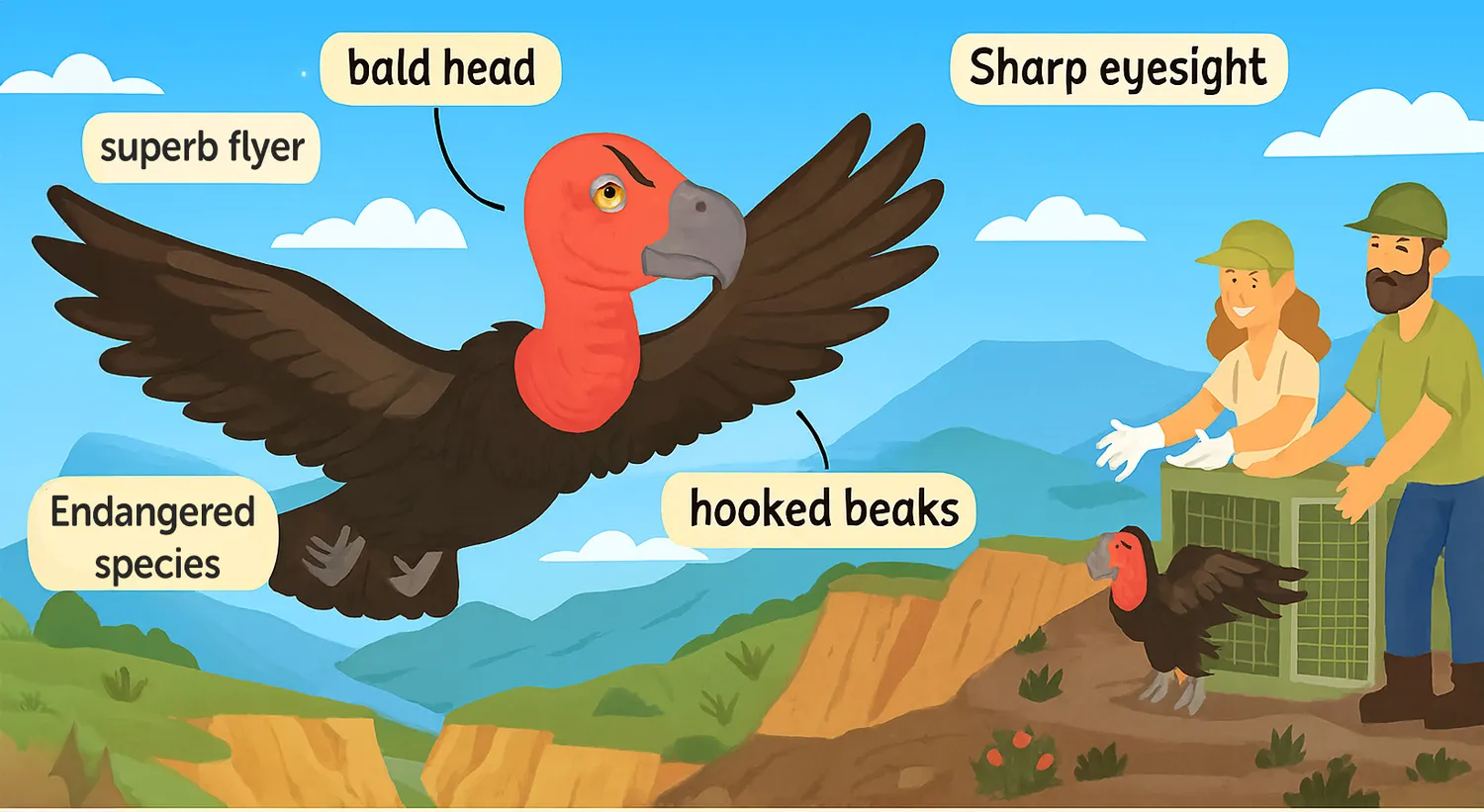
California Condor adaptations and conservation efforts shown across a wide canyon landscape.
Meet the California Condor
The California condor is the largest flying bird in North America. With a wingspan of up to 9.5 feet, these birds glide high above mountains and canyons. Their huge wings help them soar for miles without flapping, saving energy by riding on warm, rising air called thermals.
Physical Adaptations
California condors have special body features that help them survive. Their heads are bald, with no feathers. This keeps their heads clean when they eat dead animals. Their sharp, hooked beaks can tear tough meat from carcasses. Condors also have strong stomach acid that lets them safely eat rotting meat, which would make other animals sick. Their amazing eyesight helps them spot food from miles away!
Behavioral Adaptations
Condors use smart behaviors to survive. They soar on air currents, gliding for hours to look for food and save energy. They rest and sleep together in groups called roosts. By staying in groups, they can share information about where food is. When a condor family raises a chick, both parents work together for over a year to care for their one baby.
Nature’s Cleanup Crew
California condors are important scavengers. They eat dead animals, cleaning up nature and helping to stop the spread of disease. You can think of them as giant flying vacuum cleaners keeping the wild healthy!
From Endangered to Hopeful
By 1987, only 27 condors were left because of problems like lead poisoning from eating dead animals with bullet fragments. People started a captive breeding program, raising condors in zoos and then releasing them back into the wild. Laws were made to ban lead bullets, and scientists use numbered tags to keep track of each bird. Now, there are more than 500 condors, with many flying free in California, Arizona, and Mexico. But condors still face dangers, like lead poisoning, power lines, and losing their habitats.
Interesting Fact: The California condor can soar as high as a jet airplane—over 15,000 feet in the sky!
What is a condor’s wingspan?
Up to 9.5 feetUp to 2 feetUp to 20 feetUp to 5 feet
Why is the condor’s head bald?
To keep it cleanTo fly fasterTo see betterTo stay warm
What do condors eat?
Dead animalsTree leavesFish onlyFruit
How do condors save energy?
By soaring on thermalsBy sleeping all dayBy eating fruitBy swimming
Why are condors important for nature?
They clean up dead animalsThey plant treesThey eat only plantsThey dig holes
What is one danger condors face today?
Lead poisoningToo much foodToo many chicksStrong winds
Condors can soar as high as 15,000 feet.
TrueFalse
What does 'scavenger' mean?
Eats dead animalsPlants treesBuilds nestsFlies at night
Perfect For:
👩🏫 Teachers
• Reading comprehension practice
• Auto-graded assessments
• Literacy skill development
👨👩👧👦 Parents
• Reading practice at home
• Comprehension improvement
• Educational reading time
🏠 Homeschoolers
• Reading curriculum support
• Independent reading practice
• Progress monitoring
Reading Features:
📖
Reading Passage
Engaging fiction or nonfiction text
❓
Comprehension Quiz
Auto-graded questions
📊
Instant Feedback
Immediate results and scoring
📄
Printable Version
Download for offline reading
🔊
Read Aloud
Voice-over with word highlighting
Reviews & Ratings
No reviews yet. Be the first to share your experience!
Related Content
The Nature of Life Science
This passage, aligned with NGSS MS-LS1-1, introduces students in grades 6-8 to the foundational concepts of life science...
MS-LS1-1
Science Vocabulary
This worksheet on domain-specific words will help students learn some science vocabulary. Students will be asked to matc...
L.3.6L.3.4.A
The Science of Hibernation
This educational module, featuring an audio-integrated reading passage titled 'The Science of Hibernation,' is designed ...
Simple Machines Science Report
This science writing task requires students to clearly explain how three simple machines work using precise domain-speci...
W.5.4
Adaptation
This engaging middle school science passage explores adaptation, focusing on how inherited traits enable organisms to su...
MS-LS4-4MS-LS4-6
Desert Rain Frog Behavioral Adaptations
Dive into the fascinating world of the Desert Rain Frog and discover its incredible unique adaptations for survival in a...
Animal Adaptations Word Sort
This engaging word sort activity helps students understand the difference between physical and behavioral adaptations in...
Herbivore Adaptations
This engaging reading passage, integrated with audio, delves into the fascinating world of herbivore adaptations. Studen...
Ocean Animal Adaptations
Students will read a passage that provides information about various adaptations that marine animals have developed to t...
W.4.9.B
Nocturnal Adaptations of the Strange Aye-Aye
This engaging reading passage, integrated with audio, takes grade 5 students on a journey to discover the fascinating no...
Early Life Forms and Their Adaptations
This educational passage focuses on early life forms and their basic adaptations, supporting NGSS standard 3-LS4-2 for e...
RI.3.3RI.4.3RI.5.33-LS4-2
Binturong Adaptations
This engaging, audio-integrated reading passage, 'Binturong Adaptations,' for Grade 6 students delves into the fascinati...
Barnacle Biology and Adaptations
Dive into the intriguing world of barnacles with this engaging Grade 6 reading passage. Students will learn about these ...
Whale Blubber: Function and Adaptation
This engaging, audio-integrated reading passage, 'Whale Blubber Function and Adaptation,' introduces young learners to t...
Mountain Animal Adaptations
This reading comprehension worksheet focuses on the topic of animal adaptations for survival in mountainous environments...
W.4.9.B
Amur Leopard Adaptations
This engaging, audio-integrated reading passage, 'Amur Leopard Adaptations,' is designed for Grade 6 science students. I...
Climate Zone Adaptations Word Sort
This word sort activity examines how plants and animals adapt to different climate conditions. Students sort 12 differen...
Plant Adaptations for Survival
This NGSS-aligned word sort activity, suitable for kindergarten, focuses on plant survival adaptations, helping students...
K-LS1-1
The Pumpkin Life Cycle
This informational worksheet explores the pumpkin lifecycle, guiding students through procedural steps in a scientific t...
RI.2.3RI.2.10
What Is Earth Science?
This engaging middle school science passage introduces students to the field of Earth science, aligning with NGSS standa...