This learning resource is available in interactive and printable formats. The interactive worksheet can be played online and assigned to students. The Printable PDF version can be downloaded and printed for completion by hand.
This middle school science passage explores the concept of deposition, a type of physical change where matter transitions directly from a gas to a solid, skipping the liquid phase. Aligned with NGSS standard MS-PS1-4, the text delves into the mechanisms and real-world significance of deposition, using examples like frost on windows, snowflake formation, and freezer burn. Students will learn how deposition is the reverse of sublimation and understand its role in natural and artificial environments. The passage integrates academic vocabulary, cause-and-effect relationships, and connections to broader scientific principles. Activities include comprehension questions, writing prompts, graphic organizers, and a glossary, making it suitable for grades 6-8. Audio integration supports diverse learners. This resource helps students build a strong foundation in understanding physical changes and their applications.
CONTENT PREVIEW
Expand content preview
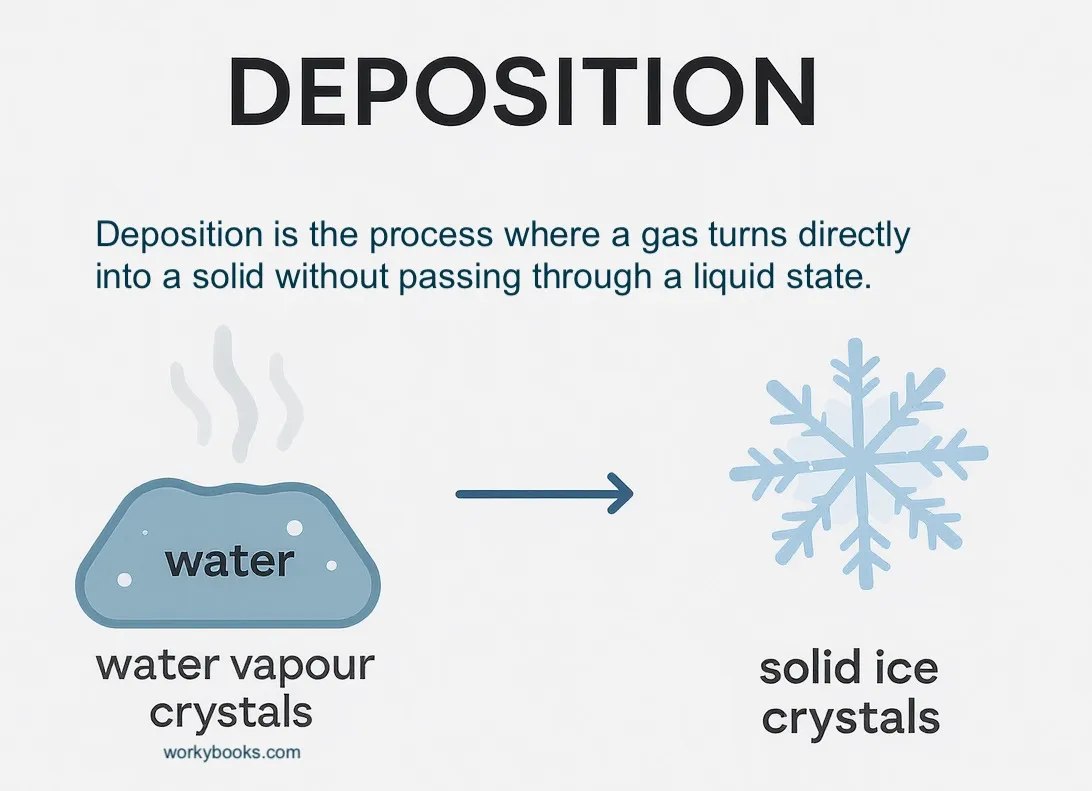
Deposition is a physical change that occurs when a substance changes state directly from a gas to a solid, skipping the liquid phase. This phenomenon is important in both natural environments and technology. In the winter, frost crystals form on windows when water vapor in the air becomes solid ice without first becoming liquid water. Scientists study deposition to better understand weather patterns, preserve food, and improve industrial processes.
How Deposition Happens: The Mechanism Behind the Change
Deposition occurs when gas particles lose energy very quickly, usually because the temperature drops suddenly. At the molecular level, gas molecules slow down so much that they arrange themselves into a solid structure, bypassing the liquid state entirely. This is the reverse of sublimation, which is when a solid turns into a gas without becoming a liquid first. For deposition to occur, the surrounding air must be cold enough and often at a certain humidity. An example is when water vapor in cold air deposits as ice crystals on a surface, forming frost. Another example is in the formation of snowflakes, where water vapor in clouds turns directly into solid ice crystals as it cools.
Applications and Connections: From Nature to Technology
Deposition is not just a curiosity; it has real-world applications. In food science, freezer burn happens when water vapor inside frozen food deposits as ice, changing the food’s texture. Scientists use knowledge of deposition in processes like thin film deposition to build electronic devices, layering materials atom by atom. In Earth’s atmosphere, deposition helps build the snowpack in polar regions, which can be measured to study climate change. Deposition also competes with other phase changes, such as condensation, depending on temperature and humidity. Understanding these interactions helps meteorologists predict weather events like frost or snow.
Complexities and Broader Impacts
Not all substances undergo deposition under the same conditions. For example, carbon dioxide gas can deposit into solid dry ice at very low temperatures and high pressures. In outer space, deposition plays a role on planets and moons where temperatures are extremely cold. The study of deposition helps scientists design better refrigerators, preserve biological samples, and even discover evidence of water or other materials on distant worlds. As researchers continue to investigate phase changes, new discoveries about matter and energy become possible.
Deposition, as a direct gas-to-solid change, demonstrates the interconnectedness of energy, matter, and the environment. By examining deposition, scientists link microscopic actions to global systems, connecting atomic behavior to weather, technology, and planetary science.
Interesting Fact: Each snowflake is unique because the conditions that cause deposition—temperature, humidity, and air movement—are always changing in the atmosphere.
What is deposition?
A change from gas directly to solid, skipping the liquid phase.A change from solid to liquid.A change from liquid to gas.A change from solid to gas.
Which of the following is an example of deposition?
Frost forming on a window.Ice melting in the sun.Water boiling on a stove.Rain falling from a cloud.
What is the reverse process of deposition called?
CondensationSublimationEvaporationFreezing
What happens to gas particles during deposition?
They slow down and arrange into a solid.They speed up and become a liquid.They spread apart and become a gas.They turn into a plasma.
In the passage, what technology uses thin film deposition?
Building electronic devices.Making ice cream.Washing windows.Cooking food.
What is freezer burn caused by?
Water vapor inside frozen food depositing as ice.Food getting too hot in the freezer.Food being left out in the sun.Adding too much salt to the food.
Which of the following best describes the importance of deposition in nature?
It helps build snowpacks important for climate studies.It melts snow quickly.It causes rain to fall.It turns water into ice cream.
If the air is not cold enough, will deposition occur?
No, because gas particles will not lose enough energy.Yes, deposition always occurs.
Deposition and condensation are the same process. (True/False)
TrueFalse
Deposition can occur with carbon dioxide to form dry ice. (True/False)
TrueFalse
Perfect For:
👩🏫 Teachers
• Reading comprehension practice
• Auto-graded assessments
• Literacy skill development
👨👩👧👦 Parents
• Reading practice at home
• Comprehension improvement
• Educational reading time
🏠 Homeschoolers
• Reading curriculum support
• Independent reading practice
• Progress monitoring
Reading Features:
📖
Reading Passage
Engaging fiction or nonfiction text
❓
Comprehension Quiz
Auto-graded questions
📊
Instant Feedback
Immediate results and scoring
📄
Printable Version
Download for offline reading
🔊
Read Aloud
Voice-over with word highlighting
Reviews & Ratings
No reviews yet. Be the first to share your experience!
Related Content
The Melting Point of Substances
This middle school science reading passage, titled 'The Melting Point of Substances', explores the physical property kno...
5-PS1MS-PS1-4RI.6.3RI.7.1
The Melting Point of Steel
This engaging science passage, 'The Melting Point of Steel,' explains a key physical property of steel—its melting point...
5-PS1MS-PS1-4RI.6.3RI.7.1
The Melting Point of Aluminum
This science reading passage, 'The Melting Point of Aluminum,' introduces middle school students to the physical propert...
5-PS1MS-PS1-4RI.6.3RI.7.1
The Melting Point of Copper
This reading passage, 'The Melting Point of Copper,' introduces middle school students to an important physical property...
5-PS1MS-PS1-4RI.6.3RI.7.1
The Boiling Point of Water
This passage, 'The Boiling Point of Water,' introduces students to the physical property of boiling point through one of...
5-PS1MS-PS1-4RI.6.3RI.7.1
Is Sublimation Endothermic or Exothermic?
This NGSS-aligned science passage for middle school explains the thermodynamic nature of sublimation, showing how a soli...
MS-PS1-4HS-PS1
How Many Valence Electrons Does Oxygen Have?
This NGSS-aligned science reading passage teaches middle school students about the number of valence electrons in oxygen...
MS-PS1-2MS-PS1-4
How Many Valence Electrons Does Chlorine Have?
This NGSS-aligned science reading passage explains how many valence electrons chlorine has and why that makes it such a ...
MS-PS1-2MS-PS1-4
What Is Vapor Pressure?
This NGSS-aligned science passage explains the concept of vapor pressure in an age-appropriate, engaging way for middle ...
MS-PS1-4MS-LS1-2
What is Freezing Point Depression
This passage, 'Freezing Point Depression,' introduces students to the physical science concept of how adding substances ...
5-PS1MS-PS1-4RI.6.3RI.7.1
Solids, Liquids, and Gases
This comprehensive middle school science passage explains the scientific concepts behind the three common states of matt...
MS-PS1-4
Behavior of Gases
This comprehensive reading passage explores the behavior of gases for middle school students, aligned with NGSS standard...
MS-PS1-4
Evaporation as Physical Change
This middle school science passage examines the process of evaporation, a fundamental physical change where a liquid tur...
MS-PS1-4
Physical Changes: Condensation
This middle school science passage explores the process of condensation, the physical change where a gas becomes a liqui...
MS-PS1-4
Sublimation as Physical Change
This educational passage for grades 6-8 explores the science of sublimation—a physical change where a solid transforms d...
MS-PS1-4
Scientific Investigations
This passage, aligned with NGSS standards for grades 6-8, introduces students to the process of scientific investigation...
MS-ETS1-1MS-ETS1-2MS-ETS1-3MS-ETS1-4
Scientific Theories
This reading passage for grades 6-8 introduces students to the concept of scientific theories, emphasizing that these ar...
MS-PS1-1MS-PS1-4MS-PS3-4SCIENCE AND ENGINEERING PRACTICES
Particle Model of Matter
This comprehensive science reading passage for grades 6-8 explores the particle model of matter, aligning with NGSS stan...
MS-PS1-1MS-PS1-4
Kinetic Theory of Matter
This middle school science reading passage introduces students to the kinetic theory of matter, aligning with NGSS MS-PS...