This learning resource is available in interactive and printable formats. The interactive worksheet can be played online and assigned to students. The Printable PDF version can be downloaded and printed for completion by hand.
This middle school science passage explores the process of condensation, the physical change where a gas becomes a liquid. Aligned with NGSS standard MS-PS1-4, it begins with everyday phenomena such as dew on grass and water droplets on cold drinks, then delves into the particle-level mechanisms and energy transfer involved. Students will learn about how condensation is part of larger systems, including weather and the water cycle, and its significance in the environment and technology. The passage uses academic vocabulary with in-text definitions, includes a glossary, and is supported by comprehension, writing, and graphic organizer activities. Spanish translation and differentiated, simplified versions are included for accessibility. Audio integration enhances engagement for all learners. This resource is ideal for grades 6-8, helping students understand both the science and the importance of condensation in daily life and global systems.
CONTENT PREVIEW
Expand content preview
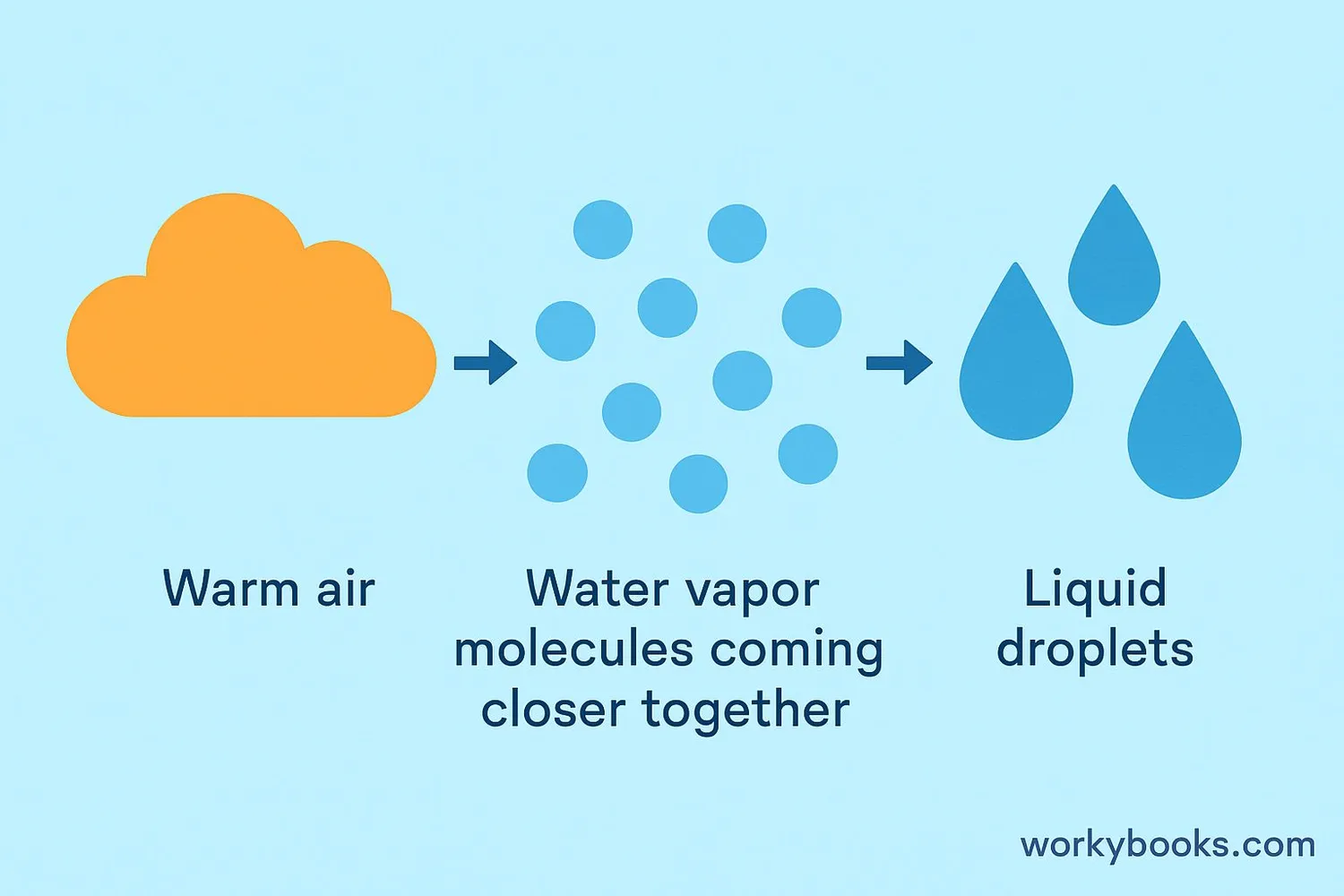
Diagram of the condensation process
Condensation is a physical process where a substance changes from a gas to a liquid. This change is important in many natural and everyday systems, such as the formation of dew on grass or water droplets on a cold drink. When water vapor in the air cools down, it turns into liquid water. This transformation is part of the water cycle, which moves water through the environment and affects weather and climate. Understanding condensation helps explain how clouds form, how rain develops, and why mirrors fog up after a hot shower.
How Condensation Happens: The Particle Perspective
On a microscopic level, all matter is made of particles that are always moving. In a gas, like water vapor, these particles move quickly and are far apart. When the gas cools, the particles lose energy and begin to slow down. As they move slower, the particles come closer together and form a liquid. This process releases energy into the surroundings, often as heat. For example, when humid air touches a cold surface, like the outside of a chilled glass, the water vapor cools and condenses, forming visible droplets. The rate of condensation increases when the temperature of the surface is much colder than the air, which is why more droplets appear on very cold drinks.
Real-World Examples and Applications
Condensation is responsible for many familiar phenomena. Dew forms on grass in the early morning when the air cools overnight, causing water vapor to condense on surfaces. Fog appears when warm, moist air meets cooler air or ground, making tiny droplets of water suspended in the air. After a hot shower, the bathroom mirror fogs up because water vapor hits the cold glass and condenses. In the atmosphere, clouds form when air rises, cools, and water vapor condenses around tiny particles like dust. Condensation is also essential in technology, such as air conditioners and refrigerators, which use it to remove heat and cool spaces efficiently.
Condensation and the Water Cycle
The role of condensation goes beyond everyday life. It is a critical part of the water cycle. Water evaporates from oceans, lakes, and rivers into the atmosphere as vapor. When this vapor rises and cools, condensation turns it back into liquid water, which can become clouds and eventually precipitation like rain or snow. This cycle ensures that fresh water is distributed across the planet, supporting all life. Scientists study condensation to better predict weather patterns and understand climate systems. The energy released during condensation also plays a role in storm development and atmospheric movement.
Condensation shows how changes in energy and particle motion can lead to important physical changes. It connects the behavior of molecules to large-scale natural processes, demonstrating the interactions between matter and energy in our world.
Interesting Fact: A single cumulus cloud can contain more than 500,000 kilograms (over 1 million pounds) of condensed water droplets created by condensation in the atmosphere!
What is condensation?
A process where a gas turns into a liquid.A process where a liquid turns into a gas.A process where a solid turns into a gas.A process where a liquid turns into a solid.
Which of the following is an example of condensation?
Dew forming on grass in the morning.Ice melting on a sunny day.Water boiling on a stove.Salt dissolving in water.
Why do water droplets form on the outside of a cold drink?
Because water vapor in the air cools and condenses on the surface.Because the drink is leaking.Because the glass is melting.Because the air is completely dry.
What happens to the energy of particles during condensation?
Particles lose energy and slow down.Particles gain energy and speed up.Particles split into atoms.Particles disappear.
What does the term 'precipitation' mean in the context of the water cycle?
Water that falls from clouds to the ground.Water that evaporates from the ocean.Water that forms fog.Water that freezes into ice.
In the passage, what does the word 'particles' mean?
Tiny pieces of matter that make up substances.Large drops of water.Pieces of glass.Units of temperature.
How does condensation relate to cloud formation?
Clouds form when water vapor cools and condenses around dust particles.Clouds form when rain evaporates.Clouds form from melting ice.Clouds form when the sun shines on water.
Why is condensation important in air conditioners and refrigerators?
Because it helps remove heat and cool spaces.Because it creates electricity.Because it makes ice instantly.Because it keeps food dry.
Condensation only happens at high temperatures. (True/False)
FalseTrue
The energy released during condensation can help form storms. (True/False)
TrueFalse
Perfect For:
👩🏫 Teachers
• Reading comprehension practice
• Auto-graded assessments
• Literacy skill development
👨👩👧👦 Parents
• Reading practice at home
• Comprehension improvement
• Educational reading time
🏠 Homeschoolers
• Reading curriculum support
• Independent reading practice
• Progress monitoring
Reading Features:
📖
Reading Passage
Engaging fiction or nonfiction text
❓
Comprehension Quiz
Auto-graded questions
📊
Instant Feedback
Immediate results and scoring
📄
Printable Version
Download for offline reading
🔊
Read Aloud
Voice-over with word highlighting
Reviews & Ratings
No reviews yet. Be the first to share your experience!
Related Content
The Melting Point of Substances
This middle school science reading passage, titled 'The Melting Point of Substances', explores the physical property kno...
5-PS1MS-PS1-4RI.6.3RI.7.1
The Melting Point of Steel
This engaging science passage, 'The Melting Point of Steel,' explains a key physical property of steel—its melting point...
5-PS1MS-PS1-4RI.6.3RI.7.1
The Melting Point of Aluminum
This science reading passage, 'The Melting Point of Aluminum,' introduces middle school students to the physical propert...
5-PS1MS-PS1-4RI.6.3RI.7.1
The Melting Point of Copper
This reading passage, 'The Melting Point of Copper,' introduces middle school students to an important physical property...
5-PS1MS-PS1-4RI.6.3RI.7.1
The Boiling Point of Water
This passage, 'The Boiling Point of Water,' introduces students to the physical property of boiling point through one of...
5-PS1MS-PS1-4RI.6.3RI.7.1
Is Sublimation Endothermic or Exothermic?
This NGSS-aligned science passage for middle school explains the thermodynamic nature of sublimation, showing how a soli...
MS-PS1-4HS-PS1
How Many Valence Electrons Does Oxygen Have?
This NGSS-aligned science reading passage teaches middle school students about the number of valence electrons in oxygen...
MS-PS1-2MS-PS1-4
How Many Valence Electrons Does Chlorine Have?
This NGSS-aligned science reading passage explains how many valence electrons chlorine has and why that makes it such a ...
MS-PS1-2MS-PS1-4
What Is Vapor Pressure?
This NGSS-aligned science passage explains the concept of vapor pressure in an age-appropriate, engaging way for middle ...
MS-PS1-4MS-LS1-2
What is Freezing Point Depression
This passage, 'Freezing Point Depression,' introduces students to the physical science concept of how adding substances ...
5-PS1MS-PS1-4RI.6.3RI.7.1
Solids, Liquids, and Gases
This comprehensive middle school science passage explains the scientific concepts behind the three common states of matt...
MS-PS1-4
Behavior of Gases
This comprehensive reading passage explores the behavior of gases for middle school students, aligned with NGSS standard...
MS-PS1-4
Evaporation as Physical Change
This middle school science passage examines the process of evaporation, a fundamental physical change where a liquid tur...
MS-PS1-4
Sublimation as Physical Change
This educational passage for grades 6-8 explores the science of sublimation—a physical change where a solid transforms d...
MS-PS1-4
Physical Changes: Deposition
This middle school science passage explores the concept of deposition, a type of physical change where matter transition...
MS-PS1-4
Scientific Investigations
This passage, aligned with NGSS standards for grades 6-8, introduces students to the process of scientific investigation...
MS-ETS1-1MS-ETS1-2MS-ETS1-3MS-ETS1-4
Scientific Theories
This reading passage for grades 6-8 introduces students to the concept of scientific theories, emphasizing that these ar...
MS-PS1-1MS-PS1-4MS-PS3-4SCIENCE AND ENGINEERING PRACTICES
Particle Model of Matter
This comprehensive science reading passage for grades 6-8 explores the particle model of matter, aligning with NGSS stan...
MS-PS1-1MS-PS1-4
Kinetic Theory of Matter
This middle school science reading passage introduces students to the kinetic theory of matter, aligning with NGSS MS-PS...