The Idea of the Atom
Interactive passage with audio narration, comprehension questions, and printable PDF.
By completing this purchase you agree to our Terms of Use and Privacy Policy. Your subscription renews automatically until you cancel. You can cancel anytime from your account settings. All sales are final and non-refundable. Digital content is available for download in your account immediately upon purchase.
What's included
The Idea of the Atom preview and details
About this printable The Idea of the Atom science reading passage, NGSS-aligned (Grades 5-8)
Sample passage and quiz from The Idea of the Atom
Reading passage and comprehension quiz preview
What Are Atoms
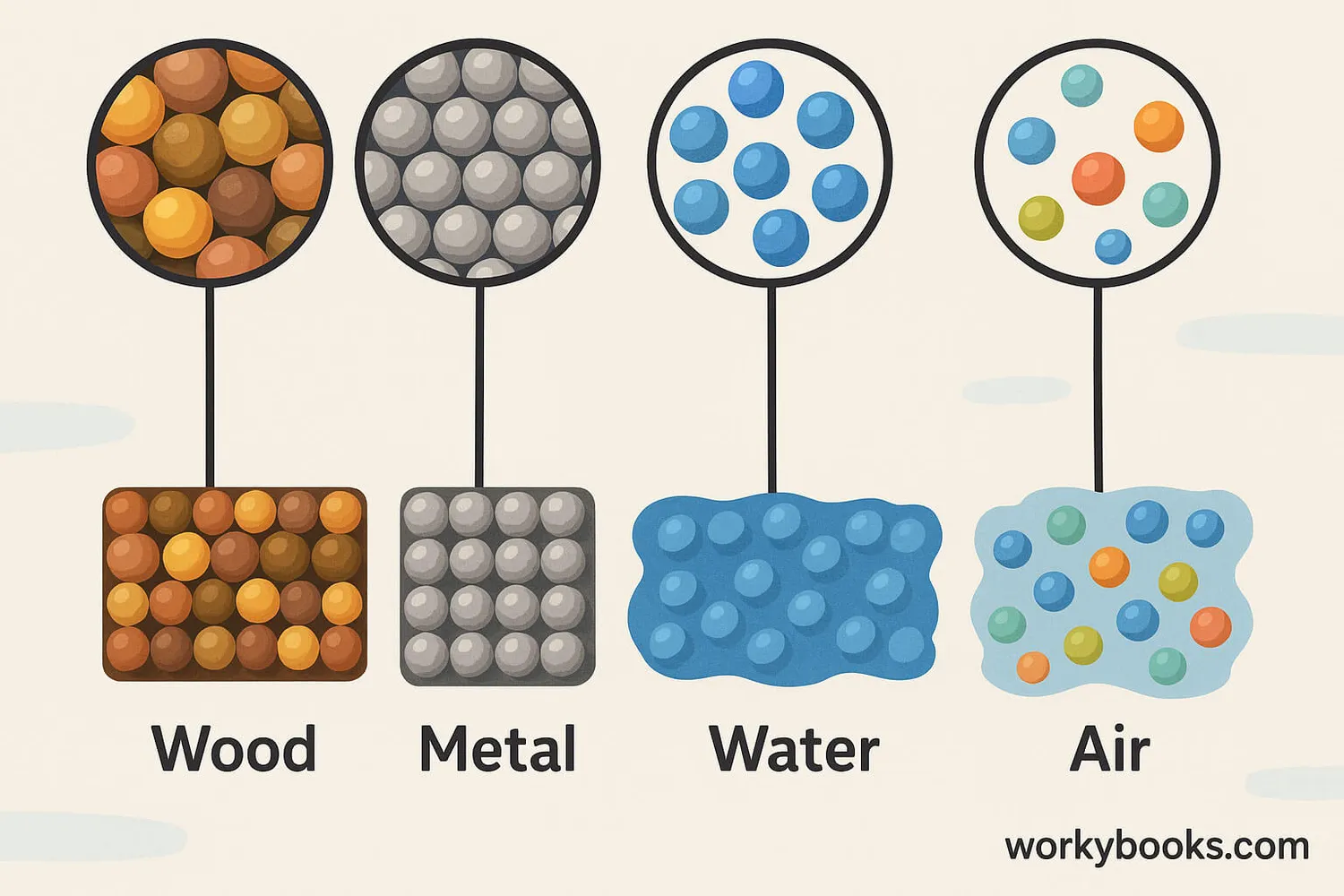
Matter makes up everything in the universe, from the air we breathe to the food we eat and the ground beneath our feet. Scientists discovered that all matter is composed of extremely small particles called atoms. Understanding what atoms are and how they behave allows us to explain the properties of materials, chemical reactions, and even the structure of life itself. The development of atomic theory is a story of curiosity, observation, and scientific thinking that has shaped modern science.
Early Ideas About Atoms
Over 2,000 years ago, the Greek philosopher Democritus proposed that all matter could be divided into smaller and smaller pieces until reaching a particle that could not be divided further. He called these particles "atomos," meaning "uncuttable." However, Democritus had no experimental evidence for his idea; it was a philosophical concept. For centuries, people believed that matter was made of earth, air, fire, and water. The atomic idea was not widely accepted until scientific methods could provide proof.
Dalton’s Atomic Theory: A New Foundation
In the early 1800s, English scientist John Dalton conducted experiments with gases and chemicals. Dalton observed that elements always combined in fixed ratios, which suggested that matter was made of individual particles. He formulated Dalton’s atomic theory, which included several key ideas: (1) all matter is made of tiny, indivisible atoms; (2) atoms of the same element are identical; (3) atoms of different elements are different; and (4) atoms cannot be created or destroyed in a chemical reaction, only rearranged. Dalton’s theory provided the first real scientific explanation for the behavior of matter.
Atoms: The Smallest Units with Unique Properties
Atoms are incredibly small; a single drop of water contains over a billion billion atoms. Each atom of an element, such as gold or oxygen, has properties that make it different from atoms of other elements. For example, oxygen atoms always have eight protons, while gold atoms have seventy-nine. The structure of atoms—how their nucleus and electrons are arranged—determines the properties of elements and how they interact to form compounds. These interactions are the foundation for the diversity of materials and living things on Earth.
Atomic Theory and Modern Science
The idea that everything is made of atoms has led to enormous advances in science and technology. Understanding atoms has enabled scientists to develop new materials, medicines, and energy sources. It has also revealed that the world is governed by laws at the atomic and molecular level. From explaining why water boils at 100°C to how batteries generate electricity, atomic theory connects to every part of our daily lives. As scientists continue to explore the atom, they uncover even more about the universe and open the door to future discoveries.
Interesting Fact: If you lined up atoms from a single grain of sand, they would stretch for more than one meter—showing just how tiny, and how numerous, atoms truly are!
Comprehension quiz (10 questions)
1. What is the smallest unit of an element that retains its properties?
2. Who first suggested that matter is made of tiny, indivisible particles called 'atomos'?
3. According to Dalton’s atomic theory, atoms of the same element are:
4. What does the nucleus of an atom contain?
5. What does the word 'atomos' mean?
6. What is the main reason Dalton’s atomic theory was accepted more than Democritus’s idea?
7. Atoms of which element always have seventy-nine protons?
8. True or False: Atoms can be destroyed in chemical reactions.
9. True or False: The arrangement of electrons and nucleus in an atom determines the element’s properties.
10. Which discovery about atoms helped scientists create new materials and medicines?
Perfect for the way you teach
- Build comprehension skills
- Auto-graded quiz
- Differentiated reading
- Read together at home
- Improve fluency
- Quiet reading time
- Reading curriculum support
- Independent practice
- Track Lexile growth