Citizen Science and Ecological Monitoring — Reading Comprehension
Rate this
Premium Resource
Present
Present in classroom. No work saved
Assign
Classroom with student accounts, Track progress
Quick Play
No student accounts, assign with a link
Grades
5
6
7
8
Standards
MS-LS2-1
PRINT+DIGITAL RESOURCE
This learning resource is available in interactive and printable formats. The interactive worksheet can be played online and assigned to students. The Printable PDF version can be downloaded and printed for completion by hand.
This engaging passage for grades 6-8 introduces the concept of citizen science and its critical role in ecological monitoring. Aligned with NGSS standard MS-LS2-1, the reading explains how public participation expands scientists’ ability to collect data across large areas and over long periods. Students learn about real-world projects like eBird, Globe at Night, and Monarch Watch, and discover how to contribute by submitting observations or analyzing data. The passage explores the importance of data quality, training, and verification, and connects these efforts to broader scientific principles such as systems interactions and long-term ecosystem change. Activities include a glossary, Spanish translation, differentiated version, multiple-choice and writing prompts, and graphic organizers. The resource is suitable for diverse learners and is audio integrated, making it ideal for classroom science lessons on ecology and scientific practices.
CONTENT PREVIEW
Expand content preview
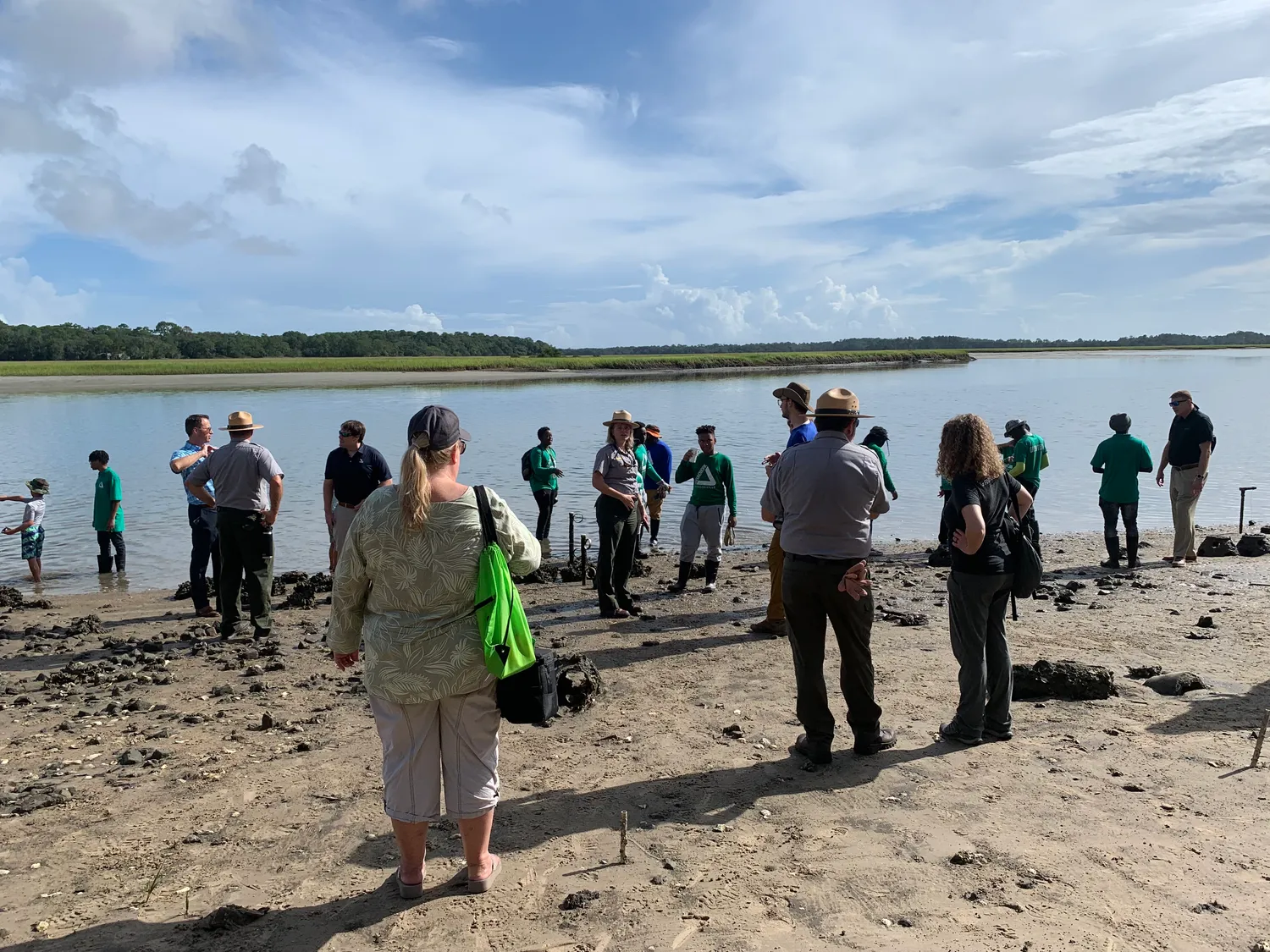
Volunteers help in shoreline restoration by planting and monitoring grasses and installing oyster structures. Image by NPS / Wikimedia Commons (Public domain).
Citizen science is public participation in real scientific research. Each year, scientists face a major challenge: they need lots of data from different places and times to understand how ecosystems change. However, scientists cannot be everywhere at once. Citizen science solves this problem by allowing volunteers to help collect, organize, and even analyze scientific data. These contributions are especially important in monitoring biodiversity, tracking animal migrations, and observing environmental changes. As a result, citizen science projects expand the reach of ecological research and help answer important questions about nature.
How Citizen Science Works
In citizen science, volunteers follow specific protocols to ensure data is reliable. For example, people use mobile apps or online platforms to record sightings of birds, plants, or insects. Projects like eBird collect millions of bird observations each year, while iNaturalist allows anyone to upload photos and identify any living species. Some projects, such as Monarch Watch, focus on tracking the migration of monarch butterflies. In urban areas, Globe at Night asks participants to measure light pollution by counting visible stars. To maintain data quality, many projects provide training materials, and experts verify unusual records. Statistical methods are used to address variability in observations. By combining thousands or millions of records, scientists can detect trends that would be impossible to see with only a few researchers.
Applications and Long-term Monitoring
Citizen science has led to major discoveries in ecology. For example, data from the Christmas Bird Count has shown how bird populations shift in response to climate change. Long-term monitoring projects, such as phenology networks, track the timing of natural events like leaf-out or bird nesting over years or decades. This helps scientists detect changes in ecosystems that might indicate environmental stress or adaptation. Students can participate by conducting schoolyard biodiversity surveys, monitoring local water quality, or making species inventories. These activities not only support real research but also build scientific thinking skills and connect participants to their local environment.
Complexities and Challenges
While citizen science offers many benefits, there are challenges. Data collected by volunteers can vary in accuracy, especially for difficult-to-identify species. Projects address this by providing clear instructions, using expert reviewers, and applying statistical corrections. Some citizen science platforms, such as Zooniverse, engage volunteers in analyzing images or data sets online, reducing errors through repeated checks. Despite these challenges, citizen science remains a powerful tool for expanding our scientific knowledge and involving communities in environmental stewardship.
By working together, scientists and citizens can observe, record, and protect the natural world. As ecological changes accelerate, ongoing public participation is vital for understanding and conserving our planet’s ecosystems.
Interesting Fact: In 2022, eBird participants submitted over 250 million bird observations worldwide, creating one of the largest biodiversity databases in history.
What is the main purpose of citizen science in ecology?
To involve the public in collecting scientific data about ecosystems.To replace professional scientists with volunteers.To watch movies about nature.To keep science secret from the public.
Which of the following is an example of a citizen science project focusing on birds?
eBirdGlobe at NightZooniverseMonarch Watch
Why do citizen science projects provide training materials and protocols?
To make sure volunteers collect reliable data.To make the projects more difficult.To keep people from joining.To teach people how to build computers.
What is a protocol in the context of citizen science?
A rule or set of steps for collecting data.A type of bird.A kind of smartphone app.A group of scientists.
What does 'biodiversity' mean as used in the passage?
The variety of living species in a habitat or on Earth.A type of scientific tool.A weather pattern.A way to collect data.
In the passage, what is the role of statistical methods in citizen science?
To address variability and improve data accuracy.To teach volunteers how to use microscopes.To replace all human observations.To keep data secret.
What can student groups do to participate in citizen science?
Conduct schoolyard biodiversity surveys or monitor water quality.Only read about science in textbooks.Ignore all scientific protocols.Wait for scientists to visit their school.
Which statement best describes a challenge of citizen science?
Volunteer data can vary in accuracy, especially for hard-to-identify species.Volunteers never make mistakes.All data is collected perfectly every time.Scientists do not need any help.
True or False: Zooniverse is a citizen science platform where volunteers help analyze scientific data online.
TrueFalse
True or False: The Christmas Bird Count is only for professional scientists.
TrueFalse
Perfect For:
👩🏫 Teachers
• Reading comprehension practice
• Auto-graded assessments
• Literacy skill development
👨👩👧👦 Parents
• Reading practice at home
• Comprehension improvement
• Educational reading time
🏠 Homeschoolers
• Reading curriculum support
• Independent reading practice
• Progress monitoring
Reading Features:
📖
Reading Passage
Engaging fiction or nonfiction text
❓
Comprehension Quiz
Auto-graded questions
📊
Instant Feedback
Immediate results and scoring
📄
Printable Version
Download for offline reading
🔊
Read Aloud
Voice-over with word highlighting
Reviews & Ratings
No reviews yet. Be the first to share your experience!
Related Content
The Leafy Sea Dragon: Nature's Living Seaweed
This NGSS-aligned passage explores how leafy sea dragons (Phycodurus eques) demonstrate key life science concepts for mi...
MS-LS2-1RI.6.3RI.7.3RI.8.8
The Narwhal: Arctic’s Unicorn of the Sea
This NGSS-aligned passage (MS-LS2-1) explores how narwhals survive in Arctic ecosystems. Students learn about specialize...
MS-LS2-1RI.6.3RI.7.3RI.8.8
The Blue-Ringed Octopus
This NGSS aligned passage explores how the tiny blue-ringed octopus impacts its ecosystem through predator-prey relation...
MS-LS2-1RI.6.3RI.7.3RI.8.8
Tardigrades: Microscopic Superheroes
Aligned to MS-LS1-1, this passage examines how tardigrade cell structures (TDP proteins, DNA-repair enzymes) allow survi...
MS-LS2-1RI.6.3RI.7.3RI.8.8
What Do Axolotls Eat?
This science reading passage, titled "What Do Axolotls Eat?", offers an engaging exploration into the feeding habits of ...
MS-LS2-1
Where Do Axolotls Live?
This science reading passage, titled "The Axolotl's Home," delves into the specific natural environment of the fascinati...
MS-LS4-DMS-LS2-1
The Blobfish
This science reading passage, titled "The Blobfish: A Deep-Sea Mystery," introduces students to one of Earth's most pecu...
MS-LS4-DMS-LS2-1
What Do Blobfish Eat?
This science reading passage, titled "What Do Blobfish Eat?", offers an engaging exploration into the feeding habits of ...
MS-LS2-1
Where Do Penguins Live?
This engaging science reading passage, titled "Where Do Penguins Live? A Cold and Coastal World," clarifies the diverse ...
MS-LS2-1
The Emperor Penguin
This science reading passage, titled "The Emperor Penguin: Antarctica's Royal Survivor," introduces students to one of t...
MS-LS2-1
The Adélie Penguin
This engaging science reading passage, titled "The Adélie Penguin: Antarctica's Little Explorer," introduces students to...
MS-LS2-1
How Does Global Warming Affect Adélie Penguins?
This comprehensive science passage, titled "How Does Global Warming Affect Adélie Penguins?", details the significant im...
MS-LS2-1
Desert Birds
This informational passage for grades 6-8 examines how desert birds survive and thrive in some of the harshest environme...
MS-LS2-1MS-LS2-2MS-LS1-4
Abiotic Factors in Ecosystems
This comprehensive informational reading passage is designed for middle school science students and aligns with NGSS sta...
MS-LS2-1
Biomes: Terrestrial Ecosystems
This NGSS-aligned science reading passage for grades 6-8 provides a comprehensive survey of Earth’s major terrestrial bi...
MS-LS2-1
Biomes: Aquatic Ecosystems
This middle school science passage, aligned with NGSS standard MS-LS2-1, introduces students to the key features and mec...
MS-LS2-1
Galápagos Islands
This engaging science passage explores the Galápagos Islands, a volcanic archipelago located off the coast of Ecuador in...
MS-LS2-1MS-LS4-4MS-ESS3-4
Florida Everglades
This comprehensive passage introduces middle school students to the Florida Everglades, a distinctive wetland ecosystem ...
MS-LS2-1MS-LS2-4MS-ESS3-3MS-ESS3-4
Great Barrier Reef
This passage introduces middle school students to the Great Barrier Reef, the world's largest coral reef system, located...
MS-LS2-1MS-LS2-4MS-ESS3-5
Wetland Biomes
This comprehensive science passage introduces middle school students to the concept of wetland biomes. Aligned with NGSS...