Child Labor in the Industrial Revolution
Interactive passage with audio narration, comprehension questions, and printable PDF.
By completing this purchase you agree to our Terms of Use and Privacy Policy. Your subscription renews automatically until you cancel. You can cancel anytime from your account settings. All sales are final and non-refundable. Digital content is available for download in your account immediately upon purchase.
What's included
Part of this bundle

Child Labor in the Industrial Revolution preview and details
About this printable Child Labor in the Industrial Revolution reading passage (Grades 3-5)
Sample passage and quiz from Child Labor in the Industrial Revolution
Reading passage and comprehension quiz preview
Child Labor in the Industrial Revolution
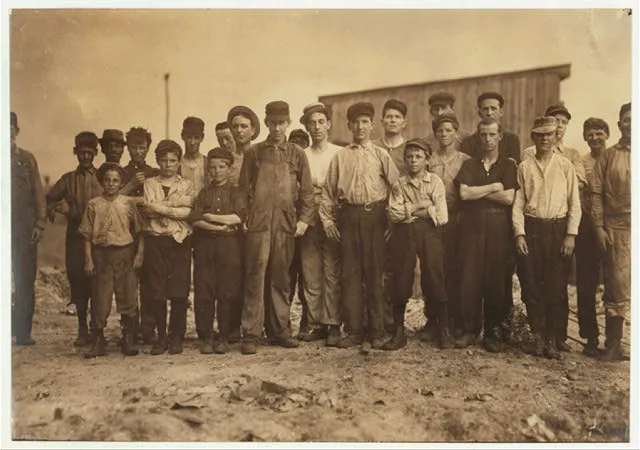
Source: Library of Congress - Hine, Lewis Wickes, 1874-1940
The Industrial Revolution changed the United States in many ways. Starting in the late 1700s and growing through the 1800s, new machines and factories made it possible to produce goods faster than ever before. But this progress also created problems. One big problem was child labor.
During the Industrial Revolution, many children worked in factories, mines, and mills. Some were as young as five years old. Their families were often poor and needed every family member to earn money. Instead of going to school, children worked long hours. A typical workday could last 10 to 12 hours.
Children did many jobs. Some ran machines in loud, dirty factories. Others crawled into small spaces in coal mines to pick rocks or fix tools. Many worked in textile mills, where they helped spin thread or weave cloth. These jobs were very dangerous. Children could get hurt by sharp machines or heavy equipment. They often worked in dark, crowded rooms with little air to breathe.
Many people saw these problems and wanted to help. Reformers, like Lewis Hine, took photographs and wrote newspaper articles to show how hard life was for child workers. These reformers believed children should be safe and have a chance to learn in school. They spoke to lawmakers and the public, asking for new rules to protect children.
Over time, more people agreed that child labor was wrong. Laws were passed to stop factories from hiring young children. These laws set age limits and made sure children went to school. Life improved for many families. Children no longer had to work in dangerous places. Instead, they could learn and play like other kids.
The fight to end child labor was not easy. It took the hard work of many brave people to change the laws. Today, these laws protect children from dangerous jobs and help them get the education they need.
Interesting Fact: In 1900, about 1 out of every 6 children in the United States had a job outside the home.
Comprehension quiz (8 questions)
1. What is child labor?
2. Where did many children work?
3. Who was Lewis Hine?
4. Why did children work?
5. What was one effect of new laws?
6. Why did reformers take photos and write articles?
7. Child labor is now illegal. True or false?
8. What does 'reformer' mean in this passage?
Common Core standards for Child Labor in the Industrial Revolution
Explain events, procedures, ideas, or concepts in a historical, scientific, or technical text, including what happened and why, based on specific information in the text.
Determine the meaning of general academic and domain-specific words or phrases in a text relevant to a grade 4 topic or subject area.
Write informative/explanatory texts to examine a topic and convey ideas and information clearly.
Perfect for the way you teach
- Build comprehension skills
- Auto-graded quiz
- Differentiated reading
- Read together at home
- Improve fluency
- Quiet reading time
- Reading curriculum support
- Independent practice
- Track Lexile growth