Children and Women During the Civil War
Interactive passage with audio narration, comprehension questions, and printable PDF.
What's included
Part of this bundle

Children and Women During the Civil War preview and details
About this printable Children and Women During the Civil War reading passage (Grades 3-5)
Sample passage and quiz from Children and Women During the Civil War
Reading passage and comprehension quiz preview
Civil War Women Children
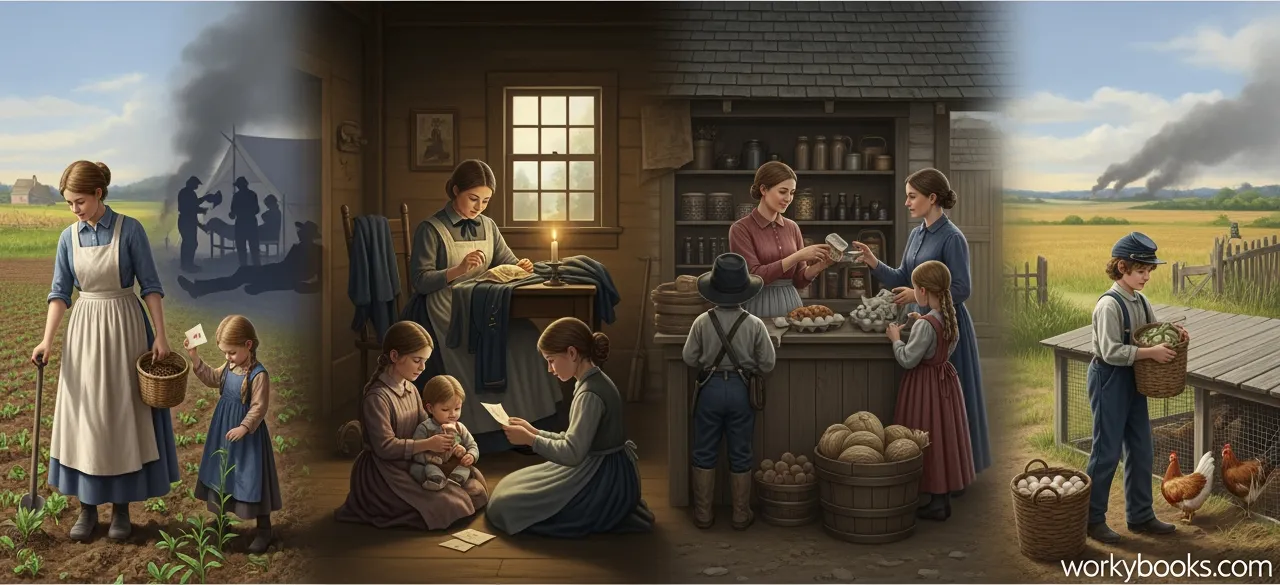
The American Civil War started in 1861 and ended in 1865. While men fought as soldiers, women and children had to keep life going at home. Farms and small towns depended on their hard work. Many men left home to join the army, so it was up to the families they left behind to do their jobs. This was a big responsibility.
Women took on many new roles. They worked in fields, planted crops, and took care of animals. Some women became nurses and helped care for wounded soldiers in hospitals. Others made clothes and sewed uniforms for the army. Women also raised money and gathered supplies for soldiers. Their work was important to the war effort. Without them, soldiers would not have had enough food or clothing.
Life was hard for children, too. Many children had to help with chores, like milking cows, gathering eggs, or working in gardens. Some older children even took over jobs their fathers did before the war. Children learned to be strong and helpful. They missed their fathers and brothers but knew they had to help the family.
During the Civil War, supplies like food, cloth, and medicine were often scarce. Families had to find creative ways to get by. Women used old fabric to make new clothes. They grew vegetables in gardens and learned to make do with less. Some women wrote letters to soldiers to keep their spirits up. They showed bravery and perseverance every day.
After the war ended, families were finally able to reunite. The hard work and sacrifices of women and children helped keep their communities together during a difficult time. Their courage and kindness were a big part of the home front story.
Interesting Fact: Some women even disguised themselves as men so they could fight alongside soldiers in battle.
Comprehension quiz (8 questions)
1. When did the Civil War start?
2. What jobs did women do?
3. Why were supplies scarce?
4. How did children help families?
5. What is one way women helped soldiers?
6. What does perseverance mean?
7. Families had enough food and supplies. True or false?
8. What is a uniform?
Common Core standards for Children and Women During the Civil War
Refer to details and examples in a text when explaining what the text says explicitly and when drawing inferences from the text.
Explain events, procedures, ideas, or concepts in a historical, scientific, or technical text, including what happened and why, based on specific information in the text.
Determine the meaning of general academic and domain-specific words or phrases in a text relevant to a grade 4 topic or subject area.
Write informative/explanatory texts to examine a topic and convey ideas and information clearly.
Perfect for the way you teach
- Build comprehension skills
- Auto-graded quiz
- Differentiated reading
- Read together at home
- Improve fluency
- Quiet reading time
- Reading curriculum support
- Independent practice
- Track Lexile growth