Persian Empire in Mesopotamia
Interactive passage with audio narration, comprehension questions, and printable PDF.
By completing this purchase you agree to our Terms of Use and Privacy Policy. Your subscription renews automatically until you cancel. You can cancel anytime from your account settings. All sales are final and non-refundable. Digital content is available for download in your account immediately upon purchase.
What's included
Part of this bundle

Persian Empire in Mesopotamia preview and details
About this printable Persian Empire in Mesopotamia reading passage (Grades 5-8)
Sample passage and quiz from Persian Empire in Mesopotamia
Reading passage and comprehension quiz preview
Persian Empire
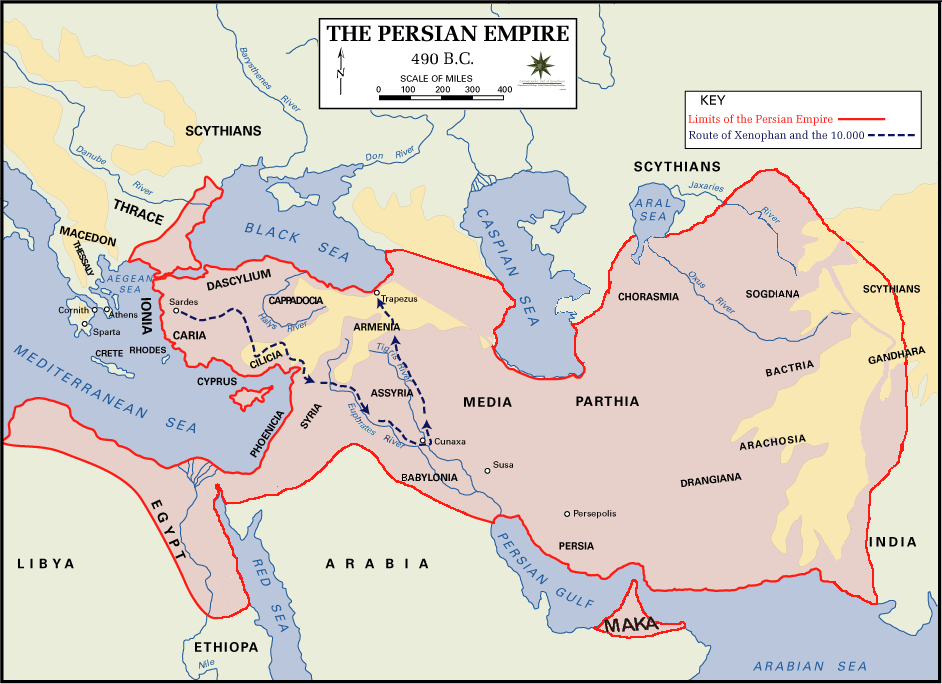
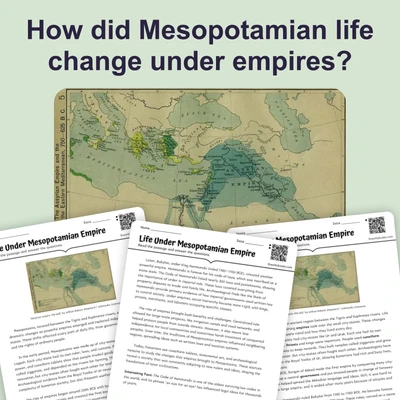
Persian Empire, 490 BC, showing route of Cyrus the Younger, Xenophon and the 10.000.Legends:━━━━ Route of Xenophon and the 10.000—— Limits of the Persian Empire.Expansion of Empire. ? (probably supposed to be mountains, but poorly drawn and inconsistent) by DHUSMA / Wikimedia Commons
The Persian Empire emerged as a powerful force in Mesopotamia in the mid-6th century BCE, transforming the region’s history. Mesopotamia, known as the land between the Tigris and Euphrates Rivers, was a center of civilization long before the Persians arrived. By 550 BCE, the Persians, led by Cyrus the Great, conquered Babylon and created one of the largest empires the world had seen.
Under Cyrus the Great, the Persians used innovative methods to rule their vast, multicultural empire. Cyrus is known for his policy of tolerance toward different peoples and religions, which helped unite the many groups within his empire. The Cyrus Cylinder, discovered in Babylon, records how he allowed exiled peoples, such as the Jews, to return to their homelands—a rare act of respect for conquered peoples during this era. His capital, Pasargadae, featured impressive architecture that reflected both Persian and Mesopotamian influences.
After Cyrus’s death, his successors, especially Darius I, expanded and organized the empire even further. Darius divided the territory into provinces called satrapies, each governed by a satrap. This system improved efficiency and helped prevent rebellions. Darius also built the Royal Road, a vast network that connected the empire from Susa to Sardis, making travel and communication faster. Archaeological evidence, such as inscriptions at Persepolis, show how Darius used both local and Persian officials to maintain control.
The Persian Empire changed Mesopotamia by introducing new systems of government, law, and trade. Unlike earlier empires that ruled by fear, the Persians often kept local rulers in place and respected local customs. This encouraged loyalty and stability. The empire’s wealth allowed for advancements in art, architecture, and technology, as seen in the grand palaces of Persepolis and the famous gardens of Babylon. Social hierarchy was still important, but people from different backgrounds could rise in society through service to the empire.
The rise of the Persian Empire marked a major turning point for Mesopotamia and the wider ancient world. Its policies of tolerance, efficient administration, and respect for diversity influenced later civilizations, including the Greeks and Romans. The empire’s legacy can still be seen today in ideas about governance and human rights.
Interesting Fact: Did You Know? The ancient Persian postal system, based on relay stations along the Royal Road, inspired the phrase “neither snow nor rain nor heat nor gloom of night” used by modern postal services. This study of the Persian Empire helps us understand how powerful states shaped the development of civilization and connects to broader themes of empire, cultural exchange, and human rights.
Comprehension quiz (8 questions)
1. Who founded the Persian Empire?
2. What is a satrap?
3. What did the Royal Road connect?
4. Why did Cyrus allow exiles to return?
5. How did satrapies help the empire?
6. What was a key feature of Persian rule?
7. The Persian Empire influenced Greece and Rome.
8. What does 'tolerance' mean in the passage?
Perfect for the way you teach
- Build comprehension skills
- Auto-graded quiz
- Differentiated reading
- Read together at home
- Improve fluency
- Quiet reading time
- Reading curriculum support
- Independent practice
- Track Lexile growth