Mesopotamian Inventions: Wheel, Plow, and More — Reading Comprehension
Rate this
Premium Resource
Present
Present in classroom. No work saved
Assign
Classroom with student accounts, Track progress
Quick Play
No student accounts, assign with a link
Grades
5
6
7
8
PRINT+DIGITAL RESOURCE
This learning resource is available in interactive and printable formats. The interactive worksheet can be played online and assigned to students. The Printable PDF version can be downloaded and printed for completion by hand.
This passage explores the major inventions of ancient Mesopotamia, focusing on technological breakthroughs such as the wheel, the plow, and irrigation systems. Students will learn how these advances arose from the needs of daily life and the geographic context of the Fertile Crescent. The text aligns with CA HSS 6.2 and CCSS RI.6-8 standards, providing evidence from archaeological discoveries and primary sources to support understanding of cause and effect, change over time, and the impact of innovation on society. Activities include a multiple-choice quiz, writing prompts, graphic organizers, a timeline, glossary, and Spanish translation. This resource supports history classes with read aloud audio and Spanish language options, challenging students to analyze history like historians while mastering complex informational text skills.
CONTENT PREVIEW
Expand content preview
Some of the most important inventions in human history originated in ancient Mesopotamia over 5,000 years ago.
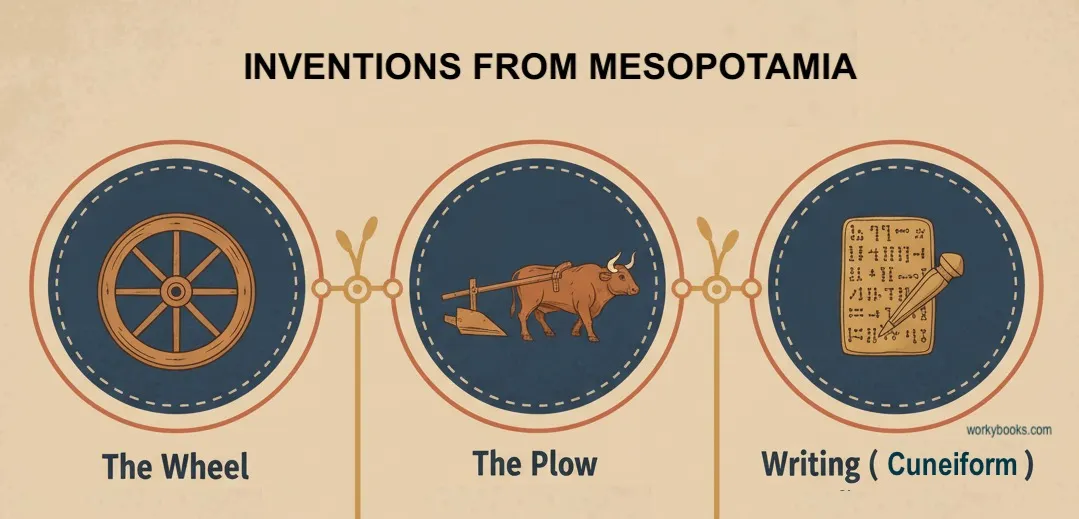
The region known as Mesopotamia, located between the Tigris and Euphrates rivers in present-day Iraq, is often called the "cradle of civilization" because of its many innovations. Some of the most important inventions in human history—including the wheel and the plow—originated in ancient Mesopotamia over 5,000 years ago. These technological advances transformed daily life, shaped social hierarchy, and set the stage for the rise of complex societies.
The wheel is perhaps Mesopotamia’s most famous invention. Archaeological evidence from the city-state of Ur shows that solid wooden wheels attached to carts appeared as early as 3500 BCE. The wheel made transportation of goods and people easier, allowing trade to expand between city-states. Later, wheels were adapted for use in pottery-making, as seen in the potter’s wheel. This technology helped craftspeople produce more uniform pottery, an essential item in everyday life and trade.
Another vital invention was the plow, which revolutionized agriculture. Early Mesopotamians relied on the annual flooding of rivers to irrigate their crops, but farming by hand was slow and inefficient. Sometime before 3000 BCE, Sumerian farmers developed the plow, making it easier to turn and aerate the soil. This allowed them to grow more food, support larger populations, and create surplus crops for trade. The plow’s success led to the development of a social hierarchy where farmers, landowners, and laborers had different roles and status in society.
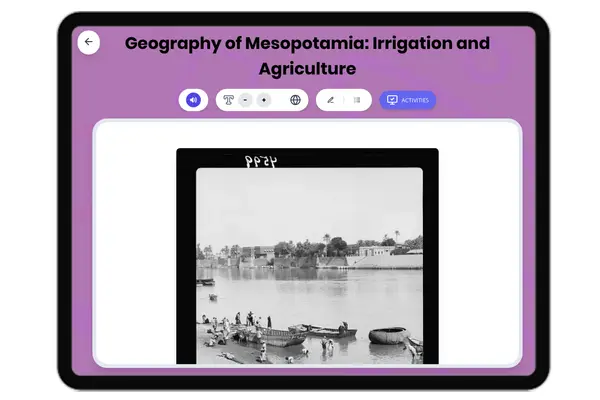
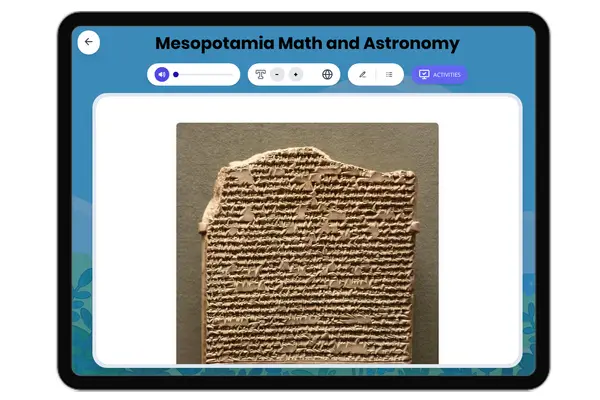
Mesopotamians also invented complex irrigation systems, such as canals and levees, to manage the unpredictable flooding of the rivers. These projects required careful planning and cooperation, as shown in ancient cuneiform records. With improved irrigation, city-states like Uruk and Lagash could produce enough food for their citizens and support specialized workers such as scribes, priests, and artisans. Another major innovation was cuneiform writing, which developed around 3200 BCE. Written language allowed people to record transactions, laws, and stories, preserving knowledge for future generations.
The inventions of Mesopotamia had lasting effects far beyond their own time and place. The wheel and plow spread to other civilizations, changing how people traveled, traded, and farmed. Innovations in irrigation and writing made it possible for cities to grow and governments to form. These advances show how human creativity and adaptation to geographic challenges can change the course of history.
Mesopotamia’s inventions connect with the broader theme of how early civilizations responded to their environment and shaped the world we live in today.
Interesting Fact: The earliest known map in the world was drawn on a clay tablet in Mesopotamia over 4,000 years ago.
Where was Mesopotamia located?
Between Tigris and Euphrates riversNear the Nile RiverIn South AmericaOn the Mediterranean Sea
What is Mesopotamia’s most famous invention?
WheelCompassSailboatPaper
When did cuneiform writing develop?
Around 3200 BCE1000 CE200 BCE6000 BCE
Why was the plow important for farming?
It turned and aerated soilIt made potteryIt carried waterIt wrote laws
How did irrigation help Mesopotamian cities?
Produced more foodStopped all floodsCreated desertsBuilt stone roads
What effect did the wheel have on trade?
Made trade easierStopped tradeDestroyed cropsBuilt temples
Mesopotamia’s inventions spread to other civilizations. True or false?
TrueFalse
What does "hierarchy" mean?
System of social rankingType of farming toolAncient writing systemA kind of wheel
Perfect For:
👩🏫 Teachers
• Reading comprehension practice
• Auto-graded assessments
• Literacy skill development
👨👩👧👦 Parents
• Reading practice at home
• Comprehension improvement
• Educational reading time
🏠 Homeschoolers
• Reading curriculum support
• Independent reading practice
• Progress monitoring
Reading Features:
📖
Reading Passage
Engaging fiction or nonfiction text
❓
Comprehension Quiz
Auto-graded questions
📊
Instant Feedback
Immediate results and scoring
📄
Printable Version
Download for offline reading
🔊
Read Aloud
Voice-over with word highlighting
Reviews & Ratings
No reviews yet. Be the first to share your experience!
Related Content
Daily Life in Ancient Mesopotamia
This engaging history reading passage explores daily life in ancient Mesopotamia, focusing on the social structure, role...
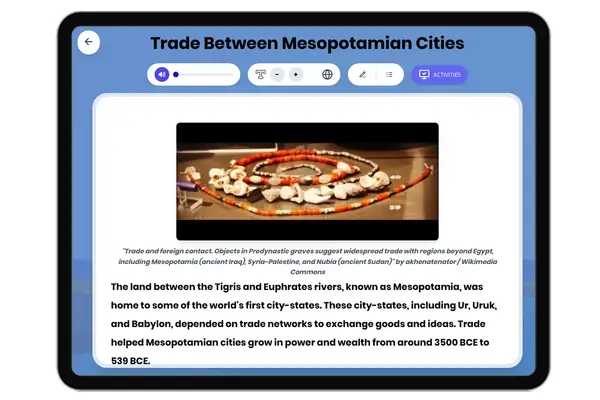
Trade Between Mesopotamian Cities
This history reading passage explores the development and significance of trade networks among ancient Mesopotamian citi...
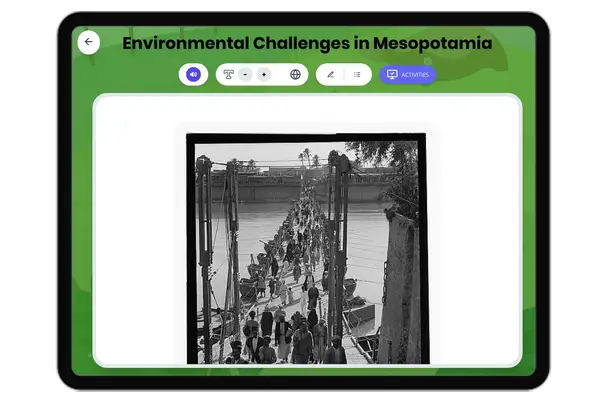
Environmental Challenges in Mesopotamia
This reading passage explores the environmental challenges faced by ancient Mesopotamia, the 'land between the rivers.' ...
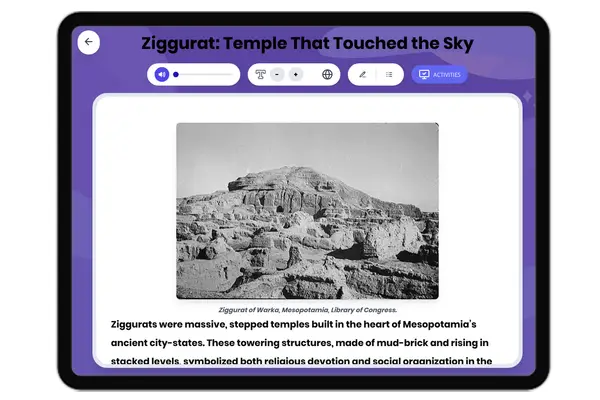
Mesopotamia Ziggurats
This engaging history reading passage explores the awe-inspiring ziggurats of ancient Mesopotamia, focusing on their con...
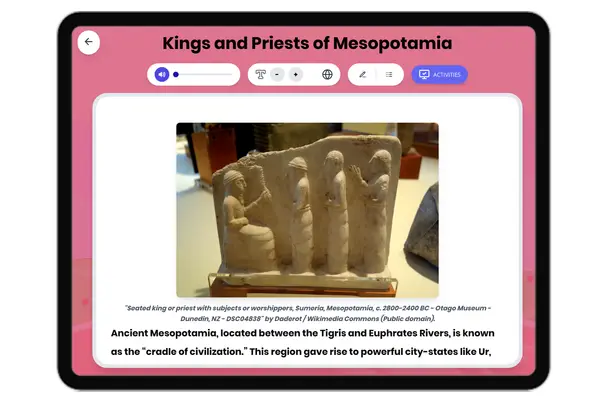
Mesopotamian Kings and Priests
This reading passage explores the complex relationship between power, religion, and patriarchy in Ancient Mesopotamia, f...
Mesopotamia Agriculture
This engaging reading passage explores how the geography of Mesopotamia shaped its civilization through innovative irrig...
Math and Astronomy in Mesopotamia
This engaging passage explores the scientific achievements of ancient Mesopotamia, the region between the Tigris and Eup...
Persian Empire in Mesopotamia
This engaging passage explores the rise of the Persian Empire and its impact on Mesopotamia, aligning with CA HSS 6.2 an...
Life Under Mesopotamian Empire
This passage explores the transformation of Mesopotamian life under powerful empires, including Sargon’s Akkadian Empire...
Evidence in Ancient History
This engaging history reading passage investigates how archaeologists and historians discover clues about how ancient pe...
Assyrian and Babylonian Empires
This comprehensive history reading passage explores the rise and fall of Assyria and Babylon, two great empires that rul...
The Tigris and Euphrates Rivers
This engaging history reading passage explores the vital role of the Tigris and Euphrates rivers in the development of a...
Ancient Greek City-States
This history reading passage explores the development and significance of city-states in ancient civilizations, focusing...
Code of Hammurabi
This rigorous history reading passage explores Hammurabi's Code, one of the earliest and most influential legal codes in...
Ancient Agriculture Farming
This passage explores the transformative impact of farming on ancient societies, examining how the Neolithic Revolution ...
Epic of Gilgamesh
This engaging passage delves into The Epic of Gilgamesh, the oldest known epic poem and a key artifact from ancient Meso...
Ancient Mathematics
This passage explores the essential role of mathematics in ancient civilizations, including Mesopotamia, Egypt, Greece, ...
Women in Ancient Societies
This reading passage explores the complex roles of women in the ancient world, focusing on civilizations such as Mesopot...
Mesopotamia—Informatonal Text
This informational text on Mesopotamia is a great way to practice reading comprehension. Students will read the text the...