The Tigris and Euphrates Rivers — Reading Comprehension
Rate this
Premium Resource
Present
Present in classroom. No work saved
Assign
Classroom with student accounts, Track progress
Quick Play
No student accounts, assign with a link
Grades
5
6
7
8
PRINT+DIGITAL RESOURCE
This learning resource is available in interactive and printable formats. The interactive worksheet can be played online and assigned to students. The Printable PDF version can be downloaded and printed for completion by hand.
This engaging history reading passage explores the vital role of the Tigris and Euphrates rivers in the development of ancient Mesopotamia, known as the 'Cradle of Civilization.' Students will investigate the environmental factors that shaped early societies, focusing on the importance of river geography for agriculture, trade, and urbanization. The passage uses specific archaeological and primary source evidence, such as cuneiform tablets and city-state ruins, to highlight the achievements and challenges faced by Mesopotamians. It also examines cause-and-effect relationships, social hierarchy, and daily life in cities like Ur and Babylon. The resource is aligned to California HSS 6.2 and CCSS RI.6.1, and includes read aloud audio, a Spanish translation, multiple-choice and writing activities, glossary, timeline, and graphic organizers. This passage is ideal for deepening students' historical thinking skills and understanding of how geography influenced early civilizations in the Fertile Crescent.
CONTENT PREVIEW
Expand content preview
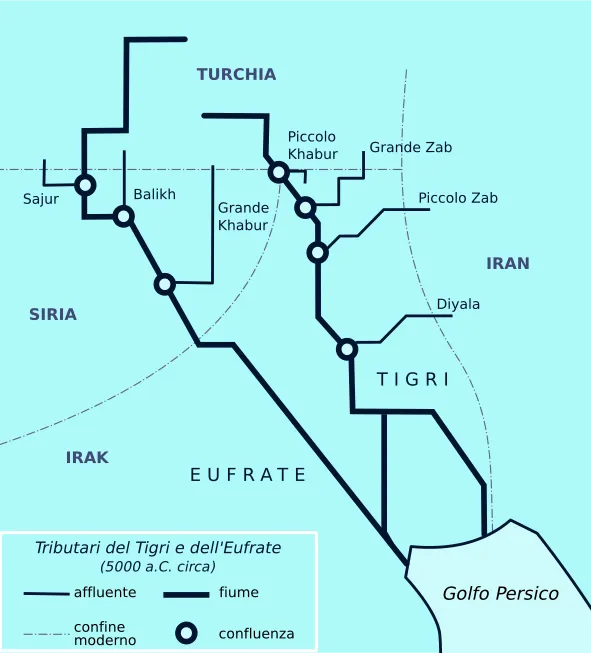
Tributaries of the Tigris and Euphrates by Ruthven / Wikimedia Commons
The Tigris and Euphrates rivers flow through the region called Mesopotamia, which means “land between the rivers” in Greek. This area, now mostly in modern Iraq, is where some of the world’s first civilizations arose around 3500 BCE. The rivers’ regular flooding and fertile soil made it possible for humans to settle, farm, and build complex societies. Mesopotamia’s geography shaped its history in powerful ways.
The ancient people of Mesopotamia depended on the Tigris and Euphrates for water, food, and transportation. The rivers flooded each year, leaving behind rich silt that made farming possible. Using simple tools and later, advanced irrigation systems, people grew crops like barley and wheat. Archaeologists have discovered clay tablets with early writing, called cuneiform, documenting how city-states managed water and agriculture. For example, a 2100 BCE tablet from the city-state of Lagash records rules for sharing irrigation canals. This evidence shows how river management was essential for survival.
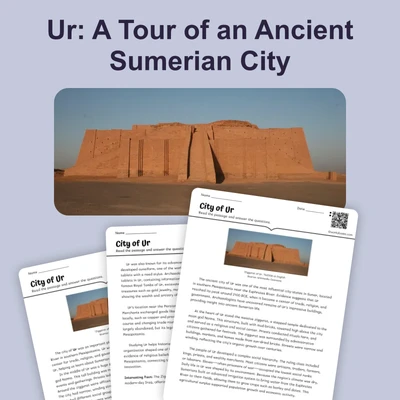
Mesopotamian society was organized into city-states such as Ur, Uruk, and Babylon. Each city-state had its own ruler, laws, and religious practices, but all depended on the rivers. The rivers also enabled trade with distant regions, helping Mesopotamians obtain materials like wood and metals. The invention of the ziggurat, a stepped temple, shows how religion and government were closely linked to the environment. Kings claimed to be chosen by the gods to keep the rivers flowing and protect people from floods or droughts. Social hierarchy developed, with priests and rulers at the top, and farmers and workers lower down.
Over time, changes in climate, wars, and shifting river paths affected Mesopotamian civilization. Droughts sometimes caused hardship, while new rulers like Hammurabi (ruled c. 1792–1750 BCE) united city-states and created famous legal codes. Despite challenges, the rivers remained the lifeline of society for thousands of years. The continuity of using irrigation and river-based trade helped Mesopotamia influence later civilizations in the region.
Mesopotamia’s rivers show how geography can drive both creativity and conflict in human societies. By adapting to their environment, Mesopotamians built one of the world’s earliest urban cultures, leaving a legacy in law, writing, and technology.
Interesting Fact: Did You Know? The oldest known written story, the Epic of Gilgamesh, comes from Mesopotamia and describes a great flood, possibly inspired by the real floods of the Tigris and Euphrates.
What does Mesopotamia mean?
Land between the riversCity of the godsLand of sandHome of mountains
Which two rivers shaped Mesopotamia?
Tigris and NileTigris and EuphratesAmazon and YangtzeEuphrates and Ganges
What did Mesopotamians use for writing?
CuneiformHieroglyphsPapyrusAlphabet
Why were the rivers important for trade?
They helped build zigguratsThey made farming easierThey allowed transport to distant areasThey created mountains
How did city-states manage water?
Using clay tablets and irrigation rulesBuilding only zigguratsTrading with EgyptIgnoring the rivers
What was a ziggurat?
A kind of templeA river boatA city wallA farm tool
Mesopotamian rulers claimed the gods chose them. True or false?
TrueFalse
What does 'hierarchy' mean in the passage?
A writing systemA stepped templeA system of ranking peopleA water canal
Perfect For:
👩🏫 Teachers
• Reading comprehension practice
• Auto-graded assessments
• Literacy skill development
👨👩👧👦 Parents
• Reading practice at home
• Comprehension improvement
• Educational reading time
🏠 Homeschoolers
• Reading curriculum support
• Independent reading practice
• Progress monitoring
Reading Features:
📖
Reading Passage
Engaging fiction or nonfiction text
❓
Comprehension Quiz
Auto-graded questions
📊
Instant Feedback
Immediate results and scoring
📄
Printable Version
Download for offline reading
🔊
Read Aloud
Voice-over with word highlighting
Reviews & Ratings
No reviews yet. Be the first to share your experience!
Related Content
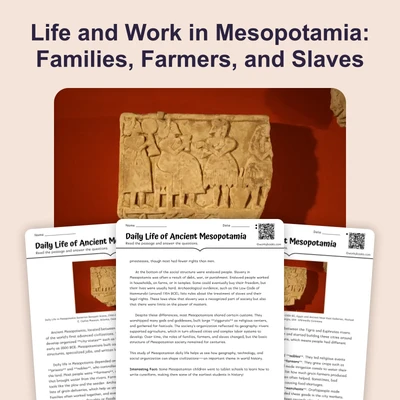
Daily Life in Ancient Mesopotamia
This engaging history reading passage explores daily life in ancient Mesopotamia, focusing on the social structure, role...
Trade Between Mesopotamian Cities
This history reading passage explores the development and significance of trade networks among ancient Mesopotamian citi...
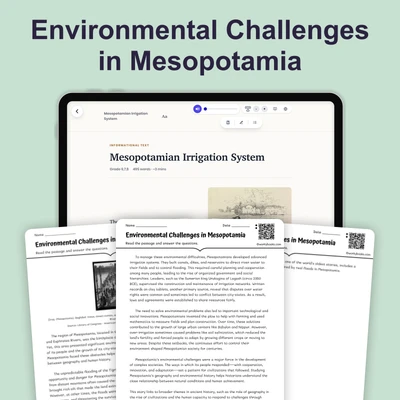
Environmental Challenges in Mesopotamia
This reading passage explores the environmental challenges faced by ancient Mesopotamia, the 'land between the rivers.' ...
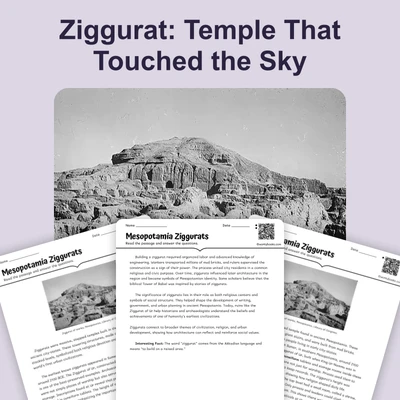
Mesopotamia Ziggurats
This engaging history reading passage explores the awe-inspiring ziggurats of ancient Mesopotamia, focusing on their con...
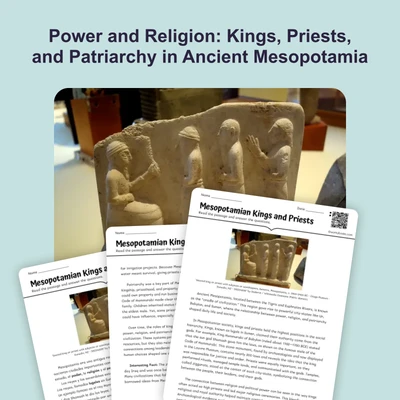
Mesopotamian Kings and Priests
This reading passage explores the complex relationship between power, religion, and patriarchy in Ancient Mesopotamia, f...
Mesopotamia Agriculture
This engaging reading passage explores how the geography of Mesopotamia shaped its civilization through innovative irrig...
Math and Astronomy in Mesopotamia
This engaging passage explores the scientific achievements of ancient Mesopotamia, the region between the Tigris and Eup...
Persian Empire in Mesopotamia
This engaging passage explores the rise of the Persian Empire and its impact on Mesopotamia, aligning with CA HSS 6.2 an...
Mesopotamian Inventions: Wheel, Plow, and More
This passage explores the major inventions of ancient Mesopotamia, focusing on technological breakthroughs such as the w...
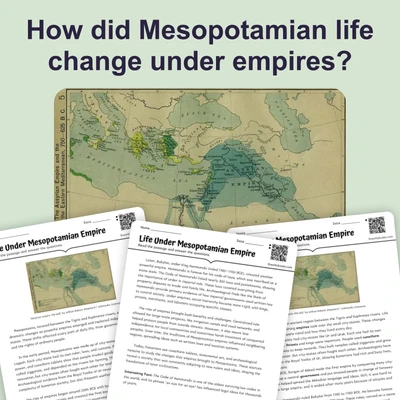
Life Under Mesopotamian Empire
This passage explores the transformation of Mesopotamian life under powerful empires, including Sargon’s Akkadian Empire...
Evidence in Ancient History
This engaging history reading passage investigates how archaeologists and historians discover clues about how ancient pe...
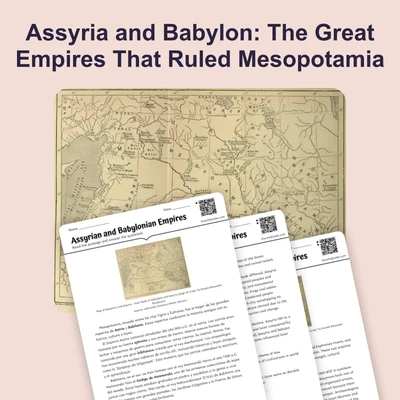
Assyrian and Babylonian Empires
This comprehensive history reading passage explores the rise and fall of Assyria and Babylon, two great empires that rul...
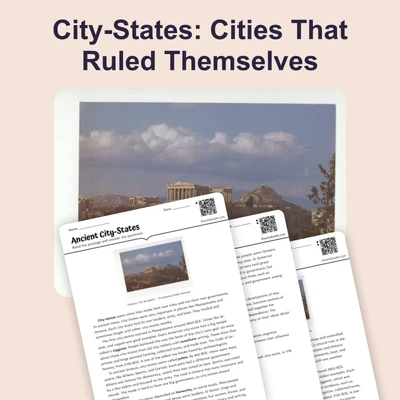
Ancient Greek City-States
This history reading passage explores the development and significance of city-states in ancient civilizations, focusing...
Code of Hammurabi
This rigorous history reading passage explores Hammurabi's Code, one of the earliest and most influential legal codes in...
Ancient Agriculture Farming
This passage explores the transformative impact of farming on ancient societies, examining how the Neolithic Revolution ...
Epic of Gilgamesh
This engaging passage delves into The Epic of Gilgamesh, the oldest known epic poem and a key artifact from ancient Meso...
Ancient Mathematics
This passage explores the essential role of mathematics in ancient civilizations, including Mesopotamia, Egypt, Greece, ...
Women in Ancient Societies
This reading passage explores the complex roles of women in the ancient world, focusing on civilizations such as Mesopot...
Mesopotamia—Informatonal Text
This informational text on Mesopotamia is a great way to practice reading comprehension. Students will read the text the...