Environmental Challenges in Mesopotamia — Reading Comprehension
Rate this
Premium Resource
Present
Present in classroom. No work saved
Assign
Classroom with student accounts, Track progress
Quick Play
No student accounts, assign with a link
Grades
5
6
7
8
PRINT+DIGITAL RESOURCE
This learning resource is available in interactive and printable formats. The interactive worksheet can be played online and assigned to students. The Printable PDF version can be downloaded and printed for completion by hand.
This reading passage explores the environmental challenges faced by ancient Mesopotamia, the 'land between the rivers.' It examines how the unpredictable flooding of the Tigris and Euphrates Rivers shaped the development of early agriculture, city-states, and technological innovation. Students will discover how Mesopotamians adapted to their harsh environment through irrigation, community cooperation, and engineering. The passage connects geographic context to historical change, highlighting the impact of human ingenuity on society. Activities include a multiple-choice quiz, writing prompts, glossary, graphic organizers, and a timeline, supporting analytical and literacy skills. Spanish translation and read aloud audio are provided. This resource aligns with CA HSS 6.2 (Ancient Civilizations), CCSS RH.6-8.1 and RH.6-8.2, and TEKS 6.2, making it ideal for history classrooms exploring the roots of civilization.
CONTENT PREVIEW
Expand content preview
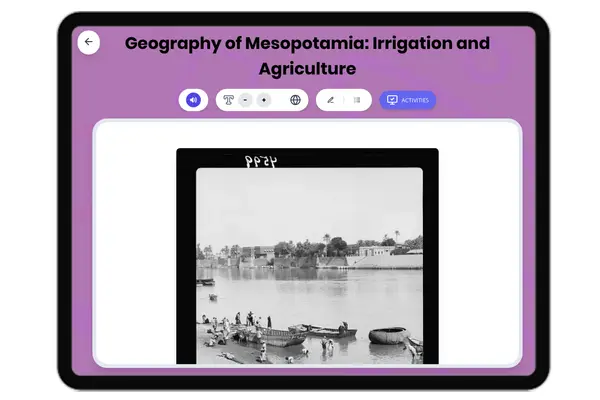
[Iraq. (Mesopotamia). Baghdad. Views, street scenes, and types. Baghdad. The Katah Bridge. Over the Tigris River]. Source: Library of Congress - American Colony (Jerusalem). Photo Department
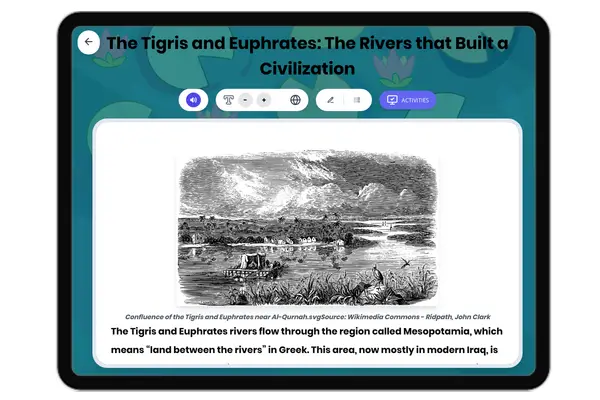
The region of Mesopotamia, located in the Fertile Crescent between the Tigris and Euphrates Rivers, was the birthplace of some of the world’s earliest civilizations. Yet, this area presented significant environmental challenges that shaped the lives of its people and the growth of its city-states. Understanding how the people of Mesopotamia faced these obstacles helps historians see the deep connections between geography and human history.
The unpredictable flooding of the Tigris and Euphrates Rivers created both opportunity and danger for Mesopotamians. Heavy spring rains and melting snow from distant mountains often caused the rivers to overflow. Sometimes, the floods brought rich silt that made the land extremely fertile for growing wheat and barley. However, at other times, the floods were devastating, destroying homes, washing away crops, and threatening the survival of entire communities. Archaeological records from sites like Uruk and Lagash show evidence of ancient flood layers, supporting the stories found in the Epic of Gilgamesh, a primary source that describes a great flood. Without natural barriers like mountains or forests, Mesopotamian settlements were also vulnerable to droughts, sudden storms, and attacks from neighboring groups.
To manage these environmental difficulties, Mesopotamians developed advanced irrigation systems. They built canals, dikes, and reservoirs to direct river water to their fields and to control flooding. This required careful planning and cooperation among many people, leading to the rise of organized government and social hierarchies. Leaders, such as the Sumerian king Urukagina of Lagash (circa 2350 BCE), supervised the construction and maintenance of irrigation networks. Written records on clay tablets, another primary source, reveal that disputes over water rights were common and sometimes led to conflict between city-states. As a result, laws and agreements were established to share resources fairly.
The need to solve environmental problems also led to important technological and social innovations. Mesopotamians invented the plow to help with farming and used mathematics to measure fields and plan construction. Over time, these solutions contributed to the growth of large urban centers like Babylon and Nippur. However, over-irrigation sometimes caused problems like soil salinization, which reduced the land’s fertility and forced people to adapt by growing different crops or moving to new areas. Despite these setbacks, the continuous effort to control their environment shaped Mesopotamian society for centuries.
Mesopotamia’s environmental challenges were a major force in the development of complex societies. The ways in which its people responded—with cooperation, innovation, and adaptation—set a pattern for civilizations that followed. Studying Mesopotamia’s geography and environmental history helps historians understand the close relationship between natural conditions and human achievement.
This story links to broader themes in ancient history, such as the role of geography in the rise of civilizations and the human capacity to respond to challenges through invention and cooperation.
Interesting Fact: The Epic of Gilgamesh, one of the world’s oldest stories, includes a flood narrative that may have been inspired by real floods in Mesopotamia.
Which two rivers shaped Mesopotamia?
Tigris and EuphratesNile and AmazonGanges and YangtzeMississippi and Ohio
What did flooding sometimes bring?
GoldSiltOilSand
Who was Urukagina?
A priest of BabylonA Sumerian kingA river godA farmer
Why did Mesopotamians build irrigation systems?
For decorationTo control waterTo make jewelryFor transportation
What problem did over-irrigation cause?
FloodsEarthquakesSalinizationWildfires
How did environmental challenges affect society?
Weakened citiesLed to cooperationStopped farmingCreated deserts
The Epic of Gilgamesh includes a flood story.
TrueFalse
What does 'hierarchy' mean?
A farming methodA river nameA ranking systemA kind of tool
Perfect For:
👩🏫 Teachers
• Reading comprehension practice
• Auto-graded assessments
• Literacy skill development
👨👩👧👦 Parents
• Reading practice at home
• Comprehension improvement
• Educational reading time
🏠 Homeschoolers
• Reading curriculum support
• Independent reading practice
• Progress monitoring
Reading Features:
📖
Reading Passage
Engaging fiction or nonfiction text
❓
Comprehension Quiz
Auto-graded questions
📊
Instant Feedback
Immediate results and scoring
📄
Printable Version
Download for offline reading
🔊
Read Aloud
Voice-over with word highlighting
Reviews & Ratings
No reviews yet. Be the first to share your experience!
Related Content
Daily Life in Ancient Mesopotamia
This engaging history reading passage explores daily life in ancient Mesopotamia, focusing on the social structure, role...
Trade Between Mesopotamian Cities
This history reading passage explores the development and significance of trade networks among ancient Mesopotamian citi...
Mesopotamia Ziggurats
This engaging history reading passage explores the awe-inspiring ziggurats of ancient Mesopotamia, focusing on their con...
Mesopotamian Kings and Priests
This reading passage explores the complex relationship between power, religion, and patriarchy in Ancient Mesopotamia, f...
Mesopotamia Agriculture
This engaging reading passage explores how the geography of Mesopotamia shaped its civilization through innovative irrig...
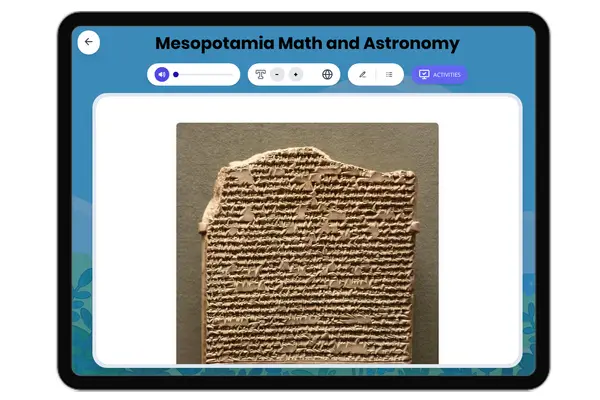
Math and Astronomy in Mesopotamia
This engaging passage explores the scientific achievements of ancient Mesopotamia, the region between the Tigris and Eup...
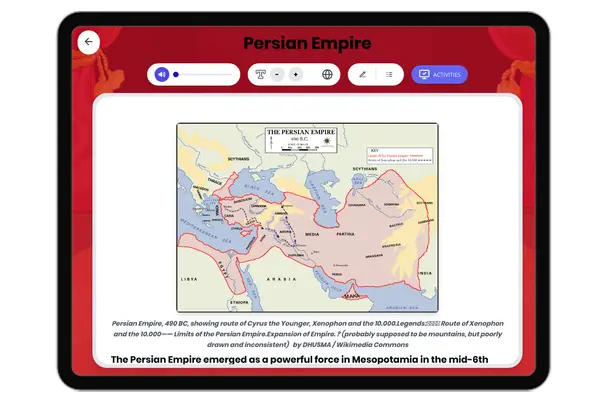
Persian Empire in Mesopotamia
This engaging passage explores the rise of the Persian Empire and its impact on Mesopotamia, aligning with CA HSS 6.2 an...
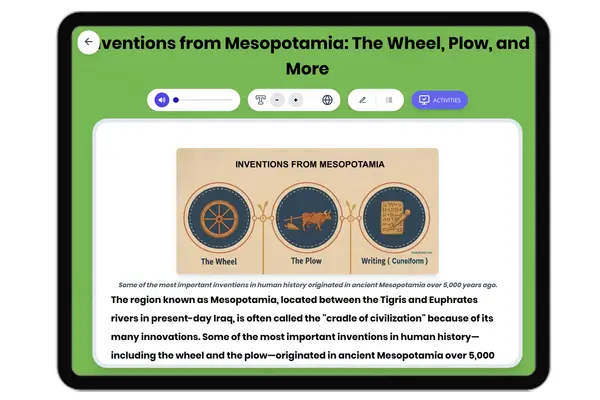
Mesopotamian Inventions: Wheel, Plow, and More
This passage explores the major inventions of ancient Mesopotamia, focusing on technological breakthroughs such as the w...
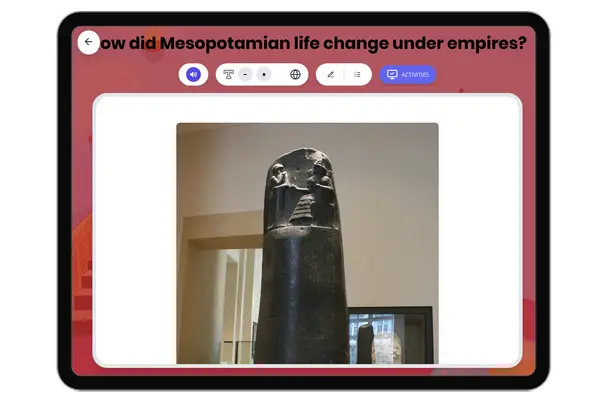
Life Under Mesopotamian Empire
This passage explores the transformation of Mesopotamian life under powerful empires, including Sargon’s Akkadian Empire...
Evidence in Ancient History
This engaging history reading passage investigates how archaeologists and historians discover clues about how ancient pe...
Assyrian and Babylonian Empires
This comprehensive history reading passage explores the rise and fall of Assyria and Babylon, two great empires that rul...
The Tigris and Euphrates Rivers
This engaging history reading passage explores the vital role of the Tigris and Euphrates rivers in the development of a...
Ancient Greek City-States
This history reading passage explores the development and significance of city-states in ancient civilizations, focusing...
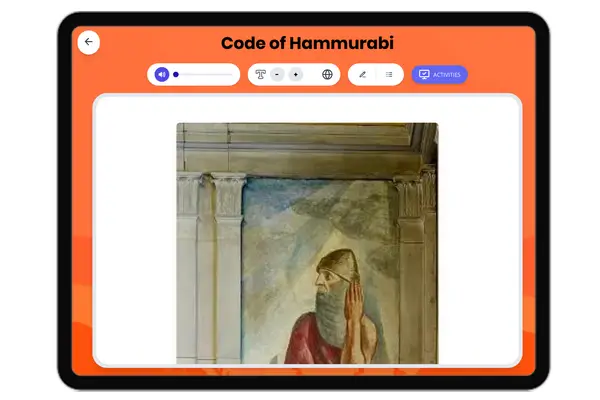
Code of Hammurabi
This rigorous history reading passage explores Hammurabi's Code, one of the earliest and most influential legal codes in...
Ancient Agriculture Farming
This passage explores the transformative impact of farming on ancient societies, examining how the Neolithic Revolution ...
Epic of Gilgamesh
This engaging passage delves into The Epic of Gilgamesh, the oldest known epic poem and a key artifact from ancient Meso...
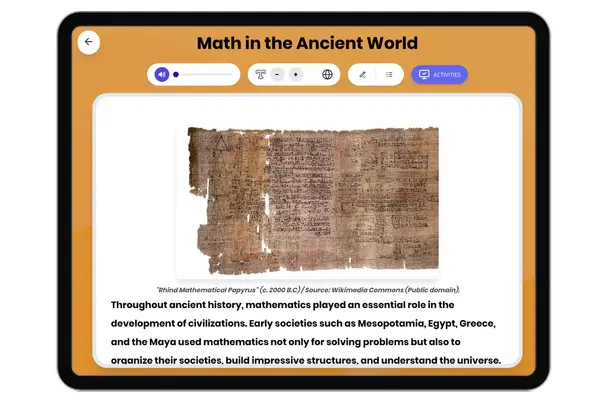
Ancient Mathematics
This passage explores the essential role of mathematics in ancient civilizations, including Mesopotamia, Egypt, Greece, ...
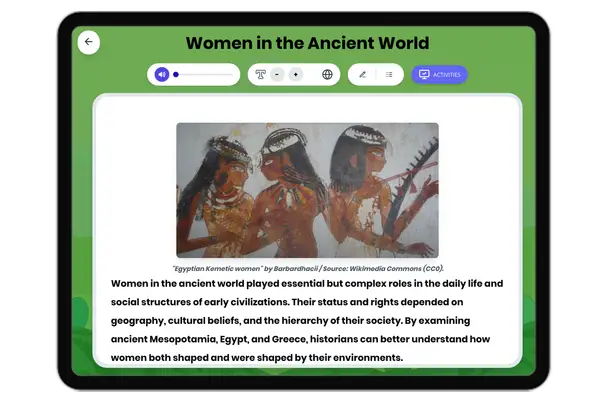
Women in Ancient Societies
This reading passage explores the complex roles of women in the ancient world, focusing on civilizations such as Mesopot...
Mesopotamia—Informatonal Text
This informational text on Mesopotamia is a great way to practice reading comprehension. Students will read the text the...