Evaporation as Physical Change — Reading Comprehension
Rate this
Premium Resource
Present
Present in classroom. No work saved
Assign
Classroom with student accounts, Track progress
Quick Play
No student accounts, assign with a link
Grades
5
6
7
8
Standards
MS-PS1-4
PRINT+DIGITAL RESOURCE
This learning resource is available in interactive and printable formats. The interactive worksheet can be played online and assigned to students. The Printable PDF version can be downloaded and printed for completion by hand.
This middle school science passage examines the process of evaporation, a fundamental physical change where a liquid turns into a gas at the surface. Aligned to NGSS MS-PS1-4, the passage provides a mechanistic explanation of evaporation, including how temperature, surface area, humidity, and air movement influence the rate of evaporation. Students will connect observable phenomena—like puddles drying after rain—to the underlying science, and explore examples ranging from wet hair drying to clothes hanging on a line. The passage integrates academic vocabulary and multiple scientific concepts, while activities such as comprehension questions, writing prompts, and graphic organizers support deep understanding. Audio integration is included for accessibility. This resource is ideal for grades 6-8 science classrooms and helps students relate physical changes to everyday life, environmental issues, and larger scientific principles.
CONTENT PREVIEW
Expand content preview
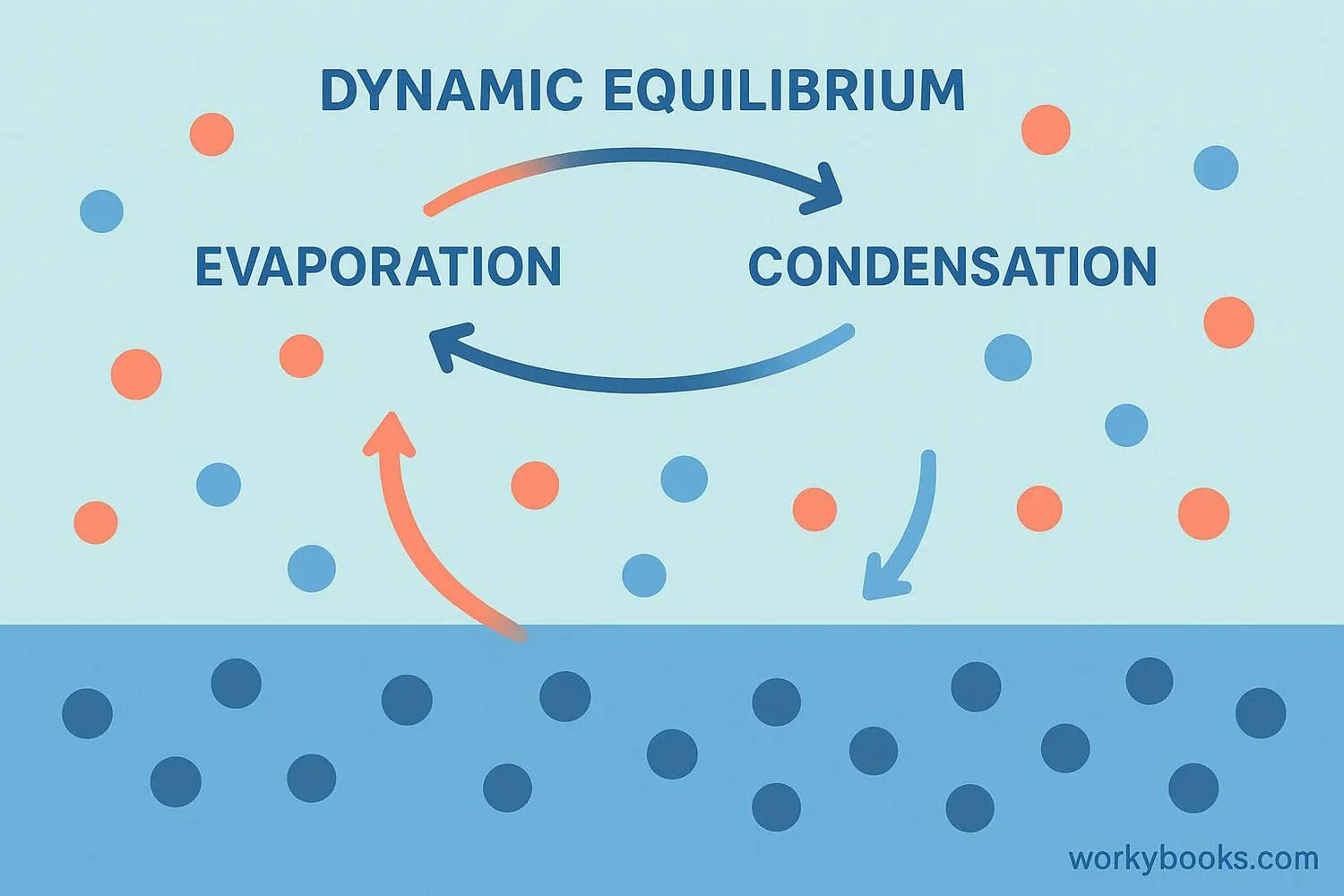
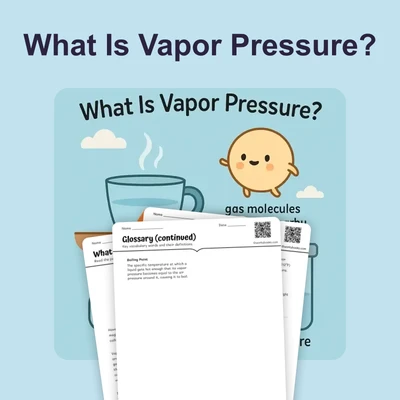
Diagram of evaporation and condensation creating vapor pressure
Evaporation is the process that changes a liquid into a gas at the surface of the liquid. This transformation can happen at any temperature, not just when the liquid is boiling. Evaporation is a key part of the water cycle and affects many everyday situations, such as drying wet clothes or the disappearance of puddles after rain. Scientists study this process to understand how matter changes state and how energy interacts with substances.
How Evaporation Works
During evaporation, molecules at the surface of a liquid gain enough energy to break free from the liquid and enter the air as a vapor. This energy usually comes from heat. However, only molecules at the surface with enough energy escape, so evaporation is called surface-level vaporization. The process occurs at all temperatures, but it happens faster when the liquid is warmer, because more molecules have enough energy to leave. For example, after a summer rain, a puddle can dry up in a few hours thanks to high temperatures and sunlight providing energy for evaporation.
Factors That Affect Evaporation
Several factors interact to influence the rate of evaporation. Temperature is the most significant: the higher the temperature, the faster evaporation occurs. Surface area matters, too—a shallow pan of water will evaporate more quickly than the same amount of water in a tall glass because more molecules are exposed at the surface. Humidity in the air slows evaporation, since the air is already holding water vapor. Air movement, like wind, increases evaporation by moving moist air away from the surface, allowing more molecules to escape. For example, laundry dries faster on a breezy day than on a still, humid one. Research shows that on a hot, dry, and windy day, a small puddle can lose up to 80% of its water in just a few hours.
Evaporation in Everyday Life and the Environment
Evaporation has important effects beyond just drying things. In the water cycle, evaporation from lakes, rivers, and oceans moves water into the atmosphere, where it later forms clouds and precipitation. This process helps regulate Earth's climate and weather. Evaporation also cools surfaces, such as when sweat evaporates from skin, lowering body temperature. In technology, cooling towers in power plants rely on evaporation to remove excess heat. However, rapid evaporation in hot regions can lead to water shortages, affecting agriculture and communities.
Understanding evaporation helps us manage water resources and solve real-world problems. It connects to the larger scientific principle of the conservation of mass, since the water does not disappear—it changes form and moves through systems.
Interesting Fact: Evaporation can occur even from ice at temperatures below freezing, a process called sublimation!
What is evaporation?
The process where a liquid changes into a gas at the surface.When a liquid boils and turns into a gas everywhere.The process where a solid turns into a liquid.Condensation of gas into a liquid.
Where does evaporation take place in a liquid?
At the surface of the liquid.At the bottom of the liquid.Throughout the whole liquid at once.Only inside a container.
According to the passage, which factor does NOT speed up evaporation?
High humidityHigh temperatureLarge surface areaWindy conditions
What happens to the molecules during evaporation?
They gain enough energy to escape into the air as vapor.They lose energy and freeze.They gather at the bottom of the container.They mix with solids to form new substances.
What is one real-world example of evaporation mentioned in the passage?
Puddles drying after rain.Ice melting in a freezer.Clouds forming in the sky.Metal rusting in air.
What does the term 'surface-level vaporization' mean in context?
Only molecules at the surface of the liquid turn into gas.The entire liquid boils at once.The process of turning solids directly into gas.Vapor forming under the surface of a solid.
Which best describes the relationship between temperature and evaporation?
Higher temperature increases evaporation rate.Lower temperature speeds up evaporation.Temperature does not affect evaporation.Evaporation only happens at freezing temperatures.
Why does air movement increase evaporation?
It removes moist air from the surface, allowing more molecules to escape.It cools down the liquid, making molecules move slower.It adds more water to the liquid.It blocks sunlight from reaching the liquid.
Evaporation can only happen when water is boiling. True or False?
TrueFalse
Evaporation is important in the water cycle. True or False?
TrueFalse
Perfect For:
👩🏫 Teachers
• Reading comprehension practice
• Auto-graded assessments
• Literacy skill development
👨👩👧👦 Parents
• Reading practice at home
• Comprehension improvement
• Educational reading time
🏠 Homeschoolers
• Reading curriculum support
• Independent reading practice
• Progress monitoring
Reading Features:
📖
Reading Passage
Engaging fiction or nonfiction text
❓
Comprehension Quiz
Auto-graded questions
📊
Instant Feedback
Immediate results and scoring
📄
Printable Version
Download for offline reading
🔊
Read Aloud
Voice-over with word highlighting
Reviews & Ratings
No reviews yet. Be the first to share your experience!
Related Content
The Melting Point of Aluminum
This science reading passage, 'The Melting Point of Aluminum,' introduces middle school students to the physical propert...
5-PS1MS-PS1-4RI.6.3RI.7.1
The Melting Point of Copper
This reading passage, 'The Melting Point of Copper,' introduces middle school students to an important physical property...
5-PS1MS-PS1-4RI.6.3RI.7.1
The Melting Point of Substances
This middle school science reading passage, titled 'The Melting Point of Substances', explores the physical property kno...
5-PS1MS-PS1-4RI.6.3RI.7.1
The Boiling Point of Water
This passage, 'The Boiling Point of Water,' introduces students to the physical property of boiling point through one of...
5-PS1MS-PS1-4RI.6.3RI.7.1
The Melting Point of Steel
This engaging science passage, 'The Melting Point of Steel,' explains a key physical property of steel—its melting point...
5-PS1MS-PS1-4RI.6.3RI.7.1
Is Sublimation Endothermic or Exothermic?
This NGSS-aligned science passage for middle school explains the thermodynamic nature of sublimation, showing how a soli...
MS-PS1-4HS-PS1
How Many Valence Electrons Does Oxygen Have?
This NGSS-aligned science reading passage teaches middle school students about the number of valence electrons in oxygen...
MS-PS1-2MS-PS1-4
How Many Valence Electrons Does Chlorine Have?
This NGSS-aligned science reading passage explains how many valence electrons chlorine has and why that makes it such a ...
MS-PS1-2MS-PS1-4
What Is Vapor Pressure?
This NGSS-aligned science passage explains the concept of vapor pressure in an age-appropriate, engaging way for middle ...
MS-PS1-4MS-LS1-2
What is Freezing Point Depression
This passage, 'Freezing Point Depression,' introduces students to the physical science concept of how adding substances ...
5-PS1MS-PS1-4RI.6.3RI.7.1
Solids, Liquids, and Gases
This comprehensive middle school science passage explains the scientific concepts behind the three common states of matt...
MS-PS1-4
Behavior of Gases
This comprehensive reading passage explores the behavior of gases for middle school students, aligned with NGSS standard...
MS-PS1-4
Physical Changes: Condensation
This middle school science passage explores the process of condensation, the physical change where a gas becomes a liqui...
MS-PS1-4
Sublimation as Physical Change
This educational passage for grades 6-8 explores the science of sublimation—a physical change where a solid transforms d...
MS-PS1-4
Physical Changes: Deposition
This middle school science passage explores the concept of deposition, a type of physical change where matter transition...
MS-PS1-4
Scientific Investigations
This passage, aligned with NGSS standards for grades 6-8, introduces students to the process of scientific investigation...
MS-ETS1-1MS-ETS1-2MS-ETS1-3MS-ETS1-4
Scientific Theories
This reading passage for grades 6-8 introduces students to the concept of scientific theories, emphasizing that these ar...
MS-PS1-1MS-PS1-4MS-PS3-4SCIENCE AND ENGINEERING PRACTICES
Particle Model of Matter
This comprehensive science reading passage for grades 6-8 explores the particle model of matter, aligning with NGSS stan...
MS-PS1-1MS-PS1-4
Kinetic Theory of Matter
This middle school science reading passage introduces students to the kinetic theory of matter, aligning with NGSS MS-PS...