Sublimation as Physical Change — Reading Comprehension
Rate this
Premium Resource
Present
Present in classroom. No work saved
Assign
Classroom with student accounts, Track progress
Quick Play
No student accounts, assign with a link
Grades
5
6
7
8
Standards
MS-PS1-4
PRINT+DIGITAL RESOURCE
This learning resource is available in interactive and printable formats. The interactive worksheet can be played online and assigned to students. The Printable PDF version can be downloaded and printed for completion by hand.
This educational passage for grades 6-8 explores the science of sublimation—a physical change where a solid transforms directly into a gas without becoming liquid first. Students will learn the mechanisms and conditions that favor sublimation, supported by real-world examples such as dry ice fog, freeze-dried foods, disappearing snow on cold dry days, and shrinking mothballs. The passage aligns with NGSS standard MS-PS1-4, encouraging scientific thinking by explaining observable phenomena and underlying cause-and-effect relationships. Activities include a glossary, multiple-choice and writing questions, and graphic organizers to deepen understanding. Audio integration and Spanish translations are provided for accessibility, making this a comprehensive resource for diverse learners.
CONTENT PREVIEW
Expand content preview
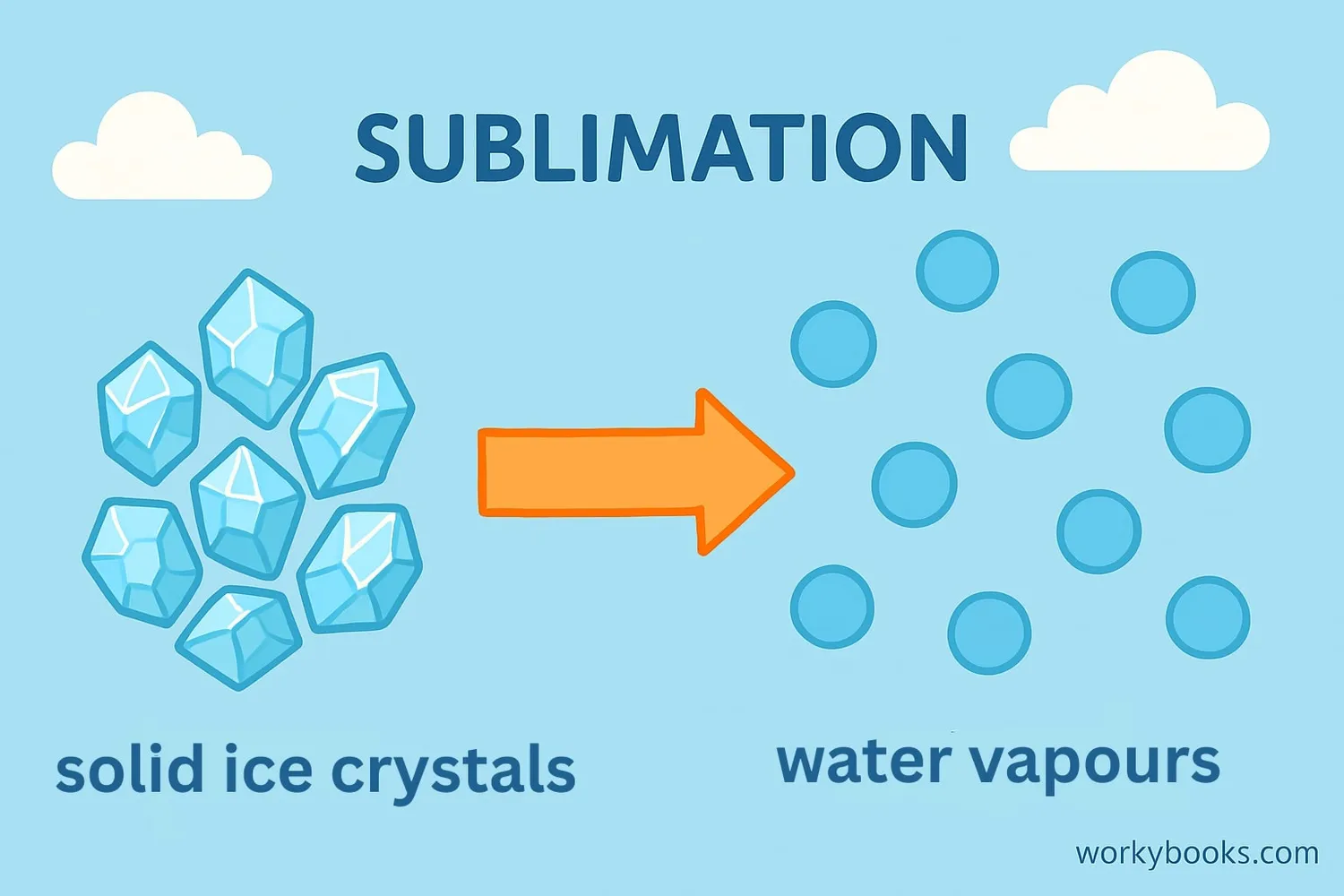
Illustration showing the basic concept of sublimation
Sublimation is a remarkable physical change in which a substance moves directly from the solid state to the gas state, skipping the liquid phase entirely. This process is important in both natural and technological settings, affecting how materials behave and how we use them. Scientists study sublimation to better understand the properties of matter and the effects of temperature and pressure on physical changes. By observing phenomena like fog from dry ice, researchers have revealed the underlying mechanisms that drive these changes.
How Sublimation Works Sublimation occurs when the molecules in a solid gain enough energy to overcome their fixed positions and change directly into a gas. This usually happens under conditions of low pressure and low humidity, or when the solid is heated rapidly. The key factor is that the substance’s vapor pressure (the pressure of its molecules escaping into the air) becomes higher than the surrounding atmospheric pressure at a specific temperature. For example, dry ice (solid carbon dioxide) sublimates at -78.5°C, forming thick fog as it turns straight into CO2 gas. Another example is freeze-drying, where food is frozen and exposed to low pressure so water sublimates out, preserving texture and nutrients. Snow can also disappear on cold, dry days due to sublimation, even when temperatures are below freezing.
Applications and Interactions Sublimation has many practical uses and interacts with other scientific processes. In nature, it is part of the water cycle in cold, windy regions, causing snow and ice to shrink without melting. In technology, freeze-drying is used to make lightweight foods for astronauts and hikers. Mothballs made of naphthalene or paradichlorobenzene shrink over time as they sublimate, releasing a gas that repels insects. These examples illustrate how energy, temperature, and pressure interact to control the state of matter. Quantitative data shows that the rate of sublimation increases as temperature rises or humidity drops, and can be measured in grams per hour or as percent mass lost over time.
Complexities and Broader Principles While sublimation is common for substances like dry ice and naphthalene, not all solids can sublimate easily. The process depends on the unique properties of each material. Scientists use knowledge of phase changes—including melting, freezing, and evaporation—to predict and control sublimation in different environments. Understanding sublimation helps us manage resources, design preservation techniques, and explain everyday mysteries like disappearing snow. It connects to the broader scientific principle that matter changes state due to energy transfers and interactions at the particle level.
In summary, sublimation is a direct solid-to-gas transition that reveals the complex relationships between pressure, temperature, and molecular energy. Its study highlights the dynamic nature of matter and the importance of physical changes in science and technology.
Interesting Fact: The word "sublimation" comes from the Latin "sublimare," meaning "to raise to a higher place." This reflects how molecules move upward from solid to gas during the process.
What is sublimation?
A solid turning directly into a gas, skipping the liquid phase.A liquid turning directly into a solid.A gas condensing into a liquid.A solid melting into a liquid.
Which of the following is an example of sublimation?
Dry ice forming fog.Water boiling.Ice melting in the sun.Condensation on a cold window.
What does 'vapor pressure' mean in the context of sublimation?
The pressure of molecules escaping from a solid or liquid into the air.The amount of water vapor in the air.The pressure inside a balloon.The temperature at which a solid melts.
In freeze-drying, what happens to the water in food?
It sublimates and leaves the food as gas.It melts and makes the food wet.It condenses and adds moisture.It stays frozen forever.
Which conditions make sublimation most likely to occur?
Low pressure and low humidity.High pressure and high humidity.Warm temperatures and wet air.Cold temperatures and high pressure.
Why do mothballs shrink over time?
They sublimate, releasing gas that repels insects.They dissolve in air.They melt into liquid.Insects eat them up.
Which is NOT a result of sublimation?
Water boiling on a stove.Dry ice fog at a concert.Snow disappearing on a dry, cold day.Mothballs getting smaller in a closet.
How does energy play a role in sublimation?
It allows molecules in a solid to break free and become a gas.It keeps molecules in place.It cools the solid down.It turns gas into a liquid.
True or False: Sublimation is a chemical change.
TrueFalse
True or False: In nature, sublimation is part of the water cycle in cold, windy regions.
TrueFalse
Perfect For:
👩🏫 Teachers
• Reading comprehension practice
• Auto-graded assessments
• Literacy skill development
👨👩👧👦 Parents
• Reading practice at home
• Comprehension improvement
• Educational reading time
🏠 Homeschoolers
• Reading curriculum support
• Independent reading practice
• Progress monitoring
Reading Features:
📖
Reading Passage
Engaging fiction or nonfiction text
❓
Comprehension Quiz
Auto-graded questions
📊
Instant Feedback
Immediate results and scoring
📄
Printable Version
Download for offline reading
🔊
Read Aloud
Voice-over with word highlighting
Reviews & Ratings
No reviews yet. Be the first to share your experience!
Related Content
The Melting Point of Aluminum
This science reading passage, 'The Melting Point of Aluminum,' introduces middle school students to the physical propert...
5-PS1MS-PS1-4RI.6.3RI.7.1
The Melting Point of Copper
This reading passage, 'The Melting Point of Copper,' introduces middle school students to an important physical property...
5-PS1MS-PS1-4RI.6.3RI.7.1
The Melting Point of Substances
This middle school science reading passage, titled 'The Melting Point of Substances', explores the physical property kno...
5-PS1MS-PS1-4RI.6.3RI.7.1
The Boiling Point of Water
This passage, 'The Boiling Point of Water,' introduces students to the physical property of boiling point through one of...
5-PS1MS-PS1-4RI.6.3RI.7.1
The Melting Point of Steel
This engaging science passage, 'The Melting Point of Steel,' explains a key physical property of steel—its melting point...
5-PS1MS-PS1-4RI.6.3RI.7.1
Is Sublimation Endothermic or Exothermic?
This NGSS-aligned science passage for middle school explains the thermodynamic nature of sublimation, showing how a soli...
MS-PS1-4HS-PS1
How Many Valence Electrons Does Oxygen Have?
This NGSS-aligned science reading passage teaches middle school students about the number of valence electrons in oxygen...
MS-PS1-2MS-PS1-4
How Many Valence Electrons Does Chlorine Have?
This NGSS-aligned science reading passage explains how many valence electrons chlorine has and why that makes it such a ...
MS-PS1-2MS-PS1-4
What Is Vapor Pressure?
This NGSS-aligned science passage explains the concept of vapor pressure in an age-appropriate, engaging way for middle ...
MS-PS1-4MS-LS1-2
What is Freezing Point Depression
This passage, 'Freezing Point Depression,' introduces students to the physical science concept of how adding substances ...
5-PS1MS-PS1-4RI.6.3RI.7.1
Solids, Liquids, and Gases
This comprehensive middle school science passage explains the scientific concepts behind the three common states of matt...
MS-PS1-4
Behavior of Gases
This comprehensive reading passage explores the behavior of gases for middle school students, aligned with NGSS standard...
MS-PS1-4
Evaporation as Physical Change
This middle school science passage examines the process of evaporation, a fundamental physical change where a liquid tur...
MS-PS1-4
Physical Changes: Condensation
This middle school science passage explores the process of condensation, the physical change where a gas becomes a liqui...
MS-PS1-4
Physical Changes: Deposition
This middle school science passage explores the concept of deposition, a type of physical change where matter transition...
MS-PS1-4
Scientific Investigations
This passage, aligned with NGSS standards for grades 6-8, introduces students to the process of scientific investigation...
MS-ETS1-1MS-ETS1-2MS-ETS1-3MS-ETS1-4
Scientific Theories
This reading passage for grades 6-8 introduces students to the concept of scientific theories, emphasizing that these ar...
MS-PS1-1MS-PS1-4MS-PS3-4SCIENCE AND ENGINEERING PRACTICES
Particle Model of Matter
This comprehensive science reading passage for grades 6-8 explores the particle model of matter, aligning with NGSS stan...
MS-PS1-1MS-PS1-4
Kinetic Theory of Matter
This middle school science reading passage introduces students to the kinetic theory of matter, aligning with NGSS MS-PS...