What is Freezing Point Depression — Reading Comprehension
Rate this
Present
Present in classroom. No work saved
Assign
Classroom with student accounts, Track progress
Quick Play
No student accounts, assign with a link
Grades
5
6
7
8
Standards
5-PS1
MS-PS1-4
RI.6.3
RI.7.1
PRINT+DIGITAL RESOURCE
This learning resource is available in interactive and printable formats. The interactive worksheet can be played online and assigned to students. The Printable PDF version can be downloaded and printed for completion by hand.
This passage, 'Freezing Point Depression,' introduces students to the physical science concept of how adding substances like salt lowers the freezing point of water. With clear examples such as icy roads, homemade ice cream, and car antifreeze, students learn how mixtures affect the freezing behavior of liquids. The concept is tied to NGSS standard MS-PS1-4, which focuses on changes in particle motion, temperature, and state. The passage highlights freezing point depression as a physical change, showing that it doesn’t alter the identity of the substance involved. Aimed at grades 5–8, the passage uses accessible language and real-world applications to engage students. It supports Common Core standards like RI.6.1 and RI.6.4 and includes 8 multiple choice questions and a science fun fact. Ideal for integrating literacy with hands-on science.
CONTENT PREVIEW
Expand content preview
Freezing Point Depression
Water usually freezes at 32°F (0°C). This is called the freezing point. At this temperature, the water molecules slow down and line up to form solid ice crystals. But what happens if you add something like salt or sugar to water? The answer is freezing point depression!
Freezing point depression means that the water needs to get even colder to freeze when another substance is mixed in. Pure water molecules fit together easily to form ice, but when you dissolve salt or sugar in water, their tiny particles get in the way. Now, the water molecules can't organize as neatly. It is like having party crashers! The salt particles crash the water's freezing party and make it harder for ice crystals to form. So, the temperature has to drop lower before the water turns into ice.
This is why cities use salt on icy roads in winter. The salt mixes with melted snow or ice, creating a solution. This solution has a lower freezing point than pure water. Regular road salt can lower the freezing point to about 15°F (-9°C), and special salts can go even lower. This helps keep roads safer for cars and people.
Freezing point depression also happens in nature. The ocean is full of salt, so ocean water freezes at about 28°F (-2°C), not 32°F like fresh water. This is why the sea rarely freezes, even when it’s very cold.
This science trick is also used when making ice cream. Rock salt is mixed with ice around the ice cream maker. The salt makes the ice melt and gets the temperature so cold that the creamy mixture inside freezes quickly into delicious ice cream!
People also use chemicals, like antifreeze, in cars. Antifreeze lowers the freezing point of the water in the engine, so it doesn’t freeze during winter.
Interesting Fact: Every winter, cities in the United States use over 20 million tons of salt to help keep roads safe from ice!
What is freezing point depression?
Water freezes at a lower temperatureWater boils at a lower temperatureSalt turns into iceIce melts at a higher temperature
What does salt do to ice on roads?
Makes it meltMakes it harderTurns it blueMakes it warmer
What is a solution?
Salt mixed with waterPlain iceJust sugarFrozen snow
Why does ocean water freeze at 28°F?
It has saltIt is deeperIt is cleanerIt is warmer
How does salt help make ice cream?
Makes ice colderMakes cream sweeterTurns salt into creamMelts the cream
What happens when you add salt to water?
It lowers freezing pointIt makes water boilIt makes water disappearIt turns water green
Antifreeze helps car engines not freeze. True or false?
TrueFalse
What does 'dissolve' mean?
Mixes fully into waterTurns coldBecomes a solidMakes ice warmer
Perfect For:
👩🏫 Teachers
• Reading comprehension practice
• Auto-graded assessments
• Literacy skill development
👨👩👧👦 Parents
• Reading practice at home
• Comprehension improvement
• Educational reading time
🏠 Homeschoolers
• Reading curriculum support
• Independent reading practice
• Progress monitoring
Reading Features:
📖
Reading Passage
Engaging fiction or nonfiction text
❓
Comprehension Quiz
Auto-graded questions
📊
Instant Feedback
Immediate results and scoring
📄
Printable Version
Download for offline reading
🔊
Read Aloud
Voice-over with word highlighting
Reviews & Ratings
No reviews yet. Be the first to share your experience!
Related Content
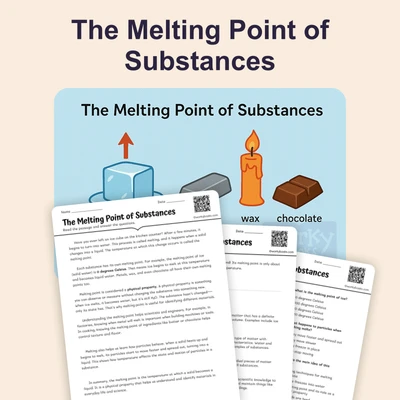
The Melting Point of Substances
This middle school science reading passage, titled 'The Melting Point of Substances', explores the physical property kno...
5-PS1MS-PS1-4RI.6.3RI.7.1
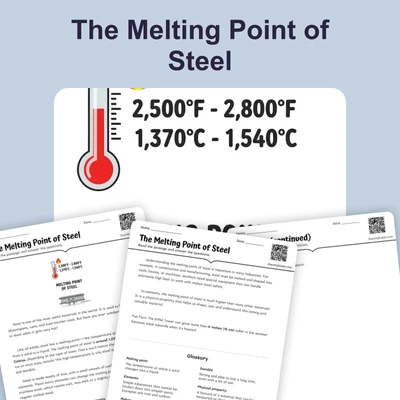
The Melting Point of Steel
This engaging science passage, 'The Melting Point of Steel,' explains a key physical property of steel—its melting point...
5-PS1MS-PS1-4RI.6.3RI.7.1
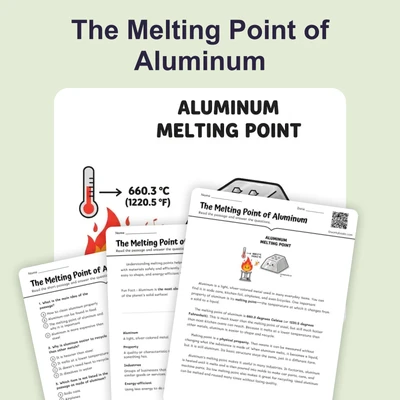
The Melting Point of Aluminum
This science reading passage, 'The Melting Point of Aluminum,' introduces middle school students to the physical propert...
5-PS1MS-PS1-4RI.6.3RI.7.1
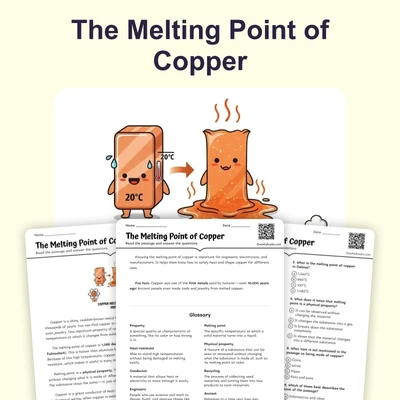
The Melting Point of Copper
This reading passage, 'The Melting Point of Copper,' introduces middle school students to an important physical property...
5-PS1MS-PS1-4RI.6.3RI.7.1
The Boiling Point of Water
This passage, 'The Boiling Point of Water,' introduces students to the physical property of boiling point through one of...
5-PS1MS-PS1-4RI.6.3RI.7.1
Is Sublimation Endothermic or Exothermic?
This NGSS-aligned science passage for middle school explains the thermodynamic nature of sublimation, showing how a soli...
MS-PS1-4HS-PS1
How Many Valence Electrons Does Oxygen Have?
This NGSS-aligned science reading passage teaches middle school students about the number of valence electrons in oxygen...
MS-PS1-2MS-PS1-4
How Many Valence Electrons Does Chlorine Have?
This NGSS-aligned science reading passage explains how many valence electrons chlorine has and why that makes it such a ...
MS-PS1-2MS-PS1-4
What Is Vapor Pressure?
This NGSS-aligned science passage explains the concept of vapor pressure in an age-appropriate, engaging way for middle ...
MS-PS1-4MS-LS1-2
Solids, Liquids, and Gases
This comprehensive middle school science passage explains the scientific concepts behind the three common states of matt...
MS-PS1-4
Behavior of Gases
This comprehensive reading passage explores the behavior of gases for middle school students, aligned with NGSS standard...
MS-PS1-4
Evaporation as Physical Change
This middle school science passage examines the process of evaporation, a fundamental physical change where a liquid tur...
MS-PS1-4
Physical Changes: Condensation
This middle school science passage explores the process of condensation, the physical change where a gas becomes a liqui...
MS-PS1-4
Sublimation as Physical Change
This educational passage for grades 6-8 explores the science of sublimation—a physical change where a solid transforms d...
MS-PS1-4
Physical Changes: Deposition
This middle school science passage explores the concept of deposition, a type of physical change where matter transition...
MS-PS1-4
Scientific Investigations
This passage, aligned with NGSS standards for grades 6-8, introduces students to the process of scientific investigation...
MS-ETS1-1MS-ETS1-2MS-ETS1-3MS-ETS1-4
Scientific Theories
This reading passage for grades 6-8 introduces students to the concept of scientific theories, emphasizing that these ar...
MS-PS1-1MS-PS1-4MS-PS3-4SCIENCE AND ENGINEERING PRACTICES
Particle Model of Matter
This comprehensive science reading passage for grades 6-8 explores the particle model of matter, aligning with NGSS stan...
MS-PS1-1MS-PS1-4
Kinetic Theory of Matter
This middle school science reading passage introduces students to the kinetic theory of matter, aligning with NGSS MS-PS...