Hibernation vs. Torpor vs. Sleep — Reading Comprehension
Rate this
Premium Resource
Present
Present in classroom. No work saved
Assign
Classroom with student accounts, Track progress
Quick Play
No student accounts, assign with a link
Grades
6
PRINT+DIGITAL RESOURCE
This learning resource is available in interactive and printable formats. The interactive worksheet can be played online and assigned to students. The Printable PDF version can be downloaded and printed for completion by hand.
This engaging reading passage, 'Hibernation vs. Torpor vs. Sleep,' for Grade 6 students delves into the fascinating ways animals survive harsh winter conditions. It explores the distinct biological processes of hibernation, torpor, and regular sleep, highlighting how these adaptations are influenced by both environmental and genetic factors. Students will learn key terms and concepts related to animal survival strategies. The content aligns with NGSS MS-LS1-5, which focuses on constructing scientific explanations for how environmental and genetic factors influence the growth of organisms. This resource includes an audio-integrated reading passage, multiple-choice questions, a glossary, and short answer questions to reinforce learning about animal adaptations and winter survival.
CONTENT PREVIEW
Expand content preview
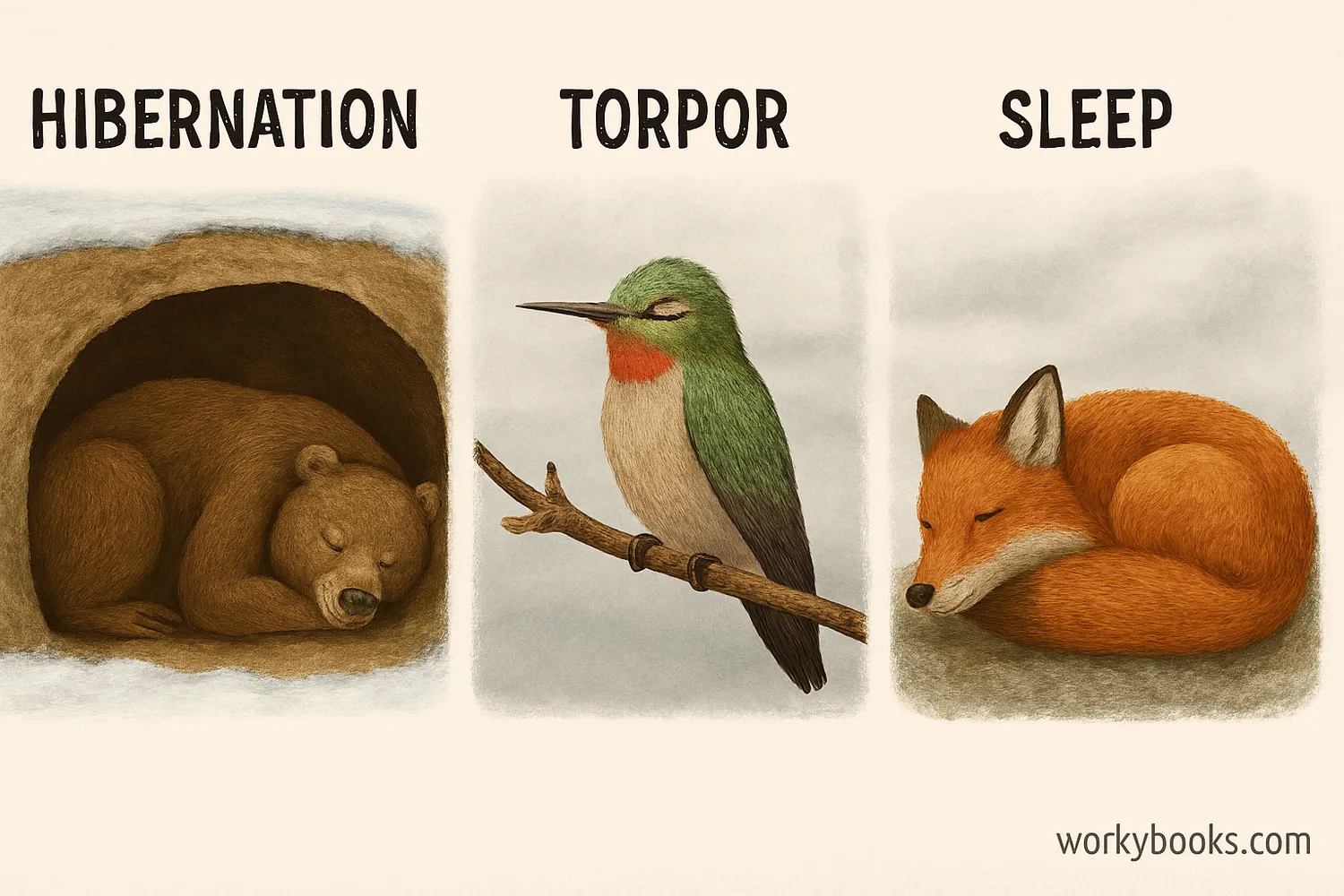
Animals use hibernation, torpor, and sleep to survive cold and food scarcity.
Imagine the world outside turning cold, food becoming scarce, and the sun barely peeking through the clouds. How do many animals survive these challenging conditions? They have incredible strategies to cope, including hibernation, torpor, and even a special kind of sleep. While these might seem similar, they are actually very different biological processes.
Let's start with hibernation. This is a long-term state of inactivity and metabolic depression in endotherms (warm-blooded animals). Think of bears, groundhogs, and some rodents. During hibernation, an animal's body temperature drops significantly, sometimes close to the outside air temperature. Their heart rate slows dramatically, their breathing becomes very shallow, and their metabolism (the chemical processes that keep them alive) slows down to save energy. They rely on stored body fat for energy. Hibernation can last for weeks or even months, allowing animals to conserve energy when food is unavailable and temperatures are extreme. This deep, extended sleep-like state is a critical adaptation for winter survival.
Then there's torpor. Torpor is like a mini-hibernation. It's a shorter-term state of reduced physiological activity, also characterized by a lower body temperature and metabolism. Animals might enter torpor daily or for a few days. Hummingbirds, for instance, enter torpor every night to save energy because their tiny bodies burn so much fuel during the day. Bats and some small mammals also use torpor. Unlike hibernation, animals can easily wake up from torpor much faster if conditions improve or they sense danger. This flexibility makes torpor an excellent strategy for coping with short periods of cold or lack of food.
Finally, we have regular sleep. This is something all animals, including humans, do. Sleep is a period of rest for the body and mind, but it's not the same as hibernation or torpor. During sleep, an animal's body temperature, heart rate, and metabolism remain relatively stable, much closer to their active state. While some animals sleep more deeply than others, they can typically be awakened quite easily. Sleep helps animals restore energy, repair cells, and process information, but it doesn't involve the drastic physiological changes seen in hibernation or torpor to survive long periods of environmental stress. The ability to enter these different states of reduced activity is a fascinating example of how environmental factors like cold and food scarcity, and genetic factors (their inherited traits), influence an organism's survival and growth.
Interesting Fact: While bears are famous for their winter sleep, scientists debate whether they truly hibernate or if their winter dormancy is a unique form of torpor, as their body temperature doesn't drop as low as other hibernators.
Which animal is mentioned as using daily torpor?
BearGroundhogHummingbirdSquirrel
What is the primary purpose of hibernation for animals?
Building muscleFinding matesConserving energyGrowing fur
True or False: An animal in hibernation can be easily awakened.
TrueFalse
What is 'metabolism' as defined in the passage?
Body temperatureSleeping deeplyChemical life processesHeart rate
How does torpor differ from hibernation in terms of duration?
Torpor is longerTorpor is shorterThey are the sameTorpor is continuous
Why do animals like hummingbirds use torpor nightly?
To hide from predatorsTo digest food fasterTo save energyTo improve sight
Which state involves the most significant drop in body temperature?
SleepTorporHibernationActive state
If an animal needs to save energy for a few hours on a cold day, which state would it likely enter?
HibernationTorporDeep sleepActive hunting
How do environmental and genetic factors relate to these animal survival strategies?
Only environment mattersOnly genetics mattersBoth influence adaptationsThey are unrelated
A scientist observes an animal whose body temperature drops drastically and heart rate slows for several months. What state is this animal most likely in?
Normal sleepDaily torporHibernationActive foraging
Perfect For:
👩🏫 Teachers
• Reading comprehension practice
• Auto-graded assessments
• Literacy skill development
👨👩👧👦 Parents
• Reading practice at home
• Comprehension improvement
• Educational reading time
🏠 Homeschoolers
• Reading curriculum support
• Independent reading practice
• Progress monitoring
Reading Features:
📖
Reading Passage
Engaging fiction or nonfiction text
❓
Comprehension Quiz
Auto-graded questions
📊
Instant Feedback
Immediate results and scoring
📄
Printable Version
Download for offline reading
🔊
Read Aloud
Voice-over with word highlighting
Reviews & Ratings
No reviews yet. Be the first to share your experience!
Related Content
The Nature of Life Science
This passage, aligned with NGSS MS-LS1-1, introduces students in grades 6-8 to the foundational concepts of life science...
MS-LS1-1
Science Vocabulary
This worksheet on domain-specific words will help students learn some science vocabulary. Students will be asked to matc...
L.3.6L.3.4.A
The Science of Hibernation
This educational module, featuring an audio-integrated reading passage titled 'The Science of Hibernation,' is designed ...
Simple Machines Science Report
This science writing task requires students to clearly explain how three simple machines work using precise domain-speci...
W.5.4
Adaptation
This engaging middle school science passage explores adaptation, focusing on how inherited traits enable organisms to su...
MS-LS4-4MS-LS4-6
Desert Rain Frog Behavioral Adaptations
Dive into the fascinating world of the Desert Rain Frog and discover its incredible unique adaptations for survival in a...
Ocean Animal Adaptations
Students will read a passage that provides information about various adaptations that marine animals have developed to t...
W.4.9.B
Animal Adaptations Word Sort
This engaging word sort activity helps students understand the difference between physical and behavioral adaptations in...
Herbivore Adaptations
This engaging reading passage, integrated with audio, delves into the fascinating world of herbivore adaptations. Studen...
Early Life Forms and Their Adaptations
This educational passage focuses on early life forms and their basic adaptations, supporting NGSS standard 3-LS4-2 for e...
RI.3.3RI.4.3RI.5.33-LS4-2
Nocturnal Adaptations of the Strange Aye-Aye
This engaging reading passage, integrated with audio, takes grade 5 students on a journey to discover the fascinating no...
Binturong Adaptations
This engaging, audio-integrated reading passage, 'Binturong Adaptations,' for Grade 6 students delves into the fascinati...
Barnacle Biology and Adaptations
Dive into the intriguing world of barnacles with this engaging Grade 6 reading passage. Students will learn about these ...
Mountain Animal Adaptations
This reading comprehension worksheet focuses on the topic of animal adaptations for survival in mountainous environments...
W.4.9.B
Whale Blubber: Function and Adaptation
This engaging, audio-integrated reading passage, 'Whale Blubber Function and Adaptation,' introduces young learners to t...
Amur Leopard Adaptations
This engaging, audio-integrated reading passage, 'Amur Leopard Adaptations,' is designed for Grade 6 science students. I...
Climate Zone Adaptations Word Sort
This word sort activity examines how plants and animals adapt to different climate conditions. Students sort 12 differen...
The Pumpkin Life Cycle
This informational worksheet explores the pumpkin lifecycle, guiding students through procedural steps in a scientific t...
RI.2.3RI.2.10
Plant Adaptations for Survival
This NGSS-aligned word sort activity, suitable for kindergarten, focuses on plant survival adaptations, helping students...
K-LS1-1
What Is Earth Science?
This engaging middle school science passage introduces students to the field of Earth science, aligning with NGSS standa...