How Conifers Survive Cold Winters — Reading Comprehension
Rate this
Premium Resource
Present
Present in classroom. No work saved
Assign
Classroom with student accounts, Track progress
Quick Play
No student accounts, assign with a link
Grades
6
PRINT+DIGITAL RESOURCE
This learning resource is available in interactive and printable formats. The interactive worksheet can be played online and assigned to students. The Printable PDF version can be downloaded and printed for completion by hand.
This educational content features an audio-integrated reading passage titled 'How Conifers Survive Cold Winters.' It delves into the unique structural and functional adaptations of conifers, such as their needle-like leaves, waxy coatings, and evergreen nature, that enable them to thrive in harsh, cold environments. Aligned with NGSS Disciplinary Core Idea LS1.A: Structure and Function, this resource is designed for Grade 6 students. It includes a comprehensive reading passage, multiple-choice questions, a glossary of key terms, and short-answer questions to enhance comprehension and application of scientific concepts. Students will learn about **photosynthesis**, **dormancy**, and the **evergreen** life cycle, discovering how these elements contribute to **conifer survival** during **cold winters**. This resource provides an engaging way to explore **plant adaptations** and **cold resistance** in trees.
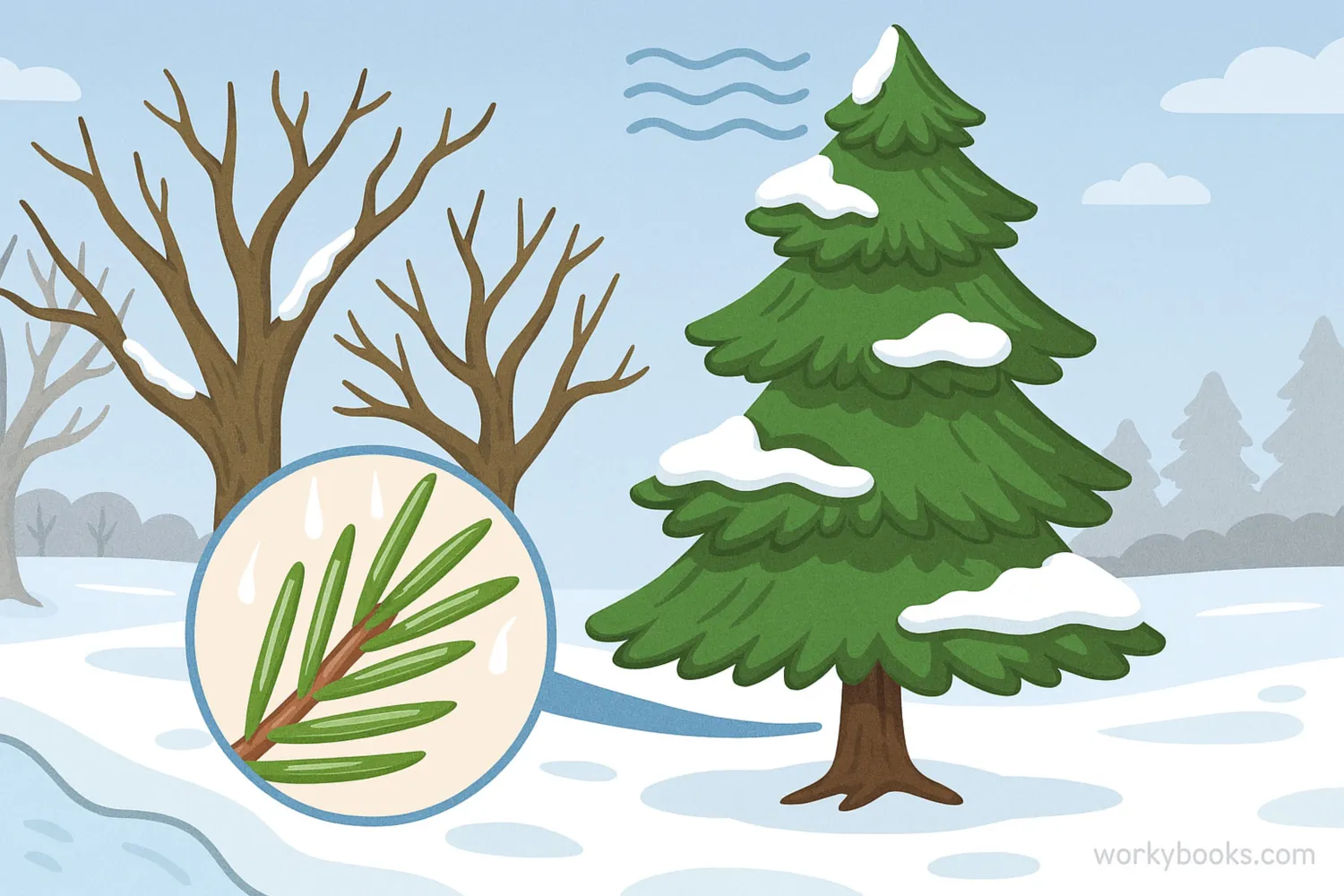
Imagine a world where everything turns grey and brown in winter. The trees lose their leaves, and the ground is covered in snow. But some trees stand tall and green, even when temperatures drop. These are conifers, like pine, spruce, and fir trees, and they have amazing ways to survive the cold. Their survival methods are excellent examples of plant adaptations – special features that help living things live in their environment.
One of the most noticeable features of conifers is their leaves. Unlike broad-leafed trees that lose their leaves in autumn, conifers have needles. These needles are small and thin, which means they have less surface area than wide leaves. This reduced surface area helps them lose less water through a process called transpiration. Losing too much water in winter can be dangerous because the ground is often frozen, making it hard for roots to take up more water. The needles also have a thick, waxy coating that acts like a waterproof jacket, further protecting them from water loss and the drying effects of cold winds.
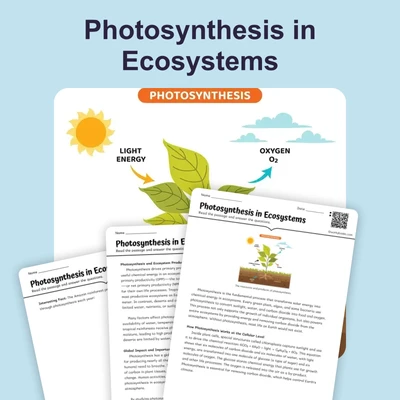
Another key to conifer survival is that they are evergreen. This means they keep their needles all year round. While other trees are bare, conifers can still perform photosynthesis, the process of turning sunlight into food. Even though photosynthesis slows down in winter due to less sunlight and colder temperatures, being evergreen gives them a head start when spring arrives. They don't have to grow new leaves before they can start making food again, unlike deciduous trees.
Conifers also prepare for winter by going into a state of dormancy. This is like a deep sleep for plants. Their growth slows down, and their internal processes become less active. This conserves energy, allowing them to endure long periods of cold and limited resources. Their branches are often flexible and droop downwards, which helps heavy snow slide off, preventing branches from breaking under the weight.
So, the next time you see a pine tree standing green in the snow, remember its incredible adaptations: its thin, waxy needles, its evergreen nature, and its ability to enter dormancy. These features allow conifers to thrive in environments where many other plants cannot.
Interesting Fact: Some conifer species can live for thousands of years, making them among the oldest living organisms on Earth.
What do conifers have instead of broad leaves?
NeedlesFlowersBranchesSeeds
What is the waxy coating on needles for?
Attracting insectsWater loss protectionStoring foodMaking them green
Which of these is NOT a conifer?
Pine treeSpruce treeOak treeFir tree
Why do conifers lose less water through their needles?
They have more surface areaThey have less surface areaThey absorb waterThey don't need water
What does being 'evergreen' allow conifers to do in winter?
Attract birdsGrow new branchesPerform photosynthesisChange color
How do flexible, drooping branches help conifers?
Hold more snowBreak easilyShed heavy snowAttract more sunlight
Why is it dangerous for plants to lose too much water in winter?
They get too heavyGround is often frozenThey need to sleepWater turns to ice
Conifers go into dormancy to conserve energy. True or False?
TrueFalse
What is the main purpose of photosynthesis?
Absorb waterTurn sunlight into foodRelease oxygenGrow roots
A plant adaptation helps a living thing
Change its colorLive in its environmentAttract pollinatorsGrow taller
Perfect For:
👩🏫 Teachers
• Reading comprehension practice
• Auto-graded assessments
• Literacy skill development
👨👩👧👦 Parents
• Reading practice at home
• Comprehension improvement
• Educational reading time
🏠 Homeschoolers
• Reading curriculum support
• Independent reading practice
• Progress monitoring
Reading Features:
📖
Reading Passage
Engaging fiction or nonfiction text
❓
Comprehension Quiz
Auto-graded questions
📊
Instant Feedback
Immediate results and scoring
📄
Printable Version
Download for offline reading
🔊
Read Aloud
Voice-over with word highlighting
Reviews & Ratings
No reviews yet. Be the first to share your experience!
Related Content
The Nature of Life Science
This passage, aligned with NGSS MS-LS1-1, introduces students in grades 6-8 to the foundational concepts of life science...
MS-LS1-1
Science Vocabulary
This worksheet on domain-specific words will help students learn some science vocabulary. Students will be asked to matc...
L.3.6L.3.4.A
The Science of Hibernation
This educational module, featuring an audio-integrated reading passage titled 'The Science of Hibernation,' is designed ...
Simple Machines Science Report
This science writing task requires students to clearly explain how three simple machines work using precise domain-speci...
W.5.4
Adaptation
This engaging middle school science passage explores adaptation, focusing on how inherited traits enable organisms to su...
MS-LS4-4MS-LS4-6
Desert Rain Frog Behavioral Adaptations
Dive into the fascinating world of the Desert Rain Frog and discover its incredible unique adaptations for survival in a...
Animal Adaptations Word Sort
This engaging word sort activity helps students understand the difference between physical and behavioral adaptations in...
Herbivore Adaptations
This engaging reading passage, integrated with audio, delves into the fascinating world of herbivore adaptations. Studen...
Ocean Animal Adaptations
Students will read a passage that provides information about various adaptations that marine animals have developed to t...
W.4.9.B
Nocturnal Adaptations of the Strange Aye-Aye
This engaging reading passage, integrated with audio, takes grade 5 students on a journey to discover the fascinating no...
Early Life Forms and Their Adaptations
This educational passage focuses on early life forms and their basic adaptations, supporting NGSS standard 3-LS4-2 for e...
RI.3.3RI.4.3RI.5.33-LS4-2
Binturong Adaptations
This engaging, audio-integrated reading passage, 'Binturong Adaptations,' for Grade 6 students delves into the fascinati...
Barnacle Biology and Adaptations
Dive into the intriguing world of barnacles with this engaging Grade 6 reading passage. Students will learn about these ...
Whale Blubber: Function and Adaptation
This engaging, audio-integrated reading passage, 'Whale Blubber Function and Adaptation,' introduces young learners to t...
Mountain Animal Adaptations
This reading comprehension worksheet focuses on the topic of animal adaptations for survival in mountainous environments...
W.4.9.B
Amur Leopard Adaptations
This engaging, audio-integrated reading passage, 'Amur Leopard Adaptations,' is designed for Grade 6 science students. I...
Climate Zone Adaptations Word Sort
This word sort activity examines how plants and animals adapt to different climate conditions. Students sort 12 differen...
Plant Adaptations for Survival
This NGSS-aligned word sort activity, suitable for kindergarten, focuses on plant survival adaptations, helping students...
K-LS1-1
The Pumpkin Life Cycle
This informational worksheet explores the pumpkin lifecycle, guiding students through procedural steps in a scientific t...
RI.2.3RI.2.10
What Is Earth Science?
This engaging middle school science passage introduces students to the field of Earth science, aligning with NGSS standa...